Slippery Elm Dosage and Timing: How to Take It Alongside Other Supplements

Slippery elm labels give ranges rather than rules, so the practical questions become how much, when, and what to keep it away from. The short version: follow the supplement label for amount, separate it from prescription medication by about two hours, and judge product quality by third party testing marks rather than by marketing copy.
Why slippery elm dosing is a range, not a rule
Slippery elm is sold as a dietary supplement, a category defined by DSHEA, the 1994 law that sets the ground rules for American supplement retail. Under that framework manufacturers make a structure function claim about traditional use rather than a drug claim, and no official recommended dose exists. What you get instead is a sensible range on the label, built from traditional practice and each brand's own formulation strength. Native American healers and later eclectic physicians used the inner bark for generations in porridges, poultices and teas, and modern labels are the standardized descendants of that long, informal history rather than the output of dose-finding trials.
Reading a slippery elm supplement label
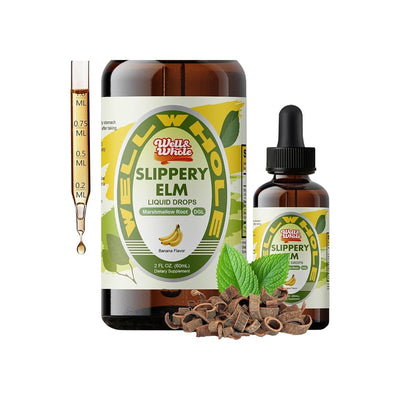
Start with the form, because dosing units follow it: capsules list milligrams of powdered inner bark, liquid drops list milliliters or drop counts, and teas measure by steeping. Check whether the label names the plant part, since the inner bark is the traditional material, then confirm the serving size and the count of servings per container so you can price per serving rather than per bottle. Two details finish the read: whether the stated amount is per serving or per day, a distinction that quietly doubles some products' real cost, and whether storage instructions ask for a cool, dry shelf, which most gel-rich products do. Labels that hide behind proprietary blend wording rather than listing amounts deserve suspicion in any supplement aisle. One last habit worth borrowing from pharmacy practice: photograph the label of anything you buy, so that a future clinician or pharmacist can see exactly what and how much you were taking without relying on memory.
Timing: spacing it from food and medication
The mucilage that makes slippery elm slippery is a gel-forming fiber, and gel-forming fibers can slow the absorption of whatever is taken alongside them. That is the whole logic of the two-hour rule: keep prescription medication, and ideally other supplements, in their own time slot so bioavailability is not quietly reduced. Many people slot it between meals or in the evening; a consistent slot matters more than a perfect one, and a full glass of water belongs next to every dose of any fiber-style product.
How to choose a quality product
If you are weighing how to choose a supplement in this family, run the same checklist you would anywhere: third party testing marks from an independent laboratory, manufacturing under GMP standards, USP verified notation where present, and a printed expiration date. Those signals of supplement quality matter more than dose bravado, because a product you trust at a modest serving beats a mystery concentrate at double the amount.
Three mistakes worth avoiding
First, doubling up because one serving felt fine; more gel-forming fiber is not more useful and just crowds the schedule. Second, taking it in the same glass as medication or stacking it against a prescription without spacing, which wastes both. Third, switching forms mid-week without recalculating, since a capsule milligram count and a drop count are not interchangeable. The quiet fourth: judging by price alone and skipping the quality marks; the cheapest bottle in the aisle is rarely the one you want on the shelf for daily use.
Key takeaways
- Follow the label range for amount; no official recommended dose exists for slippery elm.
- Keep it about two hours away from prescription medication so absorption is not reduced.
- Capsules count in milligrams, drops in milliliters, teas in steeps; match the unit to the form.
- Check whether the label amount is per serving or per day before comparing products.
- Judge quality by third party testing, GMP manufacturing and an expiration date, not by claims.

Frequently asked questions
How much slippery elm can I take per day?
Stay within the range printed on your product's supplement label, since concentrations differ between capsules, drops and teas. Start at the low end for the first week, and treat any move above the labeled range as a question for a clinician rather than a personal experiment.
Should I take slippery elm before or after meals?
Either works; what matters is consistency and spacing. Many people prefer a slot between meals so the gel does not interfere with the absorption of nutrients or medication from food, and an evening slot suits those who like its traditional place in a wind-down routine.
Can I take slippery elm with my other supplements?
Because it is a gel-forming fiber, take it in its own time slot, roughly two hours apart from other supplements and any prescription medication. If you take thyroid medication, diabetes medication or anything with a narrow dosing window, confirm the spacing with a pharmacist first.
How do I know a slippery elm brand is trustworthy?
Look for independent third party testing marks, GMP manufacturing notation, a clear plant-part statement and an expiration date, in that order. A brand that publishes batch results and lists amounts openly has already answered most of the questions a cautious buyer should ask.
Related supplements
If you want to explore this area, the Vitamins and Minerals collections cover the relevant supplements and formats.
These statements have not been evaluated by the Food and Drug Administration. This product is not intended to diagnose, treat, cure, or prevent any disease. Talk to a healthcare professional before starting any new supplement, especially if you are pregnant, nursing, taking medication, or managing a health condition.
These statements have not been evaluated by the Food and Drug Administration. This product is not intended to diagnose, treat, cure, or prevent any disease.