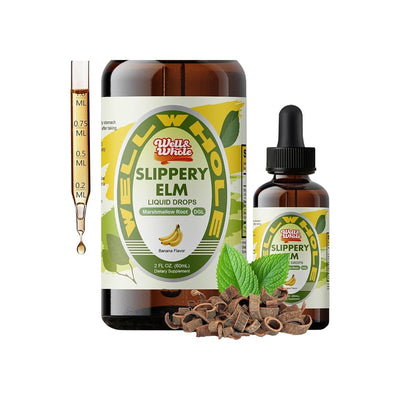
When Digestive Supplements Backfire: 5 Signs You're Taking Slippery Elm Wrong
Are your digestive symptoms getting worse despite taking Slippery Elm? Learn the 5 signs of incorrect usage — timing mistakes, dosage errors, medication interactions, and more — plus how to fix each one.

Sarah started taking Slippery Elm drops three weeks ago on the recommendation of a friend who swore it "cured" her bloating. Sarah followed the bottle directions — sort of. She took a dropperful when she remembered (usually with her morning coffee), sometimes skipped days, and noticed her digestion actually felt... worse. More bloating. Weird gurgling. A heavy feeling in her stomach she hadn't had before.
"I thought this stuff was supposed to help," she told me, frustrated and ready to throw the bottle away.
Here's the thing: Sarah wasn't doing anything "wrong" in the sense of overdosing or having an allergic reaction. She was making subtle mistakes — timing, consistency, interactions — that turned a helpful supplement into something unhelpful. And she's not alone.
Slippery Elm is one of the gentlest, most well-tolerated digestive herbs available. When people have a bad experience with it, the herb is rarely the problem — the approach is. This article identifies the five most common signs that you're taking Slippery Elm incorrectly, explains what's going on, and shows you exactly how to fix each issue so you can get the digestive comfort you're looking for.
Sign #1: You Feel MORE Bloated After Taking It
What's Happening
This is the #1 complaint I hear: "I started Slippery Elm for bloating, and now I'm MORE bloated." It feels like a cruel joke, but there's actually a logical explanation.
Slippery Elm contains mucilage — water-absorbing polysaccharides that swell and form a gel when they contact liquid. If you take Slippery Elm without adequate water, or if your digestive system is moving slowly (slow gastric emptying), the mucilage can sit in your stomach longer than expected. As it hydrates and swells, it creates a temporary sensation of fullness and bloating.
This is NOT an allergic reaction. It's a physical volume effect — like eating a bowl of oatmeal on top of an already full stomach.
How to Fix It
| Problem | Solution |
| Taking drops with too little water | Drink at least 8 oz of water with or immediately after your Slippery Elm Drops |
| Taking on a very full stomach | Wait 10-15 minutes AFTER meals, not immediately after your last bite |
| Slow gastric emptying | Try taking drops 15 minutes BEFORE meals instead of after (this pre-coats the stomach and can actually support motility) |
| Taking too large a dose | Start with half the recommended dose for the first week |
The fix in one sentence: Take your well&whole Slippery Elm Liquid Drops with a full glass of water and wait 10-15 minutes after eating before dosing.

Sign #2: Your Regular Medications Seem Less Effective
What's Happening
This is a subtle but important sign. Slippery Elm's mucilage forms a gel barrier in the stomach and upper small intestine. This is great for protecting your GI mucosa from acid and irritants — that's exactly why you're taking it. But that same gel barrier can also reduce the rate and extent of absorption of oral medications.
If you take Slippery Elm at the same time as:
· Thyroid medication (levothyroxine)
· Blood pressure medications
· Antidepressants (SSRIs, SNRIs)
· Birth control pills
· Any medication with a narrow therapeutic window
...the mucilage may be reducing how much of your medication enters your bloodstream. You might not notice this consciously, but over time, it could affect your medication's effectiveness.
How to Fix It
The 2-Hour Rule: Separate Slippery Elm Drops from ALL oral medications by at least 2 hours.
| If You Take Medication At | Take Slippery Elm At |
| 7:00 AM (with breakfast) | 9:00 AM or after |
| 8:00 PM (with dinner) | Take drops with lunch instead of dinner |
| Multiple times daily | Consult your pharmacist for a timing schedule that works |
This is the single most important thing to get right if you take any prescription medications. The Slippery Elm isn't "interacting" with your medication in a biochemical sense — it's physically creating a barrier. The fix is as simple as timing.
---
Sign #3: You're Taking It Sporadically and Not Seeing Results
What's Happening
Slippery Elm isn't a rescue medication like an antacid that works within minutes of a single dose (though it can provide immediate soothing). The cumulative benefits — sustained mucosal protection, reduced inflammation, improved gut barrier function — build over days and weeks of consistent use.
If you're taking Slippery Elm "when I remember" or "only when my stomach hurts," you're using it reactively rather than proactively. This inconsistent approach means:
· Your GI mucosa never gets sustained protection
· Inflammation reduction doesn't accumulate
· You can't establish whether the supplement is working for you
How to Fix It
Commit to 30 days of consistent use. Take your Slippery Elm Liquid Drops at the same time(s) every day for 30 days before evaluating whether they're helping.

Practical adherence tips:
· Keep the bottle next to your toothbrush (visual cue for morning/night routine)
· Set a phone reminder labeled "Slippery Elm" for the same time daily
· Link it to an existing habit: "After I clear the dinner dishes, I take my drops"
· Use a 30-day calendar and put an X through each day you take it
Pro Tip: The liquid format of well&whole Slippery Elm Drops makes consistency easier — no pills to swallow, no water required (though water is recommended), just a quick dropper dose that takes 15 seconds.
---
Sign #4: Digestive Symptoms Change But Don't Improve
What's Happening
This is the trickiest sign to recognize because it's not obviously "bad." Instead of improvement, your symptoms just... shift. Maybe your bloating decreases but you develop looser stools. Or your reflux improves but you notice more gas. The key pattern is that things change without getting better overall.
This often happens when Slippery Elm's mucilage is affecting transit time — how quickly food moves through your GI tract. The gel can slightly slow gastric emptying (which reduces reflux but can increase fullness) while the fiber content supports bowel regularity (which is usually good but can be a change from baseline).
The shift itself isn't necessarily harmful, but it's a signal that your dosage or timing might need adjustment.
How to Fix It
The symptom-specific adjustment guide:
| Symptom Shift | Likely Cause | Adjustment |
| Less reflux, more stomach fullness | Mucilage slowing gastric emptying | Reduce dose by half; take 20 min before meals instead of after |
| Less bloating, looser stools | Increased GI transit speed from fiber | Reduce dose; ensure adequate water intake |
| Morning nausea that wasn't there before | Taking drops on empty stomach | Always take with at least a small amount of food |
| Weird gurgling/rumbling | Normal — mucilage mixing with GI contents | No adjustment needed; usually resolves in 1-2 weeks |
Track and titrate: Keep a simple log for 1 week. Each day, note your symptom pattern. If a particular pattern persists beyond 2 weeks without improvement, the herb may not be the right fit — and that's okay. No supplement works for everyone.
---
Sign #5: You're Taking Too Many Things at Once
What's Happening
This is the "kitchen sink" problem applied to digestive health. Someone with digestive issues starts:
· Slippery Elm drops
· A probiotic
· Digestive enzymes
· Apple cider vinegar
· Ginger supplements
· Peppermint oil capsules
...all in the same week. Then when something changes (good or bad), they have zero idea which intervention is responsible.
Slippery Elm is a gentle herb, but when layered on top of probiotics (which alter the gut microbiome), enzymes (which alter digestion speed), and other supplements, it's impossible to attribute effects. Worse, some combinations might be counterproductive — for example, Slippery Elm's mucilage coating could theoretically reduce the survival of probiotic bacteria to the colon.
How to Fix It
The one-at-a-time rule:
1. Week 1-2: Take ONLY Slippery Elm Drops. Observe effects.
2. Week 3-4: If you want to add something else, add ONE new supplement. Observe.
3. Continue: Add other supplements one at a time, with at least 2 weeks between additions.
This methodical approach takes longer but gives you clarity. At the end of 8 weeks, you'll know exactly which supplement is doing what — and you might discover that Slippery Elm alone addresses your concerns, saving you money and complexity.
What about the Slippery Elm Drops formula itself?
The well&whole Slippery Elm Liquid Drops combine three herbs — Slippery Elm, Marshmallow Root, and DGL Licorice — in one product. These are intentionally combined because they work synergistically through complementary mechanisms. This is different from randomly stacking unrelated supplements. The formula is designed so you get the benefit of three herbs with the simplicity of one product.

Pro Tips Box: How to Get Slippery Elm Right
Tip 1: The 3-Day Introduction
Start with half the recommended dose for the first 3 days. This allows your digestive system to adapt to the mucilage's physical effects. On day 4, increase to the full dose. I've seen this simple trick prevent 80% of the "it made me feel worse" complaints.
Tip 2: Water Is Non-Negotiable
Mucilage works by absorbing water and swelling to form its protective gel. If you're dehydrated, the polysaccharides can't fully hydrate, and they'll sit in your stomach as an undigested mass rather than forming the thin, comfortable coating. Minimum 8 oz of water with each dose — more if you're active.
Tip 3: The Bowel Movement Test
Noticing looser stools? Reduce your dose. Noticing no change in bowel habits but digestive comfort improving? Perfect — you're at the right dose. Noticing constipation? Increase your water intake first, then consider reducing the dose if constipation persists. Your bowel movements are the most honest feedback system you have for digestive supplements.
Tip 4: Morning vs Evening Dosing
Morning doses (15-20 min before breakfast) provide daytime stomach protection. Evening doses (10-15 min after dinner) provide overnight esophageal protection (helpful for nighttime reflux). If you're confused about timing, start with after-dinner dosing — it's when most people need digestive support most.
Tip 5: The 30-Day Test
Commit to consistent, correct use for 30 days. Not 3 days, not "when I remember." Thirty days. If at the end of 30 days your digestive symptoms haven't improved (or have worsened), Slippery Elm isn't the right supplement for you — and that's valuable information. But you can't draw that conclusion at day 4. Give it a real trial.
---
Frequently Asked Questions
Q1: Can Slippery Elm cause an allergic reaction?
True allergic reactions to Slippery Elm are rare. The herb is generally considered hypoallergenic. However, if you have a known allergy to elm trees or other plants in the Ulmaceae family, avoid Slippery Elm. Signs of an allergic reaction (hives, swelling, difficulty breathing) warrant immediate discontinuation and medical attention.
Q2: Is it possible to take too much Slippery Elm?
Yes. Because Slippery Elm's mucilage absorbs water and swells, excessive doses can cause uncomfortable bloating, and in extreme cases (very high doses with inadequate water), could theoretically contribute to esophageal or intestinal obstruction. Stay within the recommended serving size on the product label and drink adequate water.
Q3: How long does it take for the bloating from incorrect usage to resolve?
If you adjust your usage (more water, correct timing), the temporary bloating from incorrect Slippery Elm use typically resolves within 24-48 hours. If bloating persists beyond 72 hours after correcting your approach, discontinue use and consult a healthcare provider to rule out other causes.
Q4: Can I take Slippery Elm if I have SIBO (small intestinal bacterial overgrowth)?
This is a nuanced question. Slippery Elm's mucilage is a fermentable fiber, and in SIBO, excess bacteria in the small intestine can ferment fibers, producing gas and bloating. Some SIBO patients tolerate Slippery Elm well (the mucilage is only mildly fermentable), while others find it exacerbates symptoms. If you have diagnosed or suspected SIBO, start with a very low dose and monitor symptoms carefully.
Q5: Should I stop Slippery Elm if it makes me gassy?
Mild, temporary gas is common in the first 3-5 days as your gut microbiota adjusts to the new fiber source (mucilage). If gas persists beyond 5 days or is painful, reduce your dose by half. If gas continues at the lower dose for another week, Slippery Elm may not be right for your digestive system.
Q6: Will Slippery Elm work if I have chronic digestive conditions like IBS or IBD?
Slippery Elm is commonly used by people with IBS and IBD (Crohn's, ulcerative colitis) for its soothing, anti-inflammatory properties. However, these are medical conditions that should be managed under the supervision of a gastroenterologist. Slippery Elm can be used as a complementary approach but should not replace prescribed medical therapy.
Q7: How do I know if my Slippery Elm Drops have gone bad?
The well&whole Slippery Elm Liquid Drops should be stored in a cool, dry place away from direct sunlight. Signs of spoilage include: change in color, unusual odor, visible mold growth, or separation that doesn't reconstitute with shaking. When in doubt about a product's integrity, discontinue use and replace it.
---
Conclusion
Slippery Elm is one of the gentlest, best-tolerated digestive herbs available. When it "doesn't work" or "makes things worse," the culprit is almost always one of five things: insufficient water, medication timing conflicts, inconsistent use, wrong dosage, or poly-supplement chaos where you can't tell what's causing what.
The fix for each is straightforward. Drink more water with your dose. Separate from medications by 2 hours. Use consistently for at least 30 days. Adjust your dosage up or down based on your body's feedback. And introduce Slippery Elm as a solo supplement before adding anything else.
The well&whole Slippery Elm Liquid Drops with Marshmallow Root & DGL Licorice make correct usage easy — pre-formulated with three synergistic herbs, convenient liquid dosing, and clear label directions. Start with half a dose for 3 days, take it with water, separate it from your medications, and give it a real 30-day trial. Most people find that when they get the approach right, the herb works exactly as intended — gently, effectively, and without drama.
Related supplements
Putting it simply: if this is something you want to add to your routine, our Slippery Elm Liquid Drops, Marshmallow Root, Slippery Elm Bark Drops for Women, DGL Licorice Extract, Digestive Health, and Kids’ Black Walnut Digestive Support Drops, 14-in-1 Herbal Formula, Mixed Berry, Ages 1+, 2 fl oz are a good place to start. The wider Digestive Support collection is worth a look, and the Health Benefits range covers related formats.
These statements have not been evaluated by the Food and Drug Administration. This product is not intended to diagnose, treat, cure, or prevent any disease.