What Is Magnesium Taurate? A Plain-English Guide

If you have ever stood in the supplement aisle staring at five different kinds of magnesium and wondering why one of them has a second word attached to it, this guide is for you. Magnesium taurate is not a marketing invention. It is a specific chemical pairing, and understanding that pairing is the fastest way to decide whether it belongs in your routine.
The basic idea: magnesium needs a travel partner
Magnesium is a mineral, and minerals do not travel well on their own through the digestive tract. In supplement form, a magnesium ion is almost always bound to something else — a "carrier" molecule. That carrier determines three practical things: how well the magnesium is absorbed, how it behaves once it is absorbed, and how likely it is to upset your stomach.
Magnesium oxide, the cheapest and most common form, is poorly absorbed and is the one most likely to send you to the bathroom. Magnesium citrate absorbs better but still has a laxative reputation at higher doses. Magnesium glycinate is bound to glycine, a calming amino acid. And magnesium taurate is bound to taurine, an amino acid that your body keeps in high concentrations in the heart, the brain, and the retina.
Why taurine changes the picture
Taurine is not an exotic additive. It is one of the most abundant amino acids in human tissue, and it plays a documented role in maintaining normal cell volume, calcium signalling, and the electrical stability of heart muscle. Because the body already concentrates taurine in cardiac tissue, pairing magnesium with taurine produces a compound that researchers have been interested in specifically for cardiovascular and vascular tone questions.
That is the honest framing: magnesium taurate is often chosen by people whose primary interest is heart and circulatory support, whereas magnesium glycinate is more often chosen by people whose primary interest is sleep and relaxation. Both supply magnesium. The carrier nudges where the conversation goes.
Read the label: compound weight is not elemental magnesium
This is the single most common source of confusion. A label that reads "1800 mg magnesium taurate" does not mean you are getting 1800 mg of elemental magnesium. You are getting 1800 mg of the compound, of which only a fraction is actual magnesium — typically somewhere in the neighbourhood of 8-10% by weight.
Elemental magnesium is what the dietary reference intakes are based on. Adult women are generally looking at around 310-320 mg of elemental magnesium per day from all sources, and adult men around 400-420 mg, with that number rising slightly after age 30. So when you evaluate any magnesium product, the useful question is not "how many milligrams is the serving" but "how many milligrams of elemental magnesium does the serving deliver, and does the brand say so?"
What "gentle on the stomach" actually means here
Products described as gentle are usually referring to the fact that this form does not draw significant water into the bowel. Magnesium's laxative effect is largely osmotic — unabsorbed magnesium pulls water into the intestine. Forms that are better absorbed leave less magnesium sitting in the gut, and therefore cause less of that effect. Chelated forms bound to amino acids tend to fall into this better-tolerated group.
That said, "gentle" is relative. Taking a large dose of any magnesium on an empty stomach can still cause discomfort for some people. Starting low and splitting the dose across the day is the standard, boring advice — and it is the advice that works.
Who tends to look for magnesium taurate
- People whose main interest is cardiovascular and circulatory support rather than sleep
- Anyone who has tried magnesium oxide or citrate and found the digestive side effects unpleasant
- People who already take a separate sleep formula and do not want to double up on glycine
- Older adults, for whom both magnesium intake and taurine status tend to decline, and who often tolerate chelated forms better
How it fits into a routine
Magnesium does not require an elaborate protocol. Most people take it with food, because a meal slows transit and improves tolerance. If you are using it as part of an evening wind-down, taking it an hour or so before bed is a common pattern, though there is nothing that makes the timing mandatory.
One practical interaction worth knowing: magnesium can bind with certain antibiotics — particularly tetracyclines and fluoroquinolones — as well as with some osteoporosis medications, reducing absorption of both. A separation of two to three hours is the usual recommendation. If you take levothyroxine, the same spacing logic applies. This is a conversation worth having with a pharmacist if your medication list is long.
FAQ
Is magnesium taurate the same as magnesium taurine?
Yes. "Magnesium taurate" and "magnesium taurinate" are both used to describe magnesium bound to taurine. Labels are inconsistent; the ingredient is the same.
Can I take magnesium taurate every day?
Most people can, provided kidney function is normal. Your kidneys are responsible for clearing excess magnesium, which is why reduced kidney function is the main reason a clinician would tell you to avoid supplemental magnesium.
Will it make me sleepy?
Not reliably. Taurine has calming properties in some contexts, but if sleep is your main goal, glycinate has the stronger reputation. Think of taurate as the daytime or cardiovascular-leaning option.
How long before I notice anything?
Magnesium repletion is not instant. If you were genuinely low, most people describe a difference over several weeks rather than several days. Judge it on a four-to-eight week window, not a single night.
The short version
Magnesium taurate is magnesium bound to the amino acid taurine — a combination that is well tolerated, meaningfully absorbed, and most often chosen by people focused on heart and circulatory support rather than sleep. Check the elemental magnesium figure on the label, start low, take it with food, and separate it from any interacting medication. If your primary complaint is trouble falling asleep, compare it against the glycinate options before you decide.
Where to start
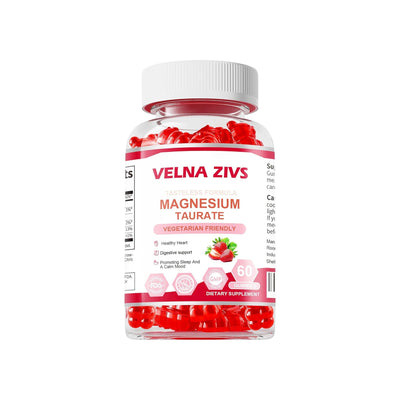
If you want to try it, our Magnesium Taurate Gummies 1800mg is formulated for this purpose. You can browse the full related collection to compare options.
These statements have not been evaluated by the Food and Drug Administration. This product is not intended to diagnose, treat, cure, or prevent any disease. Talk to a healthcare professional before starting any new supplement, especially if you are pregnant, nursing, taking medication, or managing a health condition.
These statements have not been evaluated by the Food and Drug Administration. This product is not intended to diagnose, treat, cure, or prevent any disease.