What Is Black Walnut Hull Extract? The 14-in-1 Kids' Gut Formula Explained
What is black walnut good for? Learn how black walnut hull, wormwood, and clove work in the 14-in-1 kids' gut formula — plus safety and cycling basics.

A reader recently asked us: "I keep seeing 'black walnut' in kids' digestive formulas, but no one actually explains what it does. Is it a food? An extract? Why is it always paired with wormwood and clove?"
Fair question. Black walnut (Juglans nigra) is a North American hardwood tree, and its hull — the green outer layer around the nut — has been used in traditional herbal medicine for generations, particularly in digestive-support blends. In modern supplements, it typically appears as black walnut hull extract, standardized or whole-plant, suspended in liquid drops or encapsulated.
In this guide, we break down exactly what black walnut drops do for kids gut health, which compounds do the work, how the full 14-in-1 herbal formula for kids is built, and — just as importantly — what it is not for.
The Active Compounds Inside Black Walnut Hull (Juglans Nigra)
The hull is where the interesting chemistry lives. Three classes of compounds dominate:
· Juglone (5-hydroxy-1,4-naphthoquinone) — the signature compound of black walnut hull. Juglone's chemical structure allows it to interfere with electron transport in microbial cells, which is the basis for its broad antimicrobial activity in laboratory research.
· Tannins — astringent polyphenols that support the traditional digestive-comfort role of the hull.
· Polyunsaturated oils and sterols — present in smaller amounts and contributing to the overall botanical profile.
Expert Insight: A mechanistic study by Inbaraj and Chignell in Chemical Research in Toxicology (2004) demonstrated that juglone generates reactive oxygen species and disrupts cellular redox balance, which helps explain the compound's antimicrobial and anti-proliferative activity observed across laboratory studies.
The practical takeaway: black walnut hull is not "food" — it's a concentrated botanical extract. That's precisely why it is dosed in liquid drops, not eaten by the handful, and why dosing discipline matters in any juglone supplement.
Why Black Walnut Hull Is Always Paired With Wormwood and Clove
Look at the ingredient panel of any traditional gut-support formula and you'll see the same trio. There's a reason for that.
| Herb | Key Compounds | Traditional Role | Lab-Backed Activity |
| Black walnut hull | Juglone, tannins | Gut environment support | Antimicrobial (juglone) |
| Wormwood (Artemisia absinthium) | Artemisinin-family sesquiterpene lactones | Digestive bitter tonic | Antiparasitic & antimicrobial activity; artemisinin's antimalarial action won the 2015 Nobel Prize |
| Clove (Syzygium aromaticum) | Eugenol (up to 90% of volatile oil) | Warming digestive spice | Broad-spectrum antibacterial and antioxidant activity |
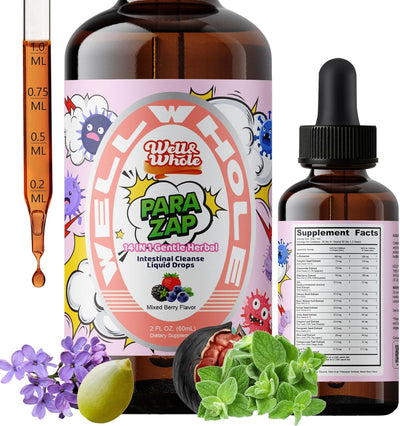
The wormwood-clove trio is additive: each plant contributes a different class of compounds, hitting the gut environment from different angles. Eugenol and the wormwood terpenoids add antioxidant capacity, while juglone contributes the quinone-based antimicrobial activity. In the Kids' Black Walnut Digestive Support Drops (14-in-1 Herbal Formula) ($19.99), this trio anchors the formula, and 11 additional botanicals round it out for overall digestive comfort — hence "14-in-1."

The 14-in-1 Herbal Formula for Kids: More Than Just the Trio
A "14-in-1" formula is built on the idea that the gut is a system, not a single target. Beyond the core trio, formulas like this typically include supporting botanicals that address different links in the digestive chain:
· Soothing / demulcent herbs — traditional ingredients like marshmallow root or licorice root that coat and comfort the digestive lining
· Carminative herbs — botanicals traditionally used to ease gas and bloating (think fennel, ginger, peppermint)
· Bitters — compounds that may stimulate normal digestive secretions
· Antioxidant spices — botanicals that support the body's own defense systems
Because every 14-in-1 formula has its own label, we recommend reading the full ingredient panel and confirming which 14 botanicals are actually included — and, just as importantly, confirming the absence of alcohol, artificial dyes, and common allergens in a children's product.
Natural Gut Support for Children: Where Black Walnut Fits in the Stack
Black walnut drops serve a specific role within natural gut support for children: the short-term "environment alteration" layer. They aren't a daily multi, they aren't a probiotic replacement, and they aren't a meal. The broader stack most pediatric dietitians recommend looks like this: fiber-rich whole foods as the foundation, fermented foods for live-microbe input, strain-specific probiotics for daily microbiome maintenance, and short botanical cycles during imbalance windows (travel, post-antibiotics, diet transitions). Black walnut drops are the last layer, not the first.
What Black Walnut Is Good For — And What It Isn't
Here is our honest, evidence-balanced breakdown:
Where black walnut has traditional and lab-supported relevance:
· Supporting a balanced microbial environment in the gut (alteration approach)
· As one component of a short-term digestive-support protocol
· Providing polyphenol and antioxidant input to the digestive tract
Where it does NOT apply:
· It is not a treatment for parasites, worms, or any diagnosed gastrointestinal condition — those require medical diagnosis and prescription antiparasitic medication when indicated
· It is not a daily micronutrient — it's a concentrated botanical, so it's used in cycles, not as an everyday multi
· It is not a substitute for probiotics — it works on the environment; probiotics repopulate it
The distinction matters for safety. Parents sometimes over-rely on "green" formulas and delay necessary medical care, or use them daily for months without a break. Both patterns are worth avoiding.
Traditional Decoctions vs Modern Standardized Liquid Drops
Generations of herbal practice prepared black walnut as a decoction — the hull simmered in water, sometimes with vinegar or alcohol as an extractive. A decoction's strength varies with the season, the tree, and the pot. Modern supplements solve that variability with standardization: the extract is produced in controlled batches, and quality-focused brands verify active-marker levels (such as juglone content) through third-party testing.
That consistency matters in a children's product because dosing assumes a stable product: a drop of an unstandardized extract might deliver vastly different juglone amounts across bottles. For the 14-in-1 formula concept, standardization also protects the supporting botanicals — each of the 14 herbs must be present in a meaningful amount, or the "14-in-1" label is marketing rather than formulation.
When you compare kids' gut formulas, the questions to ask are simple: Does the label list every botanical? Are the key markers disclosed? Is the product tested by an independent lab? Are alcohol, artificial dyes, and common allergens absent? A transparent answer to those four questions does more for your child's safety than any herbal claim on the front of the bottle.
People Also Ask: Black Walnut Hull Extract for Kids
Is black walnut safe for toddlers?
Black walnut drops are generally considered safe for toddlers ages 2 and up when used at labeled doses in short 1–2 week cycles, with pediatric approval. The active compound juglone is toxic at high doses, so never exceed the label. Avoid entirely if your child has a tree-nut allergy.
How do you give black walnut drops to kids?
Mix the labeled dose into 1–2 tablespoons of a cool, strongly flavored food like applesauce or full-fat yogurt. Use the "cheek pocket" dropper technique — aim for the inside of the cheek rather than the back of the tongue. Give at the same time each day, anchored to a meal.
What does black walnut do for the gut?
Black walnut hull contains juglone, a naphthoquinone with broad-spectrum antimicrobial activity in laboratory research. In traditional herbal practice, it alters the gut environment — shifting the terrain rather than seeding beneficial bacteria. It's typically paired with wormwood and clove in classic digestive formulas.
Can children take black walnut every day?
Daily use during a labeled cycle (typically 1–2 weeks on) is acceptable, but indefinite daily use for months isn't the traditional pattern and hasn't been studied in children. The standard protocol is 1–2 weeks on, 1–2 weeks off, with reassessment at each break.
Black walnut drops vs probiotics for kids — which is better?
They do different jobs. Probiotics have stronger pediatric clinical evidence and are designed for daily, long-term microbiome maintenance. Black walnut drops act faster and are used in short cycles for targeted gut-environment support. Many parents use both, spacing doses 2–3 hours apart.
Safety & Trust
· Keep black walnut products out of reach of children; a full bottle can be dangerous if consumed at once.
· Not for children under 2 without explicit pediatric approval.
· Avoid if the child has a tree-nut allergy or a known sensitivity to juglone.
· Use in cycles; long-term daily use has not been studied in children.
· Confirm third-party testing and a full, transparent ingredient list before choosing any 14-in-1 formula.
· If digestive symptoms are severe, persistent, or accompanied by fever or blood, see a pediatrician — do not self-manage with supplements.
References
1. Inbaraj JJ, Chignell CF, "Cytotoxic action of juglone and plumbagin: a mechanistic study using HaCaT keratinocytes," Chemical Research in Toxicology, 2004.
2. Tu Y, "Artemisinin — a gift from traditional Chinese medicine to the world (Nobel Lecture)," Angewandte Chemie International Edition, 2016.
3. Burt S, "Essential oils: their antibacterial properties and potential applications in foods — a review," International Journal of Food Microbiology, 2004.
4. Woolf AD, "Herbal remedies and children: do they work? Are they harmful?" Pediatrics, 2003.
These statements have not been evaluated by the Food and Drug Administration. This product is not intended to diagnose, treat, cure, or prevent any disease.
Related supplements
If you're ready to put this into practice, our Slippery Elm Liquid Drops, Marshmallow Root, Slippery Elm Bark Drops for Women, DGL Licorice Extract, Digestive Health, and Kids’ Black Walnut Digestive Support Drops, 14-in-1 Herbal Formula, Mixed Berry, Ages 1+, 2 fl oz are formulated with this in mind. You can also compare the Digestive Support and Health Benefits ranges to find the format that suits you.