What Does Mucuna Pruriens Do to Your Brain? L-DOPA Pathway Explained
What does mucuna pruriens do to your brain? The L-DOPA pathway explained — blood-brain barrier, dopamine conversion, reward circuits, and clinical evidence.

A reader once told us: "Mucuna pruriens sounds like a miracle — a bean that turns into dopamine. How is that even possible?"
It's a fair reaction, because the claim sounds like biology fiction. But the chain is real, documented, and — here's the part that surprises most people — it's the same chain behind one of the most important drugs in modern medicine. Levodopa, the gold-standard Parkinson's treatment for 50+ years, is literally the L-DOPA from this plant's seeds. Understanding that pathway — from velvet bean to brain chemistry — is the key to using mucuna responsibly. Let's walk through it step by step.
The Synthesis Chain: How the Brain Makes Dopamine
Dopamine doesn't exist in food. It's manufactured inside neurons from amino acids, in a four-step pipeline:
phenylalanine → tyrosine → L-DOPA → dopamine
| Step | Enzyme | Where It Happens | Notes |
| Phenylalanine → Tyrosine | Phenylalanine hydroxylase | Liver | First precursor conversion |
| Tyrosine → L-DOPA | Tyrosine hydroxylase (TH) | Dopamine neurons | Rate-limiting step — the bottleneck |
| L-DOPA → Dopamine | Aromatic amino acid decarboxylase (AADC) | Dopamine neurons | Fast, efficient |
| Dopamine storage/release | VMAT, synaptic machinery | Dopamine neurons | Packaged into vesicles |
The critical fact: tyrosine hydroxylase is the slow step. The body deliberately limits how fast tyrosine becomes L-DOPA. This is the brain's safety valve — and it's exactly the valve mucuna pruriens bypasses.
The Blood-Brain Barrier Problem (and How L-DOPA Solves It)
Here's the deeper question: why can't you just eat dopamine — or even L-tyrosine and rely on it?
· Dopamine cannot cross the blood-brain barrier. Eat dopamine and it never reaches the brain — it's metabolized in the periphery.
· L-DOPA can cross it. It's transported into the brain by the L-type large neutral amino acid transporter (LAT1) — the same shuttle that carries tyrosine and other amino acids.
· Once inside, AADC converts L-DOPA to dopamine right in the neurons, restoring dopamine where it's needed.
Expert Insight: Mercuri and Bernardi described L-DOPA as "magic" in a 2005 Trends in Pharmacological Sciences review — because among all the compounds in the dopamine chain, it is the one that combines blood-brain-barrier permeability with efficient conversion. That single property is why a velvet bean extract has real brain effects.
This is the whole secret of mucuna: the plant provides the one molecule in the chain that can travel from your stomach to your dopamine neurons.
What Dopamine Actually Does Once It's There
The raised dopamine acts across the brain's dopamine circuits, which have distinct jobs:
| Pathway | Main Job |
| Mesolimbic pathway | Reward, motivation, wanting |
| Mesocortical pathway | Focus, planning, executive function |
| Nigrostriatal pathway | Movement control, habit |
| Tuberoinfundibular pathway | Prolactin regulation |
At Parkinson's-therapy doses, the nigrostriatal pathway is the target (motor benefit). At the modest levels from a 500 mg supplement (~15–20 mg L-DOPA), the relevant effects are motivational and cognitive — the "wanting," focus, and drive functions that Schultz's reward-prediction research (Neuron, 2002) mapped to mesolimbic and mesocortical dopamine.
The Human Evidence: From Velvet Bean to Parkinson's Trials
The strongest human data on mucuna's L-DOPA comes from movement-disorder research:
· Katzenschlager et al. (2004, JNNP): double-blind crossover study in Parkinson's patients — powdered mucuna pruriens produced motor benefit comparable to standard levodopa, with a faster onset (~35 vs ~60 minutes).
· The motor benefit tracks with plasma L-DOPA levels — confirming the botanical's L-DOPA is genuinely bioavailable and active.
· The practical translation for supplement users: the pathway is human-verified, not theoretical. What's different at supplement doses is the scale, not the mechanism.
Dose Is the Whole Story
The molecule is identical; the dose separates support from therapy:
| Scenario | L-DOPA Dose | Effect |
| Mucuna gummy (500 mg) | ~15–20 mg | Dopamine tone support: motivation, focus |
| Mucuna powder (1–2 g) | ~30–80 mg | Stronger, shorter-term boost |
| Prescription levodopa | 200–800+ mg (with carbidopa) | Parkinson's therapy — medically managed |
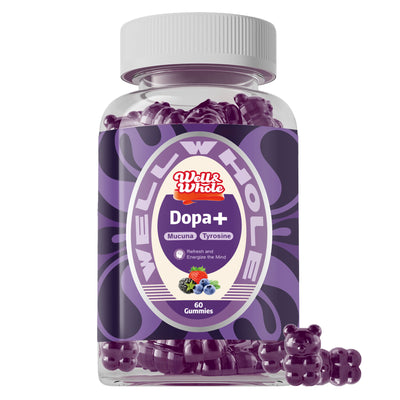
The same compound at 20 mg is "support"; at 500 mg it's a drug. This is why responsible brands disclose L-DOPA content and label doses conservatively — and why the Dopamine Gummies – Mucuna Pruriens 500mg is positioned as an everyday support product, not a therapy.

Why Carbidopa Changes Everything (and Why Supplements Don't Use It)
Here's a detail that clarifies how serious L-DOPA really is. In Parkinson's therapy, levodopa is never given alone — it's combined with carbidopa. Carbidopa blocks the enzyme aromatic amino acid decarboxylase (AADC) in the periphery (outside the brain), preventing most L-DOPA from being converted to dopamine before it crosses the blood-brain barrier. This does two things: it dramatically increases the L-DOPA that reaches the brain, and it reduces peripheral side effects (nausea, low blood pressure) caused by dopamine forming in the body.
Mucuna pruriens supplements contain no carbidopa. All their L-DOPA is exposed to peripheral AADC, so a larger fraction is converted to dopamine outside the brain. At supplement doses (~20 mg), this is manageable — but it explains the nausea some users report, and it's a reminder that mucuna's L-DOPA is the unprotected version of a molecule that medical practice deliberately protects.
Parkinson's dosing with raw mucuna has been studied (Katzenschlager et al., 2004) and it worked — but patients doing that were monitored. This is precisely why we advise: at supplement doses, respect the label; at any suggestion of Parkinson's, leave L-DOPA entirely to a neurologist.
What You Can — and Can't — Expect to Feel
Mucuna's effects are real, but they're dose- and person-dependent — and the "euphoric supplement" framing online sets up disappointment. Here's the honest expectation set:
What the Research Supports
In controlled studies of standardized L-DOPA extracts, the reproducible findings sit in arousal-adjacent domains: elevated mood scores, reduced perceived fatigue, and improved motor coordination — consistent with the precursor raising central dopamine, particularly in people with low baseline levels. Parkinson's trials (typically 100–500 mg L-DOPA) are the strongest evidence that the pathway works; wellness doses sit far below that range.
The Timing Reality
Dopamine peaks in circulation roughly 1–2 hours after an L-DOPA dose, and the subjective window people report matches that curve: effects are noticeable in the first few hours, then taper. That makes mucuna a situational tool — a morning or pre-task dose — rather than a constant background hum.
The Overlap Trap
If you're already running strong dopamine signaling — high caffeine intake, high stress, adrenaline-driven work — the added precursor can produce jitteriness rather than focus. That's not the product failing; it's the dose landing on top of an already-elevated baseline.
The realistic read: expect subtle-to-moderate focus and energy support on low-baseline days, not a cognitive rewrite.
FAQ
Q: Does mucuna pruriens increase dopamine in the brain?
A: Yes — its L-DOPA crosses the blood-brain barrier and is converted to dopamine by AADC. The increase is dose-dependent.
Q: How long after taking mucuna does dopamine rise?
A: L-DOPA peaks in plasma within 1–2 hours and converts to dopamine over roughly the same window.
Q: Why can't I just eat dopamine-rich foods?
A: Dopamine in food doesn't cross the blood-brain barrier. L-DOPA — which only mucuna (and prescription levodopa) provides — does.
Q: Is L-DOPA the same as levodopa?
A: Identical molecule. Levodopa is the pharmaceutical name; L-DOPA is the same compound. This is why mucuna deserves drug-level respect.
Q: Can mucuna rebuild dopamine neurons?
A: No — it supplies a precursor, not neurons. It supports dopamine levels, not the cells themselves.
Q: Does taking mucuna long-term cause tolerance?
A: Tolerance and dopaminergic overstimulation are theoretical concerns with chronic use; cycling (2–3 weeks on, 1 week off) and medical awareness are the standard precautions.
Safety & Trust
· Never combine with MAO inhibitors, antipsychotics, or levodopa therapy.
· Avoid with bipolar disorder or psychosis history — dopaminergic agents can destabilize.
· Take in the morning; monitor for overstimulation, nausea, or blood pressure changes.
· Choose products with declared L-DOPA content and third-party testing.
· Supports normal dopamine function; not a treatment for any disease.
References
1. Katzenschlager R et al., "Mucuna pruriens in Parkinson's disease: a double blind clinical and pharmacological study," Journal of Neurology, Neurosurgery & Psychiatry, 2004.
2. Mercuri NB, Bernardi G, "The 'magic' of L-dopa: why is it the gold standard Parkinson's disease therapy?" Trends in Pharmacological Sciences, 2005.
3. Schultz W, "Getting formal with dopamine and reward," Neuron, 2002.
These statements have not been evaluated by the Food and Drug Administration. This product is not intended to diagnose, treat, cure, or prevent any disease.
Related supplements
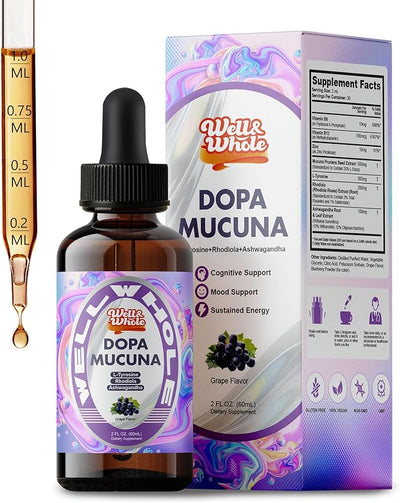
If you're ready to put this into practice, our Dopamine Gummies – Mucuna Pruriens Supplements Gummies 500mg with Mood Support and Mucuna Pruriens Liquid, Mucuna Pruriens Supplements 500MG, Fuel for Focus & Attention are formulated with this in mind. You can also compare the Mood Support and Brain Health ranges to find the format that suits you.