What Does 'Liver Support' Actually Mean?

"Liver support" is one of the most used and least defined phrases in the supplement industry. It appears on bottles containing everything from a single herb to a twelve-ingredient blend, and it is routinely attached to claims that range from defensible to absurd. Clearing up what the phrase can honestly mean is the single most useful thing you can do before spending money in this category.
First, the thing nobody selling you a detox wants to hear
Your liver already detoxifies you. Continuously, efficiently, and without instruction. It runs a two-phase enzyme system that converts fat-soluble compounds into water-soluble ones so they can be excreted through bile or urine. It clears bilirubin, metabolises alcohol and medications, regulates cholesterol, stores glycogen, and synthesises most of the proteins circulating in your blood.
A working liver does not need to be "cleansed," "flushed," or "reset." Those words are marketing, not physiology. When a product claims to flush toxins from your liver, the accurate response is scepticism, because the claim implies the organ is failing at a job it has been doing since before you were born.
So what can 'support' legitimately mean?
Strip away the pseudoscience and three defensible meanings remain.
1. Supplying substrates the liver uses. The liver's phase-two conjugation pathways depend on available amino acids and sulphur compounds. Glutathione, one of the body's central intracellular antioxidants, is synthesised from glutamate, cysteine, and glycine. Providing cysteine — often as N-acetylcysteine, which is better absorbed than free cysteine — is a biochemically coherent way to support glutathione production. This is a real mechanism, not a vague "detox" hand-wave.
2. Supporting bile flow. Bile is both a digestive fluid and an export route. Compounds that influence bile production and release are affecting a genuine physiological process. This is the category where bile acids such as TUDCA sit, and it is also why people with bile duct obstruction must avoid them.
3. Antioxidant activity in liver tissue. The liver is metabolically busy and generates oxidative stress as a side effect of doing its job. Silymarin, the flavonoid complex in milk thistle, has been studied extensively for antioxidant activity and for its effects on liver cell membranes. The clinical results across decades of trials are inconsistent, but the mechanism is serious and the safety profile is good.
Ingredients worth understanding
- Milk thistle (silymarin). The most studied botanical in the category. Decades of trials, mixed results, excellent tolerability. Often standardised to 80% silymarin content.
- N-acetylcysteine (NAC). A cysteine donor and glutathione precursor. Well studied, widely used, and one of the more defensible ingredients in any liver formula.
- TUDCA. A bile acid with a real mechanism and limited human data. Covered in detail elsewhere.
- Dandelion and artichoke. Traditional bitter herbs associated with digestive and biliary function. Long traditional use, modest modern clinical data.
- Glutathione. Sometimes included directly, though oral glutathione has questionable bioavailability compared with supplying its precursors.
Claims that should make you suspicious
A few reliable red flags. Anything promising to "reverse" liver damage, "flush" toxins, or produce results in days. Anything using the word "toxins" without naming a single one. Any product that discourages you from seeing a doctor. And any formula sold as a short "cleanse" with dramatic before-and-after framing.
The deeper problem with cleanse culture is not just that it does not work — it is that it can delay real care. Symptoms like persistent fatigue, jaundice, or unexplained abdominal discomfort are reasons to see a clinician, not reasons to buy a two-week kit.
What actually protects your liver
The unglamorous list outperforms any supplement, and it is worth stating plainly even on a page that sells supplements.
- Moderate alcohol intake, or none. This is by far the largest lever most people control.
- Keeping body weight in a healthy range, since metabolic dysfunction is now the leading driver of liver problems in developed countries.
- Vaccination against hepatitis A and B where relevant.
- Not exceeding paracetamol (acetaminophen) dosing — it is the most common cause of acute liver injury precisely because it is in so many combination products and people double up without realising.
- Being cautious with unregulated herbal products, which themselves account for a meaningful share of drug-induced liver injury.
Supplements sit on top of this foundation. They do not replace it.
FAQ
Do I need a liver supplement if I drink occasionally?
Almost certainly not in the sense of repairing anything. If you drink, the intervention with evidence behind it is drinking less, not adding a capsule.
How long should I take a liver support formula?
There is no established protocol. Most people use these cyclically or continuously at label doses. If you have elevated liver enzymes, that is a medical matter and supplementation should be supervised — and monitored with repeat blood work, not assumed effective.
Liquid drops or capsules?
Drops allow dose flexibility and are absorbed without waiting for a capsule to dissolve, which some people prefer. Capsules are more portable and have no taste. Neither is clearly superior in outcome; choose by adherence.
Can supplements damage the liver?
Yes. This surprises people, but herbal and dietary supplements are a recognised cause of drug-induced liver injury. It is a genuine reason to buy from brands that use third-party testing rather than the cheapest option available.
The short version
"Liver support" is a legitimate phrase only if it means supplying substrates for conjugation, supporting bile flow, or providing antioxidant activity — not flushing imaginary toxins. The ingredients with real mechanisms are NAC, milk thistle, and bile acids such as TUDCA. The interventions with the strongest evidence are reducing alcohol, maintaining a healthy weight, and not exceeding paracetamol dosing. If you do supplement, choose a formula with transparent dosing and third-party testing, and treat any persistent symptom as a reason to see a doctor.
Where to start
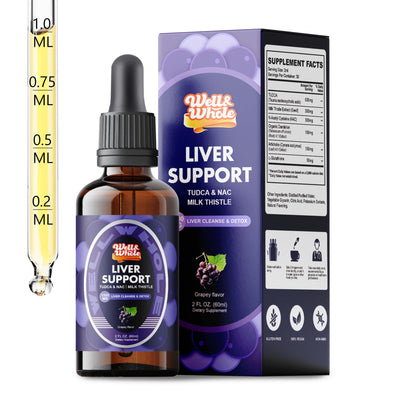
If you want to try it, our Liver Support Liquid Drops with TUDCA, Milk Thistle and NAC is formulated for this purpose. You can browse the full related collection to compare options.
These statements have not been evaluated by the Food and Drug Administration. This product is not intended to diagnose, treat, cure, or prevent any disease. Talk to a healthcare professional before starting any new supplement, especially if you are pregnant, nursing, taking medication, or managing a health condition.