What Does Cayenne Pepper Do for Your Heart? Capsaicin and TRPV1 Science
What does cayenne pepper do for your heart? Capsaicin science explained — TRPV1, circulation, metabolism, real research findings, and who should be careful.

"Does eating cayenne pepper actually do anything for my heart, or is it just an old wives' tale with a kick?" That's the exact question a reader sent us after watching her father add a hot pepper to every meal — the same ritual his cardiologist cautiously allowed, and his grandkids made fun of.
The honest answer: it's not folklore, but it's also not magic. Cayenne pepper contains capsaicin, a molecule that does measurable things in the human body — through a specific receptor that happens to be deeply involved in cardiovascular signaling. As a cayenne pepper supplement, the research is real, the effects are modest, and the "more heat = more benefit" assumption is wrong. Here's the science of cayenne pepper for heart health, explained without hype.

The TRPV1 Receptor: Where Capsaicin Actually Works
Capsaicin's whole story starts with one protein: TRPV1 (transient receptor potential vanilloid subtype 1) — a calcium-permeable ion channel found on sensory nerve fibers. When capsaicin binds TRPV1:
· It triggers the "heat and pain" signal (that's the burning — the body interprets TRPV1 activation as noxious heat)
· It triggers substance P and calcitonin gene-related peptide (CGRP) release, which promotes local vasodilation — widening of blood vessels
· With repeated exposure, it can desensitize the nerve fiber, which is why "the burn fades" over time
Expert Insight: A 2010 review in the European Journal of Pharmacology (Peng & Li, "The vanilloid receptor TRPV1: role in cardiovascular and gastrointestinal protection") summarized evidence that TRPV1 activation by capsaicin promotes vasodilation and cardioprotective signaling — establishing the receptor as a genuine cardiovascular target, not a flavor aside.
This is the mechanistic basis for cayenne's traditional use in circulation support: capsaicin-elicited vasodilation and the metabolic effects that follow. It's why capsaicin for circulation is more than an old wives' tale.
What the Population Data Shows for Cayenne Pepper for Heart Health

Population studies are association, not causation — but they're consistent and notable:
· The Moli-sani study (Bonaccio et al., Journal of the American College of Cardiology, 2019) tracked 22,811 Italian adults for a median of 8.2 years
· Those consuming chili peppers 4+ times per week (vs. none/rarely) showed roughly a 44% lower risk of death from coronary heart disease and a 61% lower risk of death from cerebrovascular disease
· The association held even after adjusting for the Mediterranean diet — meaning the chili effect appeared additive, not just a marker of healthy eating
Why might this happen? Leading hypotheses from the accompanying editorials: TRPV1-mediated vasodilation, improved lipid handling, and antiplatelet effects. None of these are confirmed mechanisms in humans at supplement doses — but the signal is consistent enough to have generated serious follow-up research.
Capsaicin, Metabolism, and Weight Support
The heart doesn't live alone — metabolic health drives cardiovascular health. Capsaicin's metabolic effects are among its best-documented:
· Thermogenesis: Capsaicin activates brown adipose tissue (BAT), increasing energy expenditure
· A 2012 systematic review and meta-analysis (Whiting et al., Appetite) of 20 trials found that capsaicinoids and capsinoids significantly increased energy expenditure, with effects sustained during the intervention periods
· Capsaicin also modestly increases fat oxidation in some trials
The practical relevance: supporting metabolic rate and weight management indirectly supports cardiovascular health. But the effect sizes are modest — roughly 50 extra calories per day in several trials, not a replacement for exercise.
How Much Cayenne Actually Helps?
In supplements, cayenne appears as cayenne pepper extract, usually standardized. Typical support doses:
| Form | Typical Dose | Notes |
| Whole cayenne powder | 500–1,000 mg | Food-level dosing |
| Cayenne extract | 40–120 mg | Standardized to capsaicin content |
| Capsaicin (pure) | 2–10 mg/day | Highest potency; used in research doses |
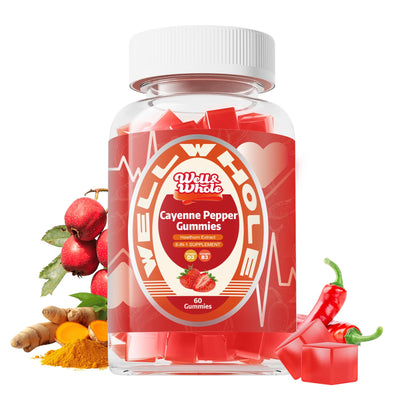
The key rule: more heat ≠ more benefit. TRPV1 receptors desensitize with overstimulation — excessive capsaicin doesn't amplify the effect, it dulls it and adds GI irritation. The Cayenne Pepper Heart Health Gummies with Hawthorn & CoQ10 & Turmeric ($19.99) uses a food-derived cayenne pepper extract dose designed for daily tolerance — pairing it with hawthorn (circulatory support), CoQ10 (energy), and turmeric (inflammatory balance) for a four-lever approach.
The Honest Limits of Cayenne Pepper Blood Pressure Effects
Cayenne is not:
· A blood pressure drug — it may support healthy vasodilation, but it won't manage hypertension on its own
· A cholesterol treatment — population data shows associations, not cholesterol-lowering mechanisms
· A treatment for existing heart disease — chest pain, palpitations, or diagnosed conditions require medical management
And it can interact: capsaicin may enhance the effects of antihypertensives (causing excessive drops) and may influence bleeding risk with anticoagulants and antiplatelets. Anyone on cardiac medication should get medical approval before adding cayenne supplements.
Capsaicin and Platelets: The Lab Evidence Worth Knowing
Cayenne's circulatory reputation extends to platelets — the cell fragments that clump to form clots. Laboratory research has examined capsaicin's effects on platelet aggregation, and several studies suggest capsaicin may modestly reduce platelet clumping under certain conditions. This is the same mechanism class as aspirin's antiplatelet effect, which is precisely why the combination deserves caution: if you take anticoagulants or antiplatelet medication, adding concentrated capsaicin could compound the bleeding tendency — an interaction our safety section covers in detail.
The practical translation: for a healthy adult, food-level cayenne is unremarkable; for someone on blood thinners, concentrated extracts need medical review. We don't recommend cayenne as a "natural blood thinner" — that's a claim beyond the evidence — but we do flag the pharmacology because understanding it protects you.
What the research does support, more cautiously, is the population-level pattern: regular chili consumers in large cohort studies show lower cardiovascular mortality. The mechanism hypotheses — TRPV1-mediated vasodilation, metabolic effects, platelet modulation — are all under active investigation, and none is confirmed at supplement doses. The responsible summary: capsaicin touches several cardiovascular levers at once, and that breadth is why cayenne earns its place in heart-support formulas — and why dosing discipline and interaction awareness matter.
Capsaicin Forms: Why Source and Dose Matter
The heart-health literature doesn't study "cayenne pepper" as one thing — it studies capsaicin (the active alkaloid, typically 0.1–2.5% of dried powder, the main capsaicinoids) and the whole-fruit matrix around it. Three formats appear in research, and they're not interchangeable:
Powder and Food (the Population Data)
Chili-eating cohorts, including the China Kadoorie Biobank (about 487,000 adults), ate fresh or dried chilies regularly for years. The dose is whole-food capsaicin spread across meals — hard to replicate precisely — but the pattern associated with cardiovascular outcomes is regular, moderate intake, not occasional extremes.
Standardized Extracts (What Gummies Deliver)
A gummy formula standardizes capsaicin per serving, measured in mg or labeled as cayenne fruit extract with a stated concentration. This is where "dose" becomes a number you can plan with: roughly 2.5 mg of capsaicin (about 1/4–1/2 teaspoon of dried cayenne) is a research-adjacent serving for adults.
Topical vs Oral
Topical capsaicin creams (0.025–0.075%) act on local TRPV1 nerve endings for joint and muscle discomfort — a completely different route from oral capsules, which act through gut TRPV1 and metabolic signaling.
The practical point: the label's mg of standardized extract — not the name "cayenne" — is the number that determines whether you're getting a research-meaningful dose or a token sprinkle. In a 4-in-1 heart gummy, cayenne is one of four actives, so its capsaicin dose is moderate by design.
People Also Ask: Cayenne Pepper for Heart Health
Does cayenne pepper help heart health?
Yes, the evidence is encouraging but not conclusive. The Moli-sani study of 22,811 Italian adults linked regular chili consumption (4+ times/week) to roughly 44% lower coronary heart disease mortality and 61% lower cerebrovascular mortality. The mechanism is likely TRPV1-mediated vasodilation and improved blood flow. It's association, not proof, but the signal is consistent.
Can I take cayenne with blood pressure medication?
Only with explicit medical approval. Capsaicin can enhance the blood-pressure-lowering effect of antihypertensives, which may cause blood pressure to drop too low. If approved, space the gummy 2–3 hours from your medication dose and monitor home BP daily.
What does CoQ10 do for the heart?
CoQ10 is the electron carrier at the center of mitochondrial ATP production — and the heart is the most mitochondria-dense organ. The Q-SYMBIO trial (420 heart-failure patients) found fewer major adverse cardiovascular events and lower cardiovascular mortality with CoQ10 over 2 years. CoQ10 also declines with age and is depleted by statins.
Is hawthorn good for heart health?
Hawthorn has the strongest botanical evidence base for heart muscle support. A Cochrane review of 14 randomized trials found hawthorn extract improved symptom control and exercise tolerance in chronic heart failure patients versus placebo. For generally healthy adults, hawthorn is used at lower doses as daily circulatory support.
When to take heart health gummies?
Take with a meal that contains some fat — CoQ10 and curcumin are fat-soluble and absorb 2–3x better with food. Morning with breakfast is the default: predictable, fed, and it keeps capsaicin's thermogenic warmth away from bedtime.
Safety & Trust
· Take cayenne with food to minimize GI irritation.
· Medical clearance required if you take antihypertensives, anticoagulants, or antiplatelets.
· Stop and seek care for chest pain, palpitations, or shortness of breath — don't attribute cardiac symptoms to "detox."
· Choose third-party-tested products with declared standardization.
References
1. Bonaccio M et al., "Chili pepper consumption and mortality in Italian adults," Journal of the American College of Cardiology, 2019.
2. Peng J, Li YJ, "The vanilloid receptor TRPV1: role in cardiovascular and gastrointestinal protection," European Journal of Pharmacology, 2010.
3. Whiting S et al., "Capsaicinoids and capsinoids. A systematic review and meta-analysis of trials on their effects on energy expenditure," Appetite, 2012.
4. Luo XJ, Peng J, Li YJ, "Recent advances in the study on capsaicinoids and cardiovascular diseases," Current Drug Targets, 2011.
These statements have not been evaluated by the Food and Drug Administration. This product is not intended to diagnose, treat, cure, or prevent any disease.
Related supplements
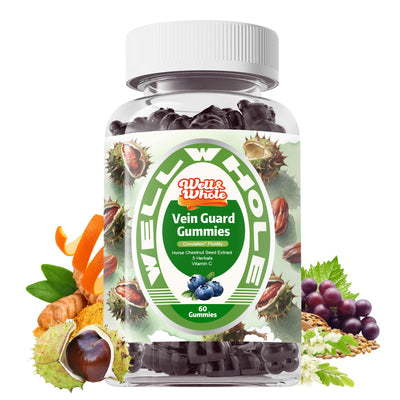
Putting it simply: if this is something you want to add to your routine, our Well&Whole Horse Chestnut Extract Gummies, Circulation Supplements for Legs and Cayenne Pepper Heart Health Gummies with Hawthorn & CoQ10 & Turmeric are a good place to start. The wider Heart Health collection is worth a look, and the CoQ10 range covers related formats.