What Do Plant Sterols Actually Do for Cholesterol? Beta-Sitosterol Explained
What do plant sterols actually do for cholesterol? Beta-sitosterol mechanism explained — intestinal absorption, LDL reductions, dosing, safety, and food sources

"Plant sterols lower cholesterol." You've seen it on spreads, yogurts, and supplement labels. But if you're like most people, you've never actually heard how — which is a shame, because the mechanism is genuinely elegant, and understanding it explains almost everything about how to use these products correctly.
Plant sterols — the most famous being beta-sitosterol — are the cholesterol strategy that works entirely in your intestines, without ever really entering your body. Here's the full story: the chemistry, the mechanism, the numbers, and the one rare condition that flips the story on its head.
The Chemistry: Cholesterol's Identical Twin
Cholesterol and plant sterols are nearly identical molecules. Both are rigid, ring-based structures with a hydroxyl group at one end and a side chain at the other. The differences are minor — an extra ethyl or methyl group in the side chain — but they change everything about how the body treats them:
| Molecule | Source | Side-Chain Difference | Absorbed by Humans? |
| Cholesterol | Animal foods, liver synthesis | — | Yes (~30–60%) |
| Beta-sitosterol | Nuts, oils, soy, avocados | Ethyl group (C-29) | Minimal (<5%) |
| Campesterol | Vegetable oils | Methyl group (C-28) | Minimal (~5%) |
| Stigmasterol | Soy, many plants | Unsaturated C-29 | Minimal |
That tiny side-chain difference is the entire trick: plant sterols look enough like cholesterol to fool the intestine, but not enough to be absorbed.
The Mechanism: Winning the Ticket to the Micelle
Digestion of dietary fat and cholesterol depends on mixed micelles — bile-acid-coated packages that ferry fat molecules across the water layer to the intestinal lining for absorption. Micelle space is limited, and molecules compete for it.
· Cholesterol and plant sterols compete for space in the micelles
· Plant sterols are slightly better at displacing cholesterol from the micelle
· The displaced cholesterol never reaches the absorptive surface — it continues down the GI tract and exits in the stool
Net result: less dietary (and biliary) cholesterol absorbed, more excreted. Because the liver compensates by pulling LDL cholesterol out of the blood to make bile acids, blood LDL drops. That's the whole pathway — elegant, local, and systemic in its effect.
Expert Insight: A controlled feeding study by Racette and colleagues (American Journal of Clinical Nutrition, 2010) directly measured the dose-response: fractional cholesterol absorption dropped progressively as phytosterol dose increased from 0 to 2.2 g/day, plateauing around 2 g/day — the basis for the universal "2 g/day" dosing recommendation.
What the LDL Numbers Actually Look Like
The evidence base is unusually clean because the mechanism is so mechanical:
| Dose | LDL Reduction | Notes |
| 0.8 g/day | ~3–5% | Typical food-fortification dose |
| 1.5 g/day | ~5–7% | Partial effect |
| 2 g/day | 8–10% | The evidence-based target; effects plateau above this |
| 3+ g/day | No additional benefit | Extra sterols just pass through |
A 2003 Mayo Clinic Proceedings review (Katan et al.) and a 2014 scientific statement (Gylling et al., Atherosclerosis) both converge on the same numbers: 2 g/day → ~8–10% LDL reduction, onset within 2–3 weeks, stable thereafter.
Important context: 8–10% is meaningful — it's roughly the same LDL reduction as a low-dose statin's first increment — but it's not "all the way." Used on top of a fiber-rich diet, the two effects add up.
Food vs Supplement: Getting to 2 g/day
Dietary intake of plant sterols in a typical Western diet: 150–400 mg/day — about 1/10 of the effective dose. Getting to 2 g/day by food alone requires:
· 2–3 servings of sterol-fortified spread (often ~1 g per serving)
· Or ~4 cups of pistachios a day (please don't)
· Or 2+ liters of certain vegetable oils (also please don't)
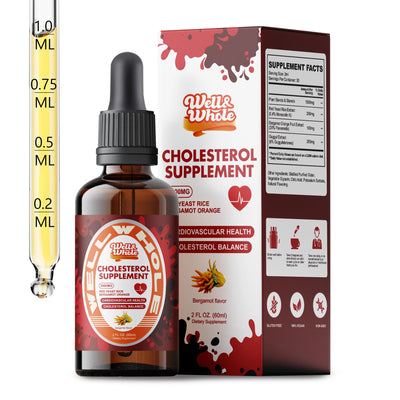
The practical reality: fortified foods and supplements are how the evidence-based dose becomes feasible. Supplements — like the Cholesterol Support Liquid Drops (Plant Sterols & Red Yeast Rice) — deliver the sterol dose in drops with meals, and this particular formula pairs it with red yeast rice to also address liver synthesis.

Three Usage Rules
1. Take sterols with meals — they only work where food is being digested; on an empty stomach they do nothing.
2. Split across meals — 1 g with breakfast and 1 g with dinner works at least as well as 2 g at once, and spreads the effect.
3. Keep taking them — the effect is reversible; stopping the sterols restores absorption within weeks.
The One Exception: Sitosterolemia
For virtually everyone, plant sterols are among the safest cholesterol tools because they're barely absorbed. The exception is sitosterolemia — a rare autosomal-recessive condition (about 1 in a million) where a transport defect causes plant sterols to accumulate dangerously in blood and tissues.
People with sitosterolemia must avoid plant sterol supplements entirely — in their case, sterols raise, not lower, cardiovascular risk. If you have unexplained high cholesterol with unusual tendon xanthomas or a family history of early heart disease, mention phytosterol testing to your doctor before starting sterol products.
Reading the Label: What "Plant Sterol 2 g" Actually Requires
When you buy a plant sterol supplement, the label number isn't the whole story — the serving math is. A product that says "plant sterols 2 g" per serving delivers the evidence-based dose in one serving. A product that says "plant sterol ester 4 g" delivers roughly 2.4 g of free sterol equivalents (esters are heavier molecules). And a product that lists a "proprietary blend" without disclosing sterol content is unusable — you cannot dose what you cannot measure.
Take sterols with the meals that contain the most cholesterol-rich food: if you're having eggs at breakfast and meat at dinner, split the 2 g across both meals. If your diet is largely plant-based with little dietary cholesterol, sterols still help — they also capture cholesterol that the liver secretes into bile, so the effect isn't zero even on a low-cholesterol diet.
Finally, keep expectations mechanical: the effect appears within 2–3 weeks and reverses within weeks of stopping. Sterols are a usage commitment, not a reset button.
FAQ
Q: Are plant sterols the same as plant stanols?
A: Close cousins — stanols are hydrogenated sterols. Dosing (2 g/day) and LDL effects (~8–10%) are equivalent.
Q: How quickly do plant sterols lower cholesterol?
A: LDL begins dropping within 2–3 weeks of consistent use and stabilizes by ~4 weeks.
Q: Do plant sterols raise my cholesterol in any way?
A: In healthy people, no — they aren't absorbed. The exception is sitosterolemia, where they must be avoided.
Q: Can I get 2 g/day from food alone?
A: Only with sterol-fortified foods; natural foods provide 150–400 mg/day. Supplements make the dose practical.
Q: Do plant sterols interact with medications?
A: Minimal — they act in the intestine. They can slightly reduce absorption of fat-soluble vitamins (A, D, E, K) and some drugs taken simultaneously; spacing other doses by 2 hours is a sensible precaution.
Q: Can plant sterols replace a statin?
A: No. They address absorption only, with an 8–10% LDL effect. High-risk patients typically need the larger reductions only medication provides.
Safety & Trust
· Avoid with sitosterolemia.
· Space sterols 2 hours from other medications and fat-soluble vitamin supplements.
· Not a substitute for medical treatment of hypercholesterolemia.
· Choose third-party-tested products with stated sterol content.
· Supplements support healthy cholesterol metabolism; they do not treat or prevent disease.
References
4. Racette SB et al., "Dose effects of dietary phytosterols on cholesterol metabolism: a controlled feeding study," American Journal of Clinical Nutrition, 2010.
5. Katan MB et al., "Efficacy and safety of plant stanols and sterols in the management of blood cholesterol levels," Mayo Clinic Proceedings, 2003.
6. Gylling H et al., "Plant sterols and plant stanols in the management of dyslipidaemia and prevention of cardiovascular disease," Atherosclerosis, 2014.
These statements have not been evaluated by the Food and Drug Administration. This product is not intended to diagnose, treat, cure, or prevent any disease.
Related supplements
Should you decide to supplement, well&whole Horse Chestnut Extract Gummies, Circulation Supplements for Legs and Cayenne Pepper Heart Health Gummies with Hawthorn & CoQ10 & Turmeric are our formulation for this purpose. For a broader comparison, see the Heart Health and CoQ10 collections.