What Are Essential Amino Acids? Why Your Body Can't Make Them
What are essential amino acids and why does your body need them? The 9 EAAs, their functions beyond muscle, food sources, and how much you need daily.

"I eat protein, so I get amino acids — why do I need a supplement with 'essential' in the name?" A reader asked this after seeing the EAA Gummies 60ct in our shop. It's a fair question, because the term "essential" is doing two jobs: it's a nutrition-science definition, and it's a supplement-category label.

The nutrition-science definition is precise and worth understanding: of the 20 amino acids your body uses to build proteins, it can make 11 itself — and cannot make 9. Those 9 are essential, meaning they must come from food (or supplements). This guide explains what each of the 9 does, why "can't make them" matters, and how much you actually need.
The 9 Essential Amino Acids and What They Do
| Amino Acid | Primary Functions | Notable Food Sources |
| Histidine | Histamine precursor; immune function; tissue repair | Meat, poultry, fish, beans |
| Isoleucine | BCAA; muscle energy; glucose regulation | Eggs, chicken, lentils |
| Leucine | BCAA; the master MPS trigger (mTORC1) | Dairy, soy, meat, eggs |
| Lysine | Collagen synthesis; calcium absorption; carnitine | Meat, fish, quinoa |
| Methionine | Protein start codon; methylation; cysteine precursor | Eggs, fish, seeds |
| Phenylalanine | Precursor of tyrosine (→ dopamine, thyroid hormones) | Meat, dairy, soy |
| Threonine | Collagen/elastin; immune protein support | Poultry, cheese, grains |
| Tryptophan | Serotonin and melatonin precursor | Turkey, eggs, oats, pumpkin seeds |
| Valine | BCAA; muscle repair; energy during exercise | Meat, dairy, soy |
Notice how spread out the jobs are: EAAs aren't just "muscle powder chemistry." They feed the neurotransmitter system (tryptophan, phenylalanine), the connective tissue system (lysine, threonine), and the immune system — which is why "protein deficiency" shows up as fatigue, poor wound healing, and lowered immunity, not just smaller muscles.
Why "Essential" Means "You Can't Make It"
Your body is a skilled manufacturer: it can synthesize 11 of the 20 proteinogenic amino acids from carbon skeletons and nitrogen. But for the other 9, it lacks the necessary enzymatic pathways — evolution simply never equipped humans to build those carbon skeletons from scratch.
The practical consequence: protein quality is measured by EAA content. The FAO/WHO protein quality scale (PDCAAS/DIAAS) scores proteins by how well they deliver the 9 EAAs. This is why:
· Animal proteins (egg, whey, casein) score near 1.0 — complete EAA coverage
· Most plant proteins score lower on one or two EAAs — typically lysine (grains) or methionine (legumes)
· The fix is combining: rice (low lysine) + beans (high lysine) = complete coverage
Expert Insight: The Joint FAO/WHO/UNU Expert Consultation on Protein and Amino Acid Requirements in Human Nutrition (WHO Technical Report Series 935, 2007) established the adult reference requirement of 0.8 g protein/kg/day and defined amino acid scoring patterns that all modern protein recommendations use. Understanding the "essential 9" starts there.
Leucine: The Special One
Among the 9, leucine deserves its own section — because it's not just a building block, it's a signal.
· Leucine activates mTORC1, the molecular switch that turns on muscle protein synthesis
· The leucine "threshold" for a robust MPS response is roughly 2–3 g per meal/serving — below it, MPS rises modestly; at it, the response turns on fully
· This is why EAA formulas and high-leucine proteins (whey, soy, eggs) outperform low-leucine sources for muscle support
A 2014 double-blind trial (Churchward-Venne et al., AJCN) demonstrated exactly this: leucine added to a low-protein drink boosted myofibrillar protein synthesis in young men.
How Much Do You Actually Need?
| Population | Protein Target | Notes |
| Sedentary adult | 0.8 g/kg/day | WHO/FAO baseline |
| Active adult / recreational athlete | 1.2–1.6 g/kg/day | EAA-rich meals distributed |
| Strength athletes | 1.6–2.2 g/kg/day | Leucine threshold per meal matters |
| Older adults (60+) | 1.2–1.5 g/kg/day | Anabolic resistance — higher protein needed |
| Vegetarian/vegan athletes | At the high end | Requires careful combining |
For a 70 kg active adult, that's 84–112 g protein/day, which delivers roughly 7–9 g of leucine across the day when distributed in 3–4 meals — the pattern the literature supports.
Supplements: Where EAAs Fit
Food should always come first — but EAA supplements have legitimate niches:
1. Training windows — a fast-absorbing EAA dose before/after training delivers amino acids faster than a meal
2. Appetite-limited eaters — people who can't stomach large protein portions
3. Older adults — where hitting leucine thresholds at every meal is genuinely hard
4. Portability — gummies solve the "shaker bottle at the office" problem
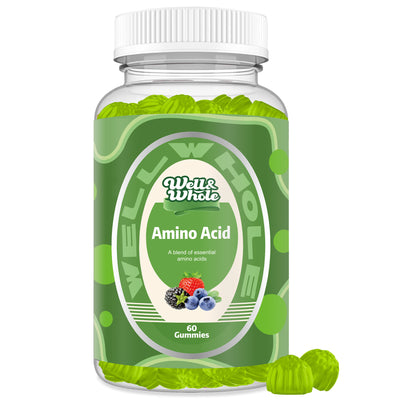
The EAA Gummies 60ct is positioned exactly there: a convenient format that ensures the 9 EAAs (with meaningful leucine) are covered on training days.

"Per Meal" Distribution: The Leucine Threshold Nobody Meets by Accident
The EAA story has a distribution detail that matters more than most people realize: muscle protein synthesis responds to each meal's leucine content, not just the daily total. The research consensus points to roughly 2–3 g of leucine per meal as the threshold for a full MPS response — below it, the response is partial.
A typical pattern that fails this test: a coffee-and-toast breakfast (0.3 g leucine), a moderate lunch, and a protein-heavy dinner. The daily total looks fine; the per-meal peaks don't fire. The fix is distribution: 25–35 g of quality protein at each of three meals, or strategic EAA gummies in the meals/windows that fall short.
This is where supplements earn their keep for older adults especially — appetite declines with age while the leucine threshold doesn't, and EAA dosing is the practical answer to "I can't eat more food." For everyone else, it's a reminder that a good protein day is a pattern of meals, not a single number.
Four EAA Myths Worth Unlearning
Misinformation about amino acids is stubborn. These four myths cost people money, effort, or both:
Myth 1: "Amino acids are only for bodybuilders."
False. The nine EAAs are required for protein synthesis in every tissue — immune cells, gut lining, skin, muscle. The athletes get the marketing; the requirement is universal.
Myth 2: "More protein automatically means more muscle."
Protein above a threshold (roughly 1.6 g/kg/day for lifters) gives diminishing returns. The body doesn't bank amino acids; excess is deaminated and oxidized. The marginal grams beyond the threshold buy less than the marketing implies.
Myth 3: "Plant-based eaters can't get complete EAAs."
Mostly false, with a caveat. A varied plant diet — legumes, grains, nuts, seeds — covers all nine EAAs. The real practical gap: plant protein tends to run lower in leucine and lysine per gram, which is why targeted EAA products can genuinely help plant-based athletes hit the leucine threshold.
Myth 4: "EAAs and BCAAs are the same thing."
They're not. BCAAs are three amino acids (leucine, isoleucine, valine) that partially stimulate muscle protein synthesis; EAAs are all nine, and the research consistently shows the full EAA set outperforms BCAAs for MPS. A product with only BCAAs is a half-solution.
FAQ
Q: How many essential amino acids are there?
A: Nine: histidine, isoleucine, leucine, lysine, methionine, phenylalanine, threonine, tryptophan, and valine.
Q: What happens if I don't get enough EAAs?
A: Protein deficiency symptoms develop: muscle loss, fatigue, poor wound healing, weakened immunity, and in children, growth delays.
Q: Is a "complete protein" a food with all 9 EAAs?
A: Yes — and it's about coverage, not magic. Meat, eggs, dairy, soy, and quinoa are complete; rice and beans become complete when combined.
Q: Do I need EAA supplements if I eat enough protein?
A: If your total protein and per-meal leucine are adequate, supplements are optional — they're a convenience layer, not a requirement.
Q: Are BCAAs a subset of EAAs?
A: Yes — the BCAAs (leucine, isoleucine, valine) are 3 of the 9 EAAs. EAAs are a superset; most experts prefer EAAs for this reason.
Q: Can I take too many EAAs?
A: Excess amino acids are deaminated and excreted — generally tolerable at label doses, but unnecessary amounts add liver/kidney workload. Respect labeled doses.
Safety & Trust
· Medical review recommended for kidney or liver disease, PKU (phenylketonuria), or protein-restricted diets.
· Keep to labeled doses; amino acids don't store, they excrete.
· Gummies are attractive to children — keep out of reach.
· Not a meal replacement; food protein remains foundational.
· Supplements support normal physiology; they do not diagnose, treat, or prevent disease.
References
5. Joint FAO/WHO/UNU Expert Consultation, "Protein and amino acid requirements in human nutrition," WHO Technical Report Series 935, 2007.
6. Paddon-Jones D et al., "Amino acid ingestion improves muscle protein synthesis in the young and elderly," American Journal of Physiology – Endocrinology and Metabolism, 2004.
7. Churchward-Venne TA et al., "Leucine supplementation of a low-protein mixed macronutrient beverage enhances myofibrillar protein synthesis in young men: a double-blind, randomized trial," American Journal of Clinical Nutrition, 2014.
These statements have not been evaluated by the Food and Drug Administration. This product is not intended to diagnose, treat, cure, or prevent any disease.
Related supplements
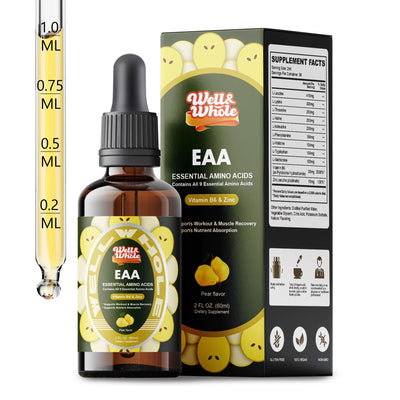
Should you decide to supplement, EAA Gummie 60 counts Essential Amino Acids Supplement Gummies for Men and Women and Essential Amino Acid (EAA) Liquid Drops & Liver Support Liquid Supplement are our formulation for this purpose. For a broader comparison, see the Amino Acids and Muscle Support collections.