TUDCA Dosage Guide: How Much Should You Take Per Day?
TUDCA dosage guide — clinical doses, supplement doses, timing, cycling, and safety. Learn how to dose TUDCA for liver support, bile flow, and longevity goals.

TUDCA (Tauroursodeoxycholic acid) has exploded in popularity over the last 5 years — going from a niche research chemical to a mainstream supplement found in every biohacker's stack.
Key Takeaways
- TUDCA (tauroursodeoxycholic acid) is a bile acid naturally present in small amounts in the body, studied for liver and cellular health support.
- It is typically taken in capsule form with meals.
- Because it affects bile, consult a healthcare professional if you have gallbladder or liver conditions or take related medication.
But dosing TUDCA isn't always straightforward. The clinical doses used in studies for primary biliary cholangitis (the FDA-approved indication) are often much higher than what supplement users take for general liver support.
This guide will walk you through the clinical research, the typical supplement doses, when to take it, and how to cycle it.
What the Research Uses
FDA-Approved Clinical Dose (PBC):
· 13–15 mg per kg of body weight per day
· For a 70 kg (154 lb) adult: ~1,000–1,050 mg/day
Studied Doses in Research:
· NAFLD/NASH: 500–1,500 mg/day
· Insulin sensitivity: 1,500 mg/day
· Bile flow / general liver support: 250–750 mg/day
· Neuroprotection studies: 1,000–1,500 mg/day
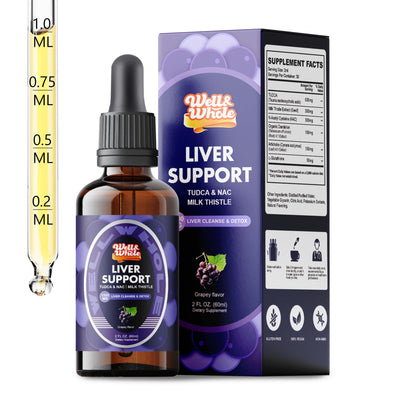
Most over-the-counter TUDCA supplements come in 250 mg or 500 mg capsules, or in liquid form (like our TUDCA + NAC Drops at 250 mg/serving).
Common Supplement Doses by Goal
How to Take TUDCA
With or Without Food?
TUDCA is a bile acid, so it actually *benefits* from being taken with meals — particularly meals containing some fat. The presence of food triggers gallbladder contraction, which "uses" the bile acids in a coordinated way.
However, many people take it on an empty stomach first thing in the morning for convenience. This is also effective, as TUDCA is well-absorbed either way.
Liquid vs Capsule:
· **Liquid drops** (like our [TUDCA + NAC Drops](https://www.wellwholeshop.com/)) absorb faster and allow flexible dosing
· **Capsules** are more convenient for travel and precise dosing
· Both are bioavailable — choice is personal preference
Time of Day:
· **Morning** (with breakfast): most common, pairs well with morning supplements
· **Evening** (with dinner): good for those who take other liver support at night
· **Split doses** (morning + evening): better for doses >500 mg/day
Cycling TUDCA
Do you need to cycle TUDCA?
The honest answer: there's no strong evidence either way. TUDCA is a naturally occurring bile acid in your body (just at lower concentrations than the therapeutic doses used in supplements). Long-term use at supplement doses (250–750 mg/day) appears safe in the available research.
Common cycling protocols:
1. **No cycling** — Daily use at 250 mg/day indefinitely (most common)
2. **5 days on / 2 days off** — Mimics intermittent fasting philosophy
3. **8–12 weeks on / 4 weeks off** — Periodic reset approach
4. **Seasonal** — Used heavily in fall/winter, less in summer
For most people, daily use at 250–500 mg/day is a sensible baseline. Increase to 500–1,000 mg/day for specific therapeutic goals, then reassess after 8–12 weeks.
Stacking TUDCA with Other Supplements
TUDCA pairs well with:
· **NAC** — Combined antioxidant + bile flow support ([TUDCA + NAC Drops](https://www.wellwholeshop.com/) deliver both)
· **Milk thistle (silymarin)** — Traditional liver herb; complementary mechanisms
· **Alpha-lipoic acid (ALA)** — Universal antioxidant; supports liver detox
· **Phosphatidylcholine** — Cell membrane support
· **Magnesium** — Often depleted in liver stress
· **B vitamins** — Cofactors for liver detox pathways
Side Effects and Safety
At supplement doses (250–1,000 mg/day), TUDCA is generally very well tolerated. Reported side effects are rare and mild:
· Loose stools (most common, usually transient)
· Mild nausea (take with food if this occurs)
· Headache (uncommon)
Drug interactions:
· May interact with bile acid sequestrants (cholestyramine, colestipol)
· May affect absorption of fat-soluble vitamins (A, D, E, K) with very long-term high-dose use
· No known serious interactions at standard doses
Who should be cautious:
· Pregnant or nursing (insufficient research)
· Children (not studied in pediatric populations)
· People with active gallstones (consult doctor)
How Long Until You See Results?
Most people report subjective benefits (better energy, less bloating, improved digestion of fats) within 2–4 weeks. Objective markers (ALT, AST, GGT) typically improve within 8–12 weeks.
FAQ
Is 250 mg of TUDCA enough?
For general maintenance and bile flow support, 250 mg/day is sufficient. For therapeutic goals, 500 mg/day is more common.
Can I take 1,000 mg of TUDCA per day?
Yes, this is within the studied clinical range. Split into two 500 mg doses (morning and evening) for best absorption.
Is TUDCA safe long-term?
At supplement doses (≤1,000 mg/day), no significant safety signals have emerged in research. TUDCA is a naturally occurring bile acid.
Should I take TUDCA on an empty stomach?
Either way works. With food (especially fat) is slightly more physiologic.
Can TUDCA reverse fatty liver?
Studies show TUDCA can improve liver enzymes, insulin sensitivity, and steatosis markers in NAFLD. It's a useful tool but works best with diet and lifestyle changes.
Does TUDCA interact with medications?
Few known interactions. Talk to your doctor if you're on bile acid sequestrants or fat-soluble vitamin supplements.
Conclusion
For most people, 250–500 mg of TUDCA per day is the sweet spot for general liver support, bile flow, and cellular health. Higher doses (500–1,000 mg/day) are appropriate for specific therapeutic goals like elevated liver enzymes, fatty liver, or GLP-1 support.
Liquid formats (like our TUDCA + NAC Drops) make dosing flexible and absorption fast. Pair with NAC for comprehensive liver support that covers both bile flow and antioxidant defense.
Related supplements
Putting it simply: if this is something you want to add to your routine, our Liver Support Liquid Drops Supplement | TUDCA Drops Liver Cleanse & Detox with Milk Thistle, NAC, Dandelion, Artichoke & Glutathione for Detox and TUDCA 1000mg Gummies with Milk Thistle 500mg for Adults are a good place to start. The wider Liver Support collection is worth a look, and the Milk Thistle range covers related formats.
What TUDCA is
TUDCA is a taurine-conjugated bile acid. Bile acids help the body digest dietary fats and support normal liver function. Endogenous levels are small, which is why supplemental forms exist.
Research interest centers on its roles in liver and cellular health pathways.
How TUDCA is commonly taken
Capsules with meals are the standard format. Serving sizes vary widely by product, so following the specific label is essential.
It is usually part of a broader liver-support routine that may also include diet adjustments.
Who might be interested
Adults focused on liver and metabolic wellness, and those already using other liver-support supplements, often explore TUDCA.
Anyone with gallbladder issues, bile-duct obstruction, or liver disease should consult a professional first.
How to choose a quality TUDCA product
Look for a clear TUDCA amount per serving, third-party purity testing, and transparent sourcing. Avoid products that do not state the active amount.
This article is for general wellness education and is not intended to diagnose, treat, cure, or prevent any condition. Individual needs vary—always review product labels and consult a qualified healthcare professional before starting any new supplement.
These statements have not been evaluated by the Food and Drug Administration. This product is not intended to diagnose, treat, cure, or prevent any disease.