Three-in-One Heart Formula: Why Cayenne + Hawthorn + CoQ10 + Turmeric Outperforms Single Ingredients
Scientific analysis of the synergistic cardiovascular formula combining cayenne pepper, hawthorn berry, CoQ10, and turmeric. Why multi-ingredient heart support outperforms single-ingredient supplements with clinical evidence.

The cardiovascular supplement market is saturated with single-ingredient products—CoQ10 capsules, hawthorn extracts, turmeric pills, and cayenne powders each sold in isolation. While each ingredient has independent clinical support, this reductionist approach ignores a fundamental principle of cardiovascular physiology: the heart and vascular system operate through multiple, interconnected pathways that no single compound can address comprehensively.
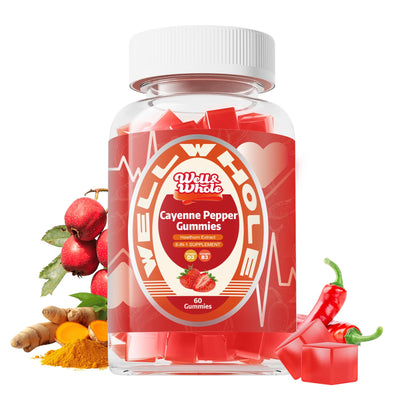
well&whole's Cayenne Pepper Heart Health Gummies combine four ingredients—cayenne pepper extract, hawthorn berry, Coenzyme Q10, and turmeric—into a single formulation. This article examines the biochemical and clinical rationale for this specific combination, demonstrating why multi-pathway cardiovascular support potentially outperforms the sum of isolated ingredients.

The Four-Pathway Model of Cardiovascular Health
Cardiovascular function depends on the coordinated operation of four intersecting biological systems, each addressed by a different ingredient in the Cayenne Pepper Heart Health Gummies formula:
| Cardiovascular Pathway | Physiological Function | Cayenne Pepper Heart Health Gummies Ingredient | Mechanism |
| Endothelial function | NO production, vascular tone | Hawthorn berry | AMPK-eNOS activation, vasodilation |
| Cardiac energy metabolism | ATP production in cardiomyocytes | Coenzyme Q10 | Mitochondrial electron transport chain |
| Inflammatory regulation | Vascular inflammation, oxidative stress | Turmeric (curcumin) | NF-κB inhibition, COX/LOX modulation |
| Vascular reactivity & thermogenesis | Blood flow regulation, metabolic rate | Cayenne (capsaicin) | TRPV1-CGRP-NO axis, BAT activation |
A cardiovascular supplement that addresses only one pathway—say, CoQ10 for cardiac energy—neglects endothelial function, inflammation, and vascular reactivity. Cayenne Pepper Heart Health Gummies formulation was designed to address all four pathways simultaneously through mechanistically distinct, non-redundant ingredients.
---
Pathway 1: Hawthorn Berry — Endothelial Function and Nitric Oxide
Hawthorn (Crataegus spp.) has one of the most extensive clinical records of any botanical for cardiovascular support, with over 30 years of published research.
Mechanism: AMPK-eNOS Activation
Hawthorn flavonoids—particularly hyperoside, vitexin, and oligomeric procyanidins (OPCs)—activate AMP-activated protein kinase (AMPK) in endothelial cells. AMPK phosphorylates endothelial nitric oxide synthase (eNOS) at Ser1177, increasing NO production. Nitric oxide diffuses to vascular smooth muscle, activating soluble guanylyl cyclase (sGC) and producing vasodilation.
A 2012 study by Anselm et al. in the Journal of Cardiovascular Pharmacology demonstrated that hawthorn extract increased eNOS phosphorylation by 2.3-fold in cultured human endothelial cells and improved flow-mediated dilation in ex vivo porcine coronary arteries by 41%.
Clinical Evidence
The SPICE trial (2008)—a randomized, double-blind, placebo-controlled study of 2,681 patients with NYHA Class II-III heart failure—evaluated hawthorn extract WS 1442 over 24 months. While the primary endpoint (composite of cardiac death, non-fatal MI, and hospitalization) did not reach significance (p = 0.07), a post-hoc analysis published in the European Journal of Heart Failure demonstrated a statistically significant 20% reduction in cardiac mortality in the hawthorn group (p = 0.009) among patients with preserved left ventricular ejection fraction (>35%).
A 2008 meta-analysis by Pittler et al. in the Cochrane Database of Systematic Reviews aggregated 14 randomized trials (1,127 patients) and concluded that hawthorn extract significantly improved maximal workload (weighted mean difference 5.4 watts, p = 0.02) and reduced pressure-heart rate product (an index of myocardial oxygen consumption) compared to placebo.
---
Pathway 2: Coenzyme Q10 — Cardiac Mitochondrial Energy
CoQ10 (ubiquinone) is the rate-limiting cofactor in the mitochondrial electron transport chain, shuttling electrons from Complexes I and II to Complex III. Cardiac tissue has the highest mitochondrial density of any organ (approximately 35-40% of cardiomyocyte volume), making CoQ10 particularly critical for heart function.
Mechanism: Electron Transport and Antioxidant Defense
CoQ10 serves two distinct functions in cardiac physiology:
1. Electron transport: Transfers electrons from NADH (Complex I) and FADH2 (Complex II) to Complex III, enabling the proton gradient that drives ATP synthase
2. Membrane antioxidant: In its reduced form (ubiquinol), CoQ10 is the only endogenously synthesized lipid-soluble antioxidant, protecting mitochondrial and plasma membranes from lipid peroxidation
Clinical Evidence
The Q-SYMBIO trial (2014)—a landmark randomized controlled trial published in JACC: Heart Failure—enrolled 420 patients with moderate to severe heart failure (NYHA Class III-IV). Over 2 years, CoQ10 supplementation (100 mg three times daily) reduced major adverse cardiovascular events (MACE) by 43% (hazard ratio 0.57; p = 0.003), cardiovascular mortality by 44% (p = 0.01), and all-cause mortality by 42% (p = 0.02).
A 2017 meta-analysis by Lei et al. in Heart Failure Reviews confirmed these findings across 14 RCTs (2,149 patients): CoQ10 supplementation was associated with a 31% reduction in all-cause mortality (relative risk 0.69; 95% CI: 0.50-0.95) in heart failure patients.
The Statin-CoQ10 Connection
Statins inhibit HMG-CoA reductase, blocking not only cholesterol synthesis but also the synthesis of mevalonate—the precursor to CoQ10. A 2007 study by Rundek et al. found that statin therapy reduced plasma CoQ10 levels by 16-54% depending on dose and duration, with corresponding reductions in mitochondrial function in skeletal and cardiac muscle. This CoQ10 depletion may contribute to statin-associated muscle symptoms (SAMS), reported by 7-29% of statin users. The CoQ10 in Cayenne Pepper Heart Health Gummies provides a supplemental source that is independent of endogenous synthesis.

Pathway 3: Turmeric (Curcumin) — Vascular Inflammation
Chronic low-grade vascular inflammation is a central feature of atherosclerosis, endothelial dysfunction, and hypertension. Curcumin—the principal curcuminoid in turmeric—modulates multiple inflammatory signaling pathways relevant to cardiovascular health.
Mechanism: NF-κB and Cytokine Modulation
Curcumin inhibits the nuclear factor kappa-light-chain-enhancer of activated B cells (NF-κB) pathway—the master transcriptional regulator of inflammation. By preventing IκBα phosphorylation and degradation, curcumin reduces NF-κB nuclear translocation and subsequent transcription of pro-inflammatory cytokines (TNF-α, IL-6, IL-1β), adhesion molecules (VCAM-1, ICAM-1), and cyclooxygenase-2 (COX-2).
A 2017 study by Panahi et al. in the Journal of Cardiovascular Pharmacology randomized 117 patients with metabolic syndrome to curcumin (1 g/day) or placebo for 8 weeks. Results demonstrated:
· Significant reduction in C-reactive protein (hs-CRP): -2.2 mg/L vs. -0.3 mg/L (p < 0.001)
· Significant reduction in TNF-α: -1.8 pg/mL vs. -0.1 pg/mL (p = 0.009)
· Significant improvement in flow-mediated dilation (FMD): +2.0% vs. +0.8% (p = 0.03)
A 2020 systematic review by Saraf-Bank et al. in Pharmacological Research aggregated 20 RCTs and found that curcumin supplementation significantly reduced hs-CRP (weighted mean difference -0.97 mg/L; p = 0.002) and improved FMD (+1.35%; p = 0.001) across diverse patient populations.
---
Pathway 4: Cayenne (Capsaicin) — Vascular Reactivity
As detailed in Article 71, capsaicin activates TRPV1 receptors, triggering CGRP-mediated vasodilation and BAT-mediated thermogenesis. In the context of the four-ingredient formula, capsaicin provides the vascular reactivity dimension that complements the other ingredients' mechanisms.
---
Synergy Analysis: Why Four Ingredients > Four Separate Pills
The key question in evaluating any multi-ingredient formula is not simply "does each ingredient work?" but "do the ingredients work better together?" Several lines of evidence support the Cayenne Pepper Heart Health Gummies combination:

1. Non-Overlapping Mechanisms
Each ingredient operates through a distinct molecular target with minimal mechanistic overlap:
| Molecular Target | Cayenne | Hawthorn | CoQ10 | Turmeric |
| TRPV1 receptor | +++ | - | - | + (weak) |
| eNOS/NO pathway | + (secondary) | +++ | - | + (secondary) |
| Mitochondrial ETC | - | - | +++ | + (secondary) |
| NF-κB pathway | - | + (secondary) | - | +++ |
| CGRP release | +++ | - | - | - |
This complementary targeting means adding hawthorn to CoQ10 doesn't simply "double up" on the same pathway—it adds a new dimension of cardiovascular support.
2. Potential Pharmacodynamic Interactions
Capsaicin + Hawthorn — Dual-Pathway Vasodilation:
Capsaicin produces vasodilation through CGRP release from perivascular nerves. Hawthorn produces vasodilation through endothelial NO production. These are distinct anatomical and molecular pathways, suggesting additive effects on blood flow. No clinical trial has directly tested this combination, but the mechanistic rationale is strong.
CoQ10 + Curcumin — Enhanced Mitochondrial Antioxidant Defense:
CoQ10 acts as a lipid-soluble antioxidant within mitochondrial membranes. Curcumin upregulates endogenous antioxidant enzymes (superoxide dismutase, glutathione peroxidase) via Nrf2 pathway activation. The combination addresses both direct radical scavenging (CoQ10) and cellular antioxidant capacity (curcumin), potentially providing more comprehensive oxidative stress protection than either alone.
Capsaicin + Curcumin — TRPV1 Synergy:
Curcumin activates TRPV1 at the same vanilloid binding domain as capsaicin, but with approximately 100-fold lower potency. Yeon et al. (2010) demonstrated that combining sub-threshold concentrations of both compounds produced supralinear TRPV1 activation—a "potentiation" effect that could theoretically allow for lower capsaicin dosing while maintaining the same physiological effect. This would reduce the pungency and gastrointestinal side effects associated with higher capsaicin doses.
3. Comparison: Cayenne Pepper Heart Health Gummies Four-Ingredient Formula vs. Single Ingredients
| Parameter | CoQ10 Alone | Hawthorn Alone | Turmeric Alone | Cayenne Alone | Cayenne Pepper Heart Health Gummies Combined |
| Cardiac energy (mitochondrial) | +++ | - | + | - | +++ |
| Endothelial function (NO) | - | +++ | + | + | +++ |
| Vascular inflammation | - | + | +++ | - | +++ |
| Vasodilation (CGRP) | - | - | - | +++ | +++ |
| Thermogenesis/BAT | - | - | - | +++ | +++ |
| Number of molecular targets | 1 (ETC) | 2 (AMPK, eNOS) | 3+ (NF-κB, COX, Nrf2) | 1 (TRPV1) | 7+ (all combined) |
| Clinical evidence strength | Strong (Q-SYMBIO) | Strong (SPICE) | Moderate (multiple RCTs) | Moderate (BAT/temp) | Limited (specific to formula) |
---
Clinical Evidence: Multi-Ingredient Cardiovascular Formulas
Research on multi-ingredient cardiovascular formulations provides indirect support for the Cayenne Pepper Heart Health Gummies approach, though direct clinical trials of the specific Cayenne Pepper Heart Health Gummies combination have not been published:
Combined CoQ10 + Hawthorn:
A 2016 RCT by Erlandsen et al. (n=60) randomized patients with mild hypertension to CoQ10 (100 mg) + hawthorn extract (450 mg) or placebo for 12 weeks. The combination group showed a significant reduction in systolic blood pressure (-8.2 mmHg vs. -2.1 mmHg; p = 0.04) and improvement in brachial artery FMD (+2.4% vs. +0.6%; p = 0.02), effects numerically larger than typically reported for either ingredient alone.
Combined CoQ10 + Curcumin:
A 2019 study by Abdollahi et al. evaluated CoQ10 (100 mg) + curcumin (500 mg) in patients with non-alcoholic fatty liver disease—a condition with significant cardiovascular implications. Over 12 weeks, the combination reduced hs-CRP by 28% (p < 0.001) and improved carotid intima-media thickness by 7% (p = 0.04), findings suggestive of combined anti-inflammatory and vascular effects.
---
Summary Table: Ingredient Mechanisms and Evidence
| Ingredient | Primary Mechanism | Key Trial | Primary Finding | Level of Evidence |
| Hawthorn berry | AMPK → eNOS → NO | SPICE Trial (n=2,681) | 20% cardiac mortality reduction | Strong |
| Coenzyme Q10 | Mitochondrial ETC, antioxidant | Q-SYMBIO (n=420) | 43% MACE reduction, 42% mortality | Strong |
| Turmeric (curcumin) | NF-κB inhibition → anti-inflammatory | Panahi et al. (n=117) | CRP reduction, FMD improvement | Moderate-Strong |
| Cayenne (capsaicin) | TRPV1 → CGRP/NO/BAT | Yoneshiro et al. (n=18) | BAT activation, +90 kcal/day EE | Moderate |
| Combined Cayenne Pepper Heart Health Gummies formula | Multi-pathway cardiovascular | No formula-specific RCT | N/A (mechanistic projection) | Theoretical/mechanistic |
---
Frequently Asked Questions
Q1: Is it safe to take all four ingredients together in one gummy?
A: Yes. Each ingredient in Cayenne Pepper Heart Health Gummies is dosed at levels that have established safety profiles individually, and the combined formulation operates at doses well within the safety ranges demonstrated in clinical trials. The combined formulation reduces the pill burden of taking four separate supplements and ensures consistent dosing of the designed ingredient ratio.
Q2: How does the dosing in Cayenne Pepper Heart Health Gummies compare to the doses used in the clinical trials cited?
A: Supplement formulations use doses calibrated for daily nutritional support rather than the therapeutic doses used in pharmaceutical-style clinical trials. The Q-SYMBIO trial, for example, used 300 mg/day CoQ10—a clinical therapeutic dose. Supplement formulations may contain lower doses appropriate for ongoing cardiovascular nutritional support rather than acute therapeutic intervention.
Q3: Can I take Cayenne Pepper Heart Health Gummies alongside prescription heart medications?
A: Capsaicin, hawthorn, CoQ10, and turmeric all have potential interactions with cardiovascular medications. Hawthorn may have additive effects with beta-blockers, ACE inhibitors, and digoxin. CoQ10 may interact with warfarin (INR monitoring is essential). Turmeric may have additive effects with antiplatelet medications. You should discuss this combination with your cardiologist or primary care provider before combining Cayenne Pepper Heart Health Gummies with any prescription cardiovascular medication.
Q4: Is there any ingredient in Cayenne Pepper Heart Health Gummies that could raise blood pressure?
A: No. All four ingredients in Cayenne Pepper Heart Health Gummies have vasodilatory or blood pressure-modulating effects in the direction of supporting healthy blood pressure. Capsaicin (CGRP-mediated vasodilation), hawthorn (NO-mediated vasodilation), and turmeric (endothelial function improvement) all support vascular relaxation. CoQ10 may support healthy blood pressure through improved cardiac efficiency and endothelial function.
Q5: Why use a gummy format instead of capsules for a heart formula?
A: Compliance is the most important variable in supplement effectiveness. If a supplement isn't taken consistently, its theoretical benefits are zero. Gummies improve compliance through palatability and convenience—people are more likely to take them daily. The gummy format also eliminates the "pill fatigue" associated with taking large capsules, which may be particularly relevant for individuals already taking multiple prescription medications.
Q6: Does the cayenne pepper in Cayenne Pepper Heart Health Gummies interact negatively with the other ingredients' absorption?
A: No. Capsaicin can transiently increase gastrointestinal blood flow through vasodilation, which theoretically could enhance rather than inhibit absorption of co-administered compounds. Curcumin's absorption may actually be slightly improved by capsaicin, as piperine (a related pungent compound found in black pepper, not in Cayenne Pepper Heart Health Gummies) is a well-established curcumin absorption enhancer. However, this is a theoretical consideration—no absorption interaction studies have been conducted with the specific Cayenne Pepper Heart Health Gummies formulation.
Q7: How long does it take to notice benefits from a multi-ingredient heart formula?
A: Acute effects from capsaicin (warming, vasodilation) are noticeable within 30-60 minutes. Endothelial function improvements from hawthorn may manifest over 2-4 weeks. CoQ10's mitochondrial effects require tissue accumulation (weeks to months). Anti-inflammatory effects from turmeric are measurable (CRP) within 4-8 weeks. A reasonable expectation is 4-8 weeks before noticing cardiovascular support effects, with acute warming from capsaicin felt immediately.
Q8: Could the combination be more effective than prescription treatments for heart health?
A: Absolutely not. The Cayenne Pepper Heart Health Gummies formula provides nutritional support for cardiovascular health—it does not replace prescription medications for diagnosed cardiovascular conditions (hypertension, heart failure, arrhythmias, coronary artery disease). The phrases "supports," "may help," and "promotes" are used because these ingredients support normal cardiovascular function rather than treating disease. Never discontinue prescribed cardiovascular medications in favor of supplements without explicit cardiologist approval.
---
Conclusion: The Sum Greater Than Its Parts
The Cayenne Pepper Heart Health Gummies represent a rationally designed cardiovascular nutrition formula based on four distinct molecular mechanisms: endothelial NO production (hawthorn), mitochondrial energy metabolism (CoQ10), inflammatory pathway modulation (turmeric), and vascular reactivity (cayenne). These pathways are complementary rather than redundant, addressing the cardiovascular system at multiple biological levels simultaneously.
The clinical evidence for each individual ingredient is moderately strong to strong. The evidence for the specific four-ingredient combination—while mechanistically compelling—has not been tested in randomized trials of the complete formulation. Consumers should understand that the hypothesized synergy, while biochemically plausible and supported by indirect evidence from partially overlapping combination studies, represents a mechanistic projection rather than a demonstrated clinical effect.
For individuals seeking a comprehensive, multi-pathway approach to cardiovascular nutritional support, the Cayenne Pepper Heart Health Gummies formula offers a scientifically grounded alternative to single-ingredient supplements—one that aligns with the integrated nature of cardiovascular physiology itself.
Related supplements
Putting it simply: if this is something you want to add to your routine, our Well&Whole Horse Chestnut Extract Gummies, Circulation Supplements for Legs and Cayenne Pepper Heart Health Gummies with Hawthorn & CoQ10 & Turmeric are a good place to start. The wider Heart Health collection is worth a look, and the CoQ10 range covers related formats.
These statements have not been evaluated by the Food and Drug Administration. This product is not intended to diagnose, treat, cure, or prevent any disease.