Taurine and Healthy Aging: What the Research Actually Says

Taurine is one of the more intriguing molecules in the healthy-aging conversation: a 2023 study in Science found that taurine levels decline substantially with age in mice, monkeys, and humans, and that daily taurine supplementation extended average lifespan in middle-aged mice by around 10–12%. That is where the solid ground ends — no human trial has shown that taurine supplements extend human lifespan or healthspan. The honest position today: the biology is real, the animal data is striking, and the human evidence is still observational.
Key takeaways
- Taurine concentrations fall with age across species, including humans, per the 2023 Science study by Vijay Yadav's group at Columbia.
- Lifespan extension data exists in mice and monkeys — not humans. Claims beyond that are extrapolation.
- Human observational data links higher taurine levels (and exercise) with better health markers, not causation.
- Magnesium taurate delivers taurine together with magnesium, a two-channel pairing relevant to vascular and nervous-system support.
What the 2023 Science study actually found
The research team, led by Vijay Yadav at Columbia University Vagelos College of Physicians and Surgeons, measured taurine across the lifespan in mice, rhesus monkeys, and humans, finding declines of roughly 80% in mice and meaningful drops in monkeys and humans by older age. Supplementing middle-aged mice with taurine delayed markers of cellular aging — DNA damage, senescence, mitochondrial dysfunction — and extended median lifespan by about 10–12% in females and 7–10% in males. A companion finding in rhesus monkeys showed weight and bone-density benefits over six months.
What the study did not do: supplement humans for decades and count life years. That experiment takes longer than careers, which is why the aging-medicine community's response was interest plus patience. An accompanying Science commentary by Joseph McGaunn and Steven Bhatt (well, McGaunn & Baur of Penn State) framed the findings as a strong hypothesis awaiting human trials — the accurate reading.
The human evidence so far is a shadow of the mouse data
Three human observations currently support the hypothesis without proving it:
- Higher circulating taurine correlates with lower rates of obesity, type 2 diabetes, and chronic inflammation in cross-sectional studies, including work from the EPIC cohort in Europe.
- Exercise raises taurine levels — one suggested contributor to exercise's health benefits — per the same 2023 analysis, where athletic individuals showed higher taurine after exertion.
- Taurine has a long, reassuring safety record in energy-drink dosing (up to about 3 g/day in regulated products), and studies in heart failure (1.5–3 g daily) and exercise performance used multi-gram doses without notable toxicity.
What is missing: a randomized human trial with an aging endpoint. Until one exists, taurine is a "well tolerated, biologically plausible, unproven" supplement — a category that deserves honesty rather than hype.
Why magnesium taurate is an interesting delivery
Taurine and magnesium each have independent support: taurine for its roles in bile acid conjugation, calcium handling in heart cells, and GABAergic nervous-system signaling; magnesium for its involvement in over 300 enzymatic reactions, blood pressure regulation, and sleep quality. Combining them as magnesium taurate means one molecule pair covering both channels — a formulation popular for cardiovascular and relaxation-focused routines. A 2018 review in Frontiers in Physiology (de Carvalho and colleagues) discusses taurine's cardiovascular roles in detail.
The pairing does not create a longevity claim that taurine alone lacks. What it does is let a single supplement support the two mineral-and-amino-acid systems where midlife diets most commonly fall short.
What taurine actually does day to day
Long before anyone measured mouse lifespans, taurine had a working resume. It conjugates bile acids — the taurine in "taurocholate" — helping fat digestion and cholesterol clearance. It regulates osmotic pressure inside cells, which is why the heart, brain, and retina keep some of the highest concentrations in the body. It moderates calcium handling in cardiac muscle cells, supporting regular contraction rhythms, and it acts on GABA and glycine receptors, contributing to its reputation as a calming influence on the nervous system. This everyday portfolio explains why taurine shows up in clinical discussions of heart failure and exercise performance independently of any aging narrative. It is also why the 2023 aging findings landed on receptive ears: a molecule with real physiological jobs and a clean safety record is a more credible longevity candidate than an untested novelty. The jobs are documented; only the lifespan claim remains on probation.

A pragmatic stance while the science matures
If you want to position yourself on the right side of this research without waiting a decade: do the things already proven for healthspan first — exercise (which, notably, raises taurine), protein adequacy, sleep, and not smoking. If taurine appeals, multi-gram doses appear well tolerated in the studies to date, and magnesium taurate offers the combination route. Treat any expected benefit as a bonus, not a plan.
Frequently asked questions
How much taurine do people typically supplement?
Studied doses range from 1 to 3 grams per day in human trials for cardiovascular and exercise outcomes. The mouse longevity study used a weight-adjusted dose that would be impractical to translate directly to humans.
Is taurine safe long term?
Available evidence suggests yes at up to about 3 g/day, the ceiling used in regulated energy drinks and most clinical trials. Kidney disease patients should consult a clinician, as taurine is renally cleared.
Does magnesium taurate help with sleep?
Magnesium has moderate evidence for sleep quality in people with low magnesium intake, and taurine's calming neurochemistry is plausible, but direct sleep trials on magnesium taurate specifically are limited. Judge it as a magnesium source first.
Can I get taurine from food?
Yes — meat, fish, and shellfish are the main dietary sources, which is why vegans and long-term vegetarians tend to have lower taurine intake. The body also synthesizes some taurine from cysteine and methionine.
Related supplements
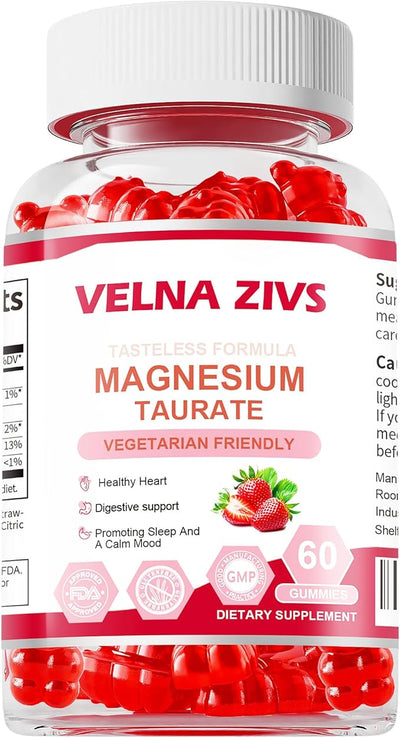
Should you decide to supplement, Magnesium Taurate Gummies 1800mg, Magnesium Taurate Supplement, High Absorption& chewable for Kid and Adults, is our formulation for this purpose. For a broader comparison, see the Magnesium Taurate and Magnesium collections.
These statements have not been evaluated by the Food and Drug Administration. This product is not intended to diagnose, treat, cure, or prevent any disease. Talk to a healthcare professional before starting any new supplement, especially if you are pregnant, nursing, taking medication, or managing a health condition.