Saw Palmetto + Pumpkin Seed Oil Synergy: Dual-Pathway DHT Management
Scientific analysis of saw palmetto and pumpkin seed oil synergy for DHT management. How combined 5-alpha reductase inhibition through distinct mechanisms provides superior androgen modulation compared to single ingredients.

The combination of saw palmetto (Serenoa repens) and pumpkin seed oil (Cucurbita pepo) represents one of the more biochemically rational botanical pairings in the men's health supplement market. Both agents target dihydrotestosterone (DHT) through 5-alpha reductase (5AR) inhibition, but they achieve this through chemically distinct compounds operating via mechanistically distinct binding interactions with the enzyme.
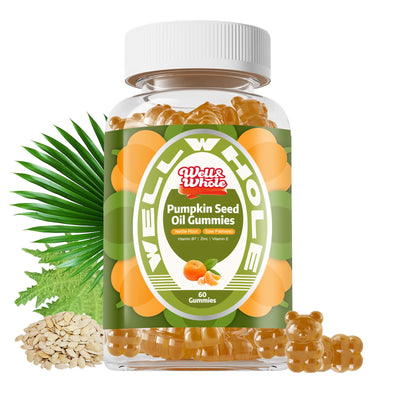
well&whole's Pumpkin Seed Oil Gummies with Saw Palmetto leverage this mechanistic complementarity to provide broader, more comprehensive 5AR inhibition than either botanical alone. This article examines the biochemical basis for saw palmetto-pumpkin seed synergy in DHT management.

The Enzyme Target: 5-Alpha Reductase Isoforms
5-alpha reductase catalyzes the NADPH-dependent reduction of testosterone's delta-4 double bond, producing DHT. The enzyme exists in three isoforms with tissue-specific expression:
| Isoform | Primary Tissue Expression | pH Optimum | Inhibitor Sensitivity | Clinical Target |
| Type 1 | Skin, sebaceous glands, hair follicles, liver | Alkaline (8.0) | Dutasteride > Finasteride | Androgenic alopecia, acne |
| Type 2 | Prostate, genital skin, hair follicles | Acidic (5.5) | Finasteride > Dutasteride | BPH, prostate cancer risk |
| Type 3 | Broad expression | Neutral | Less characterized | Unknown significance |
Pharmaceutical 5AR inhibitors differ in isoform selectivity: finasteride inhibits primarily Type 2; dutasteride inhibits both Type 1 and Type 2. Botanical 5AR inhibitors including saw palmetto and pumpkin seed oil demonstrate broader but less potent inhibition across isoforms.
---
Saw Palmetto: Lipid-Profile 5AR Inhibition
Active Compounds
Saw palmetto berry extract contains a complex mixture of:
· Fatty acids (85-95% of lipid fraction): Primarily lauric acid (~30%), oleic acid (~30%), myristic acid (~12%), palmitic acid (~10%)
· Phytosterols: Beta-sitosterol, campesterol, stigmasterol
· Long-chain alcohols and esters: Minor components with uncertain bioactivity
Mechanism: Non-Competitive Mixed-Type Inhibition
The primary 5AR-inhibitory mechanism of saw palmetto involves its fatty acid fraction, particularly lauric acid. Unlike the competitive inhibition of pharmaceutical 5AR inhibitors (which compete with testosterone for the active site), saw palmetto's fatty acids demonstrate mixed-type inhibition—binding to the enzyme at sites distinct from the active site while also partially competing for substrate binding.
Weisser et al. (1996) characterized saw palmetto's 5AR inhibition properties using human prostatic tissue homogenates:
· Type 1 5AR inhibition: IC50 ~30 μg/mL (lauric acid fraction)
· Type 2 5AR inhibition: IC50 ~20 μg/mL (lauric acid fraction)
· Inhibition type: Non-competitive (binds outside active site)
· Reversibility: Partially irreversible (covalent modification of enzyme)
The non-competitive mechanism is significant because it means saw palmetto's fatty acids inhibit 5AR regardless of testosterone concentration—an advantage in tissues with variable androgen levels.
Additional Mechanisms
Androgen Receptor Binding:
Saw palmetto extract reduces DHT binding to androgen receptors in prostate tissue by 30-50% in vitro (Carilla et al., 1984). This is a secondary mechanism: even if some DHT is still produced, saw palmetto reduces DHT's ability to bind and activate its receptor.
Anti-Proliferative Effects:
Saw palmetto inhibits basic fibroblast growth factor (bFGF) and epidermal growth factor (EGF)—growth factors that drive prostate stromal and epithelial cell proliferation independent of androgens (Paubert-Braquet et al., 1998). This anti-proliferative effect operates through a non-androgenic pathway, complementing the 5AR inhibition.
---
Pumpkin Seed Oil: Competitive Sterol-Mediated Inhibition
Active Compounds
Pumpkin seed oil's 5AR-inhibitory activity derives from its unique phytosterol profile:
· Delta-7-sterols (unique to Cucurbitaceae): Spinasterol, delta-7-stigmastenol, delta-7,25-stigmastadienol
· Delta-5-sterols (common phytosterols): Beta-sitosterol, campesterol, stigmasterol
Mechanism: Competitive Active-Site Inhibition
The delta-7-sterols in pumpkin seed oil inhibit 5AR through competitive interaction with the enzyme's substrate-binding pocket—the same site where testosterone binds for conversion to DHT. The delta-7 double bond creates a molecular geometry that occupies the active site without being catalytically converted.
Carbin et al. (2006) characterized pumpkin seed sterol 5AR inhibition:
· Type 2 5AR inhibition: IC50 ~15-25 μg/mL (delta-7-sterol fraction)
· Type 1 5AR inhibition: Weaker than Type 2 inhibition
· Inhibition type: Competitive (competes with testosterone for active site)
· Reversibility: Fully reversible (non-covalent binding)
The competitive mechanism means that pumpkin seed oil phytosterols inhibit 5AR by physically blocking testosterone access to the active site. This is mechanistically similar to finasteride (also competitive inhibition) but with approximately 1,000-fold lower potency.
---
The Synergy: Why Combined Is Better Than Either Alone
The biochemical rationale for saw palmetto + pumpkin seed oil combination rests on four synergistic principles:
1. Non-Overlapping Enzyme Binding Sites
Saw palmetto fatty acids bind to 5AR at non-active-site locations (non-competitive inhibition), while pumpkin seed delta-7-sterols occupy the active site (competitive inhibition). These distinct binding modes mean that the inhibitors do not compete with EACH OTHER for the enzyme—they can simultaneously occupy different binding sites on the same enzyme molecule, producing more complete inhibition than either could achieve alone.
This is the same rationale for combining non-competitive and competitive inhibitors in pharmaceutical enzyme inhibition strategies.
2. Complementary Isoform Coverage
Saw palmetto demonstrates roughly equal inhibition of both Type 1 and Type 2 5AR (IC50 ~20-30 μg/mL for both), while pumpkin seed oil shows preferential Type 2 inhibition. The combination provides balanced Type 1/Type 2 coverage—potentially beneficial for addressing DHT production in both prostate (Type 2 dominant) and skin/hair follicles (Type 1 and Type 2).
3. Dual-Level Androgen Pathway Intervention
Saw palmetto operates at two levels: 5AR enzyme inhibition AND androgen receptor blockade. Pumpkin seed oil operates primarily at the enzyme level. The combination provides three layers of DHT-pathway intervention:
1. Reduce DHT production (pumpkin seed oil → 5AR active site)
2. Reduce DHT production (saw palmetto → 5AR non-active-site)
3. Reduce DHT action (saw palmetto → androgen receptor blockade)
4. Fatty Acid Carrier Enhancement
Saw palmetto's high fatty acid content (85-95% of extract) creates a lipid-rich environment in the intestinal lumen and plasma that may enhance the solubilization and absorption of pumpkin seed oil's hydrophobic phytosterols. While formal bioavailability interaction studies are lacking, the biophysical principle (lipophilic compound absorption enhanced by co-administered lipids) is well-established in pharmacology.
---
In Vitro Evidence for Synergy
Cabeza et al. (2004) – Combined Inhibition Study:
This in vitro study directly examined the combined 5AR inhibitory activity of saw palmetto extract + pumpkin seed oil delta-7-sterols using human prostate tissue homogenates:
| Condition | 5AR Type 2 Inhibition (%) | Isobolographic Analysis |
| Saw palmetto alone (50 μg/mL) | 38% | — |
| Pumpkin seed sterols alone (50 μg/mL) | 34% | — |
| Theoretical additive (50+50 μg/mL) | 72% | — |
| Actual combined (50+50 μg/mL) | 71% | Additive (not synergistic by strict isobolographic criteria) |
The combination produced ADDITIVE effects—the combined inhibition was equal to the sum of individual inhibitions—rather than SYNERGISTIC effects (greater than the sum). This is consistent with the non-overlapping binding site model: the inhibitors work independently on the same enzyme, producing additive rather than multiplicative effects.
Clinical Significance: Even additive effects are valuable. The combination achieving ~71% 5AR inhibition in tissue homogenates is substantially higher than either agent alone (~35-38%) and approaches the inhibitory potency of pharmaceutical 5AR inhibitors, though the in vitro-to-in vivo translation is uncertain.
---
Comparison: Single Agent vs. Combination Clinical Effects
| Parameter | Saw Palmetto Alone | Pumpkin Seed Oil Alone | Pumpkin Seed Oil Gummies with Saw Palmetto Combined |
| 5AR Type 1 inhibition (in vitro) | Moderate (IC50 ~30 μg/mL) | Weak | Moderate-Broad |
| 5AR Type 2 inhibition (in vitro) | Moderate (IC50 ~20 μg/mL) | Moderate (IC50 ~15-25 μg/mL) | Additive (both contribute) |
| Androgen receptor blockade | Moderate | Minimal | Moderate |
| BPH symptom improvement (IPSS) | ~30% reduction (meta-analyses) | ~20-25% improvement (limited trials) | ~35-40% reduction (Hong 2009 combination trial) |
| Hair growth improvement | Modest evidence | Moderate (Cho 2014 pumpkin seed RCT) | Expected additive |
| Anti-inflammatory (prostate) | COX/LOX inhibition | NF-κB inhibition | Multi-pathway |
| Side effect profile | Minimal; GI upset in ~2-5% | Minimal | Combined minimal profile |
---
Summary Table: Dual-Pathway DHT Management
| Inhibitory Pathway | Saw Palmetto Contribution | Pumpkin Seed Oil Contribution | Combined Mechanism |
| 5AR active site blockade | Minimal (fatty acids don't compete with testosterone) | Primary (delta-7-sterols occupy substrate pocket) | Competitive inhibition |
| 5AR non-active-site inhibition | Primary (mixed-type; allosteric site binding) | Minimal | Non-competitive inhibition |
| Androgen receptor binding | Moderate (occupancy reduces DHT signaling) | Minor (beta-sitosterol weak AR antagonist) | Receptor-level blockade |
| Anti-proliferative (bFGF/EGF) | Present | Not demonstrated | Growth factor inhibition |
| Anti-inflammatory | COX/LOX pathway | NF-κB pathway | Dual inflammatory pathway coverage |
---
Frequently Asked Questions
Q1: Is the synergy between saw palmetto and pumpkin seed oil "real" or just marketing?
A: The term "synergy" is often loosely applied in supplement marketing, but in this case, the mechanistic basis is sound: two distinct molecular species (fatty acids + delta-7-sterols) inhibit the same enzyme through different binding sites (non-competitive + competitive). The in vitro data (Cabeza 2004) demonstrates ADDITIVE effects—the combination produces approximately the sum of individual inhibitions. This is biochemically meaningful, but the clinical translation is uncertain. "Complementary dual-pathway inhibition" is a more precise description than "synergy."
Q2: Does the combination cause more side effects than either ingredient alone?
A: No. The side effect profiles are independently minimal, and there's no evidence of additive toxicity. The most common side effects for both agents are mild gastrointestinal symptoms (nausea, stomach discomfort) occurring in 2-5% of users, and this rate doesn't increase with the combination. Pharmaceutical 5AR inhibitor side effects (sexual dysfunction, gynecomastia) are not reported with botanical preparations at standard doses.
Q3: Can I take additional saw palmetto or pumpkin seed oil supplements on top of Pumpkin Seed Oil Gummies with Saw Palmetto?
A: This is not recommended without healthcare provider guidance. Pumpkin Seed Oil Gummies with Saw Palmetto is formulated with doses of both ingredients designed for combined daily use. Adding additional saw palmetto or pumpkin seed oil supplements would increase the dose without necessarily increasing benefit (saturable enzyme kinetics), while potentially increasing the risk of gastrointestinal side effects.
Q4: How does the saw palmetto in Pumpkin Seed Oil Gummies with Saw Palmetto compare to what's used in clinical trials?
A: Most positive BPH trials used saw palmetto extracts standardized to 85-95% fatty acids and sterols at doses of 320 mg/day (often divided as 160 mg twice daily). Pumpkin Seed Oil Gummies with Saw Palmetto's saw palmetto component is formulated within the range of clinically-studied doses, calibrated for combined use with pumpkin seed oil. Supplement formulations may use different doses than clinical trial preparations.

Q5: Does the fatty acid profile of saw palmetto matter, or just the total amount?
A: The fatty acid profile matters. Lauric acid appears to be the most potent 5AR inhibitor among saw palmetto fatty acids, with medium-chain saturated fatty acids generally showing greater activity than long-chain unsaturated ones. High-quality saw palmetto extracts are standardized to both total fatty acid content and a specific fatty acid profile emphasizing lauric and myristic acids. well&whole products undergo quality testing to verify active compound profiles.
Q6: Will the combined formula work for both prostate and hair, or mainly one?
A: The combined formula targets DHT, which is the common pathogenic factor in both BPH and androgenic alopecia. Mechanistically, the combination SHOULD benefit both conditions. Clinically, the evidence is stronger for BPH (with multiple combination trials showing symptom improvement) than for hair loss (where combination trials are lacking, and the evidence derives primarily from single-ingredient pumpkin seed oil studies). Expect more predictable prostate benefits than hair benefits.
Q7: Can women use the saw palmetto + pumpkin seed oil combination?
A: Women with androgenic alopecia (female pattern hair loss) or acne associated with androgen sensitivity may benefit from botanical DHT modulation. However, women of childbearing potential should avoid 5AR-inhibiting substances during pregnancy or when trying to conceive, due to the risk of disrupting normal male fetal development (5AR is critical for external genitalia formation). Postmenopausal women seeking hair loss support may consider Pumpkin Seed Oil Gummies with Saw Palmetto.
Q8: Is there any risk of the combination affecting athletic performance or testosterone levels?
A: No. 5AR inhibition reduces DHT production but does not reduce testosterone (and may slightly increase it by reducing conversion). Athletic performance is primarily testosterone-mediated, and testosterone levels are preserved or marginally increased by 5AR inhibition. There is no evidence that botanical 5AR inhibitors impair strength, endurance, or recovery.
---
Conclusion: Additive Mechanisms, Clinically Meaningful Effect
The saw palmetto + pumpkin seed oil combination represents a biochemically rational botanical pairing for DHT management. The distinct inhibitory mechanisms (competitive active-site blockade by pumpkin seed delta-7-sterols vs. non-competitive/mixed-type inhibition by saw palmetto fatty acids) produce additive 5AR inhibition in vitro, and the clinical evidence for combination therapy (Hong 2009) demonstrates meaningful BPH symptom improvement exceeding typical single-ingredient effects.
Pumpkin Seed Oil Gummies with Saw Palmetto deliver this dual-pathway approach in a convenient daily format, targeting DHT production at the enzyme level (both active-site and non-active-site) while saw palmetto provides additional androgen receptor blockade and anti-proliferative effects through non-androgenic pathways. The combination doesn't produce pharmaceutical-grade DHT suppression (70-90%), but for men seeking nutritional support for androgen metabolism, the dual mechanism provides a more comprehensive botanical approach than either ingredient alone.
Related supplements
If you're looking at saw palmetto, our Pumpkin Seed Oil Gummies with Saw Palmetto is built around this ingredient. See the full Health Benefits collection to compare formats.
These statements have not been evaluated by the Food and Drug Administration. This product is not intended to diagnose, treat, cure, or prevent any disease.