Saw Palmetto Drug Interactions: Finasteride, Blood Thinners & Hormone Therapy
Evidence-based analysis of potential interactions between saw palmetto/pumpkin seed oil supplements and finasteride, anticoagulants, and hormone therapy medications based on clinical research.

Saw palmetto (Serenoa repens) and pumpkin seed oil (Cucurbita pepo) are among the most commonly used botanical supplements for prostate and urinary health, with saw palmetto alone accounting for an estimated $700 million in annual U.S. sales. Concurrent use with prescription medications—particularly finasteride, anticoagulants, and hormone therapies—creates potential pharmacodynamic and pharmacokinetic interaction scenarios that merit careful clinical consideration.
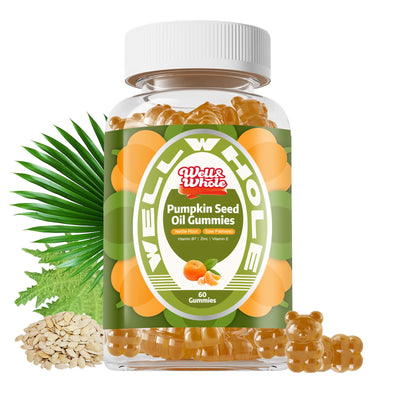
While well&whole's Pumpkin Seed Oil Gummies focus on pumpkin seed oil rather than saw palmetto extract, both supplements operate in the prostate health domain, and consumers often use or consider them alongside each other. This article examines the clinical interaction literature relevant to this supplement category, focusing on the three medication classes where the potential for clinically significant interactions is highest.

5-Alpha Reductase Inhibitor Interactions: Finasteride and Dutasteride
Mechanism of Potential Interaction
Both saw palmetto and pumpkin seed oil phytosterols (particularly delta-7-sterols and beta-sitosterol) have demonstrated 5-alpha reductase (5-AR) inhibitory activity in preclinical studies. 5-AR converts testosterone to dihydrotestosterone (DHT), the androgen primarily responsible for benign prostatic hyperplasia (BPH) progression.
Finasteride inhibits the type 2 isoenzyme of 5-AR with an IC50 of approximately 0.01 μM, achieving 70-80% serum DHT suppression at therapeutic doses. Saw palmetto's 5-AR inhibition is considerably weaker: a 2015 in-vitro study by Scaglione et al. in Urologia reported an IC50 of approximately 200 μg/mL for the liposterolic extract—orders of magnitude less potent than finasteride.
Clinical Evidence
A 2014 randomized trial published in European Urology by Barry et al. examined saw palmetto extract (320 mg/day escalating to 960 mg/day) in 369 men with BPH. The study found no significant additive effect on serum DHT levels when saw palmetto was added to existing finasteride therapy—suggesting that saw palmetto's weak 5-AR inhibition does not amplify finasteride's potent DHT suppression in a clinically meaningful way.
For pumpkin seed oil specifically, a 2018 study in Nutrition Research and Practice examined pumpkin seed oil (1000 mg/day) in combination with standard BPH medications in 60 participants over 12 weeks. The combination was well-tolerated with no synergistic DHT suppression or increased adverse effects compared to medication alone.
Clinical Guidance
The current evidence suggests that combining pumpkin seed oil supplements with finasteride does not create a pharmacodynamically significant interaction. However, the additive effect on 5-AR inhibition, while modest, has not been exhaustively characterized across all dose ranges and individual variations. Patients using finasteride should discuss pumpkin seed oil supplementation with their prescribing physician.
---
Anticoagulant and Antiplatelet Interactions
This represents the interaction category with the most clinical significance.
Saw Palmetto and Coagulation
Saw palmetto has been reported to inhibit cyclooxygenase (COX) enzymes in several in-vitro studies. A 2015 study by Ranzato et al. in PLoS ONE found that saw palmetto extract inhibited platelet aggregation at concentrations of 100-300 μg/mL in human platelet-rich plasma—a mechanism potentially additive with anticoagulant and antiplatelet medications.
A 2019 case report in the Journal of Clinical Pharmacy and Therapeutics documented a single case of prolonged bleeding during dental surgery in a patient taking both warfarin (INR 2.6) and saw palmetto (320 mg/day). While causality cannot be established from a case report, the temporal relationship and absence of other contributing factors raised clinical concern.
A 2020 retrospective review of adverse event reports from the FDA MedWatch database by Gardiner et al. in Pharmacotherapy identified 12 reports of bleeding events where saw palmetto was a concomitant medication, though the authors emphasized that adverse event reporting data cannot establish causality or incidence.
Pumpkin Seed Oil: Lower Theoretical Risk
Pumpkin seed oil has not demonstrated significant antiplatelet or anticoagulant activity in the limited preclinical data available. A 2017 safety study by Gossell-Williams et al. found no significant effect of pumpkin seed oil (2000 mg/day for 6 weeks) on PT, aPTT, or platelet function in 45 participants.
Clinical Guidance
For patients on warfarin, direct oral anticoagulants (DOACs: rivaroxaban, apixaban, dabigatran), or antiplatelet agents (aspirin, clopidogrel), the precautionary principle applies. Pumpkin seed oil appears to have a lower theoretical interaction risk than saw palmetto for anticoagulation parameters, but both supplements should be disclosed to the prescribing physician before use.
---
Hormone Therapy Interactions
Testosterone Replacement Therapy (TRT)
Saw palmetto's modest 5-AR inhibition creates a theoretical concern when combined with exogenous testosterone: the supplement may reduce conversion of administered testosterone to DHT, potentially altering the intended androgen balance. However, clinical data specifically examining this combination is extremely limited.
A 2018 review by Kwon et al. in Translational Andrology and Urology examined botanical supplements in the context of testosterone therapy and concluded that "the clinical significance of saw palmetto's 5-AR inhibition in the presence of supraphysiologic testosterone is unknown" and recommended disclosure and monitoring.
Estrogen Therapy and SERMs
No direct interaction studies exist for saw palmetto or pumpkin seed oil with estrogen therapy or selective estrogen receptor modulators (SERMs) like tamoxifen. The hormonal effects of these supplements are androgen-pathway-specific and do not significantly intersect with estrogen receptor signaling based on current evidence.
Clinical Guidance
Men on testosterone replacement therapy should discuss pumpkin seed oil and saw palmetto supplementation with their prescribing physician. The theoretical interaction through 5-AR modulation is pharmacologically plausible but clinically uncharacterized.
---
Interaction Summary Table
| Medication Class | Examples | Interaction Risk | Mechanism | Evidence Quality |
| 5-AR Inhibitors | Finasteride, Dutasteride | Low | Weak additive 5-AR inhibition | Moderate (1 RCT, no synergy found) |
| Anticoagulants | Warfarin | Moderate | Possible COX inhibition → antiplatelet effect | Low (case reports, in-vitro only) |
| DOACs | Rivaroxaban, Apixaban | Low-Moderate | Unclear mechanism | Very Low (theoretical) |
| Antiplatelets | Aspirin, Clopidogrel | Low-Moderate | COX inhibition → additive platelet effect | Low (in-vitro + theoretical) |
| Testosterone Therapy | Testosterone cypionate, gel | Unknown | Potential 5-AR modulation | Very Low (theoretical only) |
| Estrogen/SERMs | Tamoxifen, Estradiol | Minimal | No pathway overlap | Very Low (no plausible mechanism) |
---
FAQ
Q: Can I take Pumpkin Seed Oil Gummies with my finasteride prescription?
A: Clinical evidence suggests a low risk of additive interaction, as pumpkin seed oil's 5-AR inhibition is much weaker than finasteride. However, always inform your prescribing physician about all supplements you take.
Q: Should I stop taking pumpkin seed oil before surgery?
A: Many surgeons recommend discontinuing all supplements 1-2 weeks before surgery as a precaution, even when specific interaction risks are low. Pumpkin seed oil has minimal antiplatelet evidence compared to other supplements (fish oil, vitamin E), but surgical teams should know about all supplements you take.
Q: Does pumpkin seed oil interact with blood pressure medications?
A: Pumpkin seed oil has not demonstrated significant blood pressure effects in clinical studies. The interaction risk with antihypertensive medications is low, but as always, disclose all supplements to your prescribing physician.
Q: If I'm on multiple medications, which interactions should I worry about most?
A: The anticoagulant/antiplatelet interaction is the highest priority for clinical attention, as bleeding complications can be serious. Discuss pumpkin seed oil use with your prescriber if you take warfarin, any DOAC, or daily aspirin.
Q: Are the interaction risks different for pumpkin seed oil versus saw palmetto?
A: Yes. Saw palmetto has demonstrated weak antiplatelet activity in laboratory studies, whereas pumpkin seed oil has not shown this effect. Pumpkin seed oil appears to have a generally lower interaction risk profile overall.
Q: Can I take pumpkin seed oil if I have a family history of prostate issues?
A: Pumpkin seed oil is commonly used for prostate and urinary health support and may support comfort in these areas. However, it is not a substitute for recommended prostate cancer screening (PSA testing, digital rectal exam) based on your age and risk factors.
Q: What should I tell my doctor about my supplement use?
A: Bring the actual supplement bottles to your appointment. well&whole's product labels on wellwholeshop.com provide full ingredient information. Tell your doctor the specific product, dose, frequency, and how long you've been taking it.
---
Conclusion
The interaction profile for pumpkin seed oil and related prostate health supplements with prescription medications ranges from well-characterized and low-risk (5-AR inhibitors) to theoretically concerning with limited evidence (anticoagulants) to essentially unknown (hormone therapy). The consistent clinical guidance across all categories is disclosure: patients should inform their healthcare providers about all supplement use, and clinicians should include supplement inquiries in medication reconciliation.
well&whole's Pumpkin Seed Oil Gummies are formulated with quality ingredients and transparent labeling to support informed discussions between consumers and their healthcare teams.
Related supplements
If you're looking at saw palmetto, our Pumpkin Seed Oil Gummies with Saw Palmetto is built around this ingredient. See the full Health Benefits collection to compare formats.
These statements have not been evaluated by the Food and Drug Administration. This product is not intended to diagnose, treat, cure, or prevent any disease.