Pumpkin Seed Oil + Saw Palmetto for Hair Growth: Complete Guide
Discover the science behind pumpkin seed oil and saw palmetto for hair growth. Learn how these natural DHT-blockers support thicker, healthier hair.

Hair thinning affects millions of men and women—and the search for effective, natural solutions has led many to two botanicals with growing research backing: pumpkin seed oil and saw palmetto. Both target the same underlying mechanism—dihydrotestosterone (DHT), the hormone derivative most closely associated with androgenetic alopecia (pattern hair loss)—but through different pathways that may complement each other when combined.
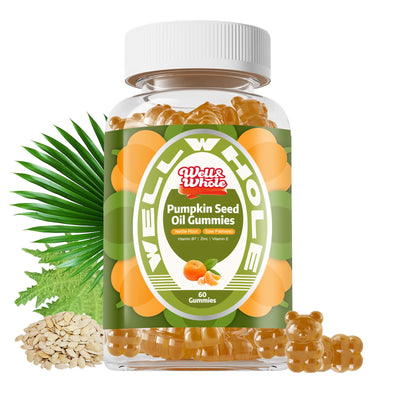
Pumpkin Seed Oil Gummies with Saw Palmetto deliver both compounds in a convenient gummy format designed for daily hair growth support.
This complete guide examines the science behind pumpkin seed oil and saw palmetto for hair growth, their mechanisms of action, clinical evidence, and how they work together in a dual-ingredient formula.
Understanding Hair Loss and DHT
Androgenetic Alopecia: The DHT Connection
Androgenetic alopecia (pattern hair loss) is the most common form of hair loss, affecting approximately 50% of men over 50 and a significant percentage of women. The primary driver is DHT (dihydrotestosterone)—a potent androgen derived from testosterone through the action of 5-alpha-reductase enzyme.
How DHT Causes Hair Thinning:
1. **Testosterone → DHT**: The enzyme 5-alpha-reductase (type II) converts testosterone to DHT, primarily in the scalp, prostate, and skin
2. **DHT binds to follicle receptors**: Hair follicles in genetically susceptible individuals have androgen receptors that DHT binds to
3. **Follicle miniaturization**: DHT binding triggers a progressive shrinking (miniaturization) of hair follicles over successive growth cycles
4. **Hair cycle disruption**: Miniaturized follicles produce thinner, shorter hairs and spend less time in the growth (anagen) phase
5. **Progressive thinning**: Over years, affected follicles may eventually stop producing visible hairs
This is why the most common pharmaceutical hair loss treatments—finasteride and dutasteride—are 5-alpha-reductase inhibitors. They reduce DHT production by blocking the enzyme that creates it.
Natural 5-Alpha-Reductase Inhibitors
Pumpkin seed oil and saw palmetto are both natural 5-alpha-reductase inhibitors—they reduce DHT production through the same enzymatic pathway as pharmaceutical treatments, but with different potency and selectivity profiles. This makes them attractive alternatives for those seeking natural approaches or who experience side effects from pharmaceutical DHT blockers.
Pumpkin Seed Oil: The Nutrient-Dense DHT Blocker
What Is Pumpkin Seed Oil?
Pumpkin seed oil (also called pepita oil) is extracted from the seeds of Cucurbita pepo (pumpkin). It has been used in traditional medicine across Eastern Europe, the Middle East, and North America for centuries—particularly in prostate health formulations, which share the DHT mechanism with hair loss.
Composition
Pumpkin seed oil contains a complex mixture of bioactive compounds:
| Compound | Content | Hair-Relevance |
|----------|---------|----------------|
| Phytosterols (β-sitosterol) | Significant | 5-alpha-reductase inhibition |
| Delta-7 sterols | Unique to pumpkin seeds | DHT pathway modulation |
| Zinc | Moderate | Hair follicle health; anti-androgenic |
| Essential fatty acids | High (linoleic, oleic) | Scalp health; inflammation reduction |
| Vitamin E | Moderate | Antioxidant; follicle protection |
| Vitamin A | Moderate | Cell differentiation; follicle function |
| L-tryptophan | Present | Serotonin precursor; stress reduction |
| Selenium | Trace | Antioxidant; thyroid support |
Mechanism of Action for Hair Growth
Pumpkin seed oil addresses hair thinning through multiple pathways:
1. 5-Alpha-Reductase Inhibition
The phytosterols in pumpkin seed oil (particularly β-sitosterol and delta-7 sterols) have demonstrated 5-alpha-reductase inhibitory activity. A study in the *Journal of Andrology* found that pumpkin seed extract inhibited 5-alpha-reductase activity, reducing DHT production (1).
2. Anti-Inflammatory Action
Chronic inflammation in the scalp can impair follicle function and accelerate miniaturization. Pumpkin seed oil's essential fatty acids (particularly linoleic acid) have well-documented anti-inflammatory properties that may help maintain a healthier scalp environment.
3. Nutrient Delivery
Zinc, vitamin E, vitamin A, and selenium in pumpkin seed oil provide direct nutritional support for hair follicles. Zinc is particularly important—it's involved in hair tissue growth and repair, and zinc deficiency is associated with hair loss.
4. Antioxidant Protection
Oxidative stress in the scalp environment has been implicated in hair follicle dysfunction. Pumpkin seed oil's antioxidant compounds (vitamin E, selenium, various polyphenols) help protect follicle cells from free radical damage.
Clinical Evidence for Hair Growth
A landmark study published in *Evidence-Based Complementary and Alternative Medicine* investigated pumpkin seed oil supplementation for hair growth in men with androgenetic alopecia. In this randomized, double-blind, placebo-controlled trial:
- Participants taking pumpkin seed oil (400 mg/day) for 24 weeks showed a 40% increase in hair count compared to placebo
- The treatment group also showed improvements in hair thickness
- No significant side effects were reported (2)
This study provided the first robust clinical evidence that pumpkin seed oil supplementation could support hair regrowth, though the sample size was modest and longer-term studies are needed.
Saw Palmetto: The Traditional DHT Modulator
What Is Saw Palmetto?
Saw palmetto (Serenoa repens) is a small palm native to the southeastern United States. Its berry extract has been used for centuries—first by Native American tribes and later by European settlers—for urogenital health. Modern research has focused primarily on its prostate health benefits, but the same DHT-modulating mechanism that makes it relevant for prostate health also applies to hair loss.
Composition
Saw palmetto berry extract contains:
| Compound | Content | Hair-Relevance |
|----------|---------|----------------|
| Free fatty acids (lauric, oleic, myristic) | 70-95% of lipid extract | 5-alpha-reductase inhibition |
| Phytosterols (β-sitosterol) | Moderate | DHT pathway modulation |
| Flavonoids | Moderate | Anti-inflammatory; antioxidant |
| Polysaccharides | Trace | Immune modulation |
Mechanism of Action for Hair Growth
1. 5-Alpha-Reductase Inhibition
Saw palmetto's fatty acids (particularly lauric acid and myristic acid) are potent inhibitors of 5-alpha-reductase. A study in the *Journal of Steroid Biochemistry and Molecular Biology* demonstrated that saw palmetto liposterolic extract inhibited both type I and type II 5-alpha-reductase, reducing DHT production (3).
2. Androgen Receptor Binding
Some research suggests that saw palmetto compounds may also compete with DHT for binding to androgen receptors on hair follicles, providing a second layer of DHT pathway modulation—blocking both DHT production and DHT action.
3. Anti-Inflammatory Action
Saw palmetto's flavonoids and fatty acids have anti-inflammatory properties that may help maintain a healthy scalp environment, reducing inflammatory mediators that can impair follicle function.
Clinical Evidence for Hair Growth
A study published in the *Journal of Alternative and Complementary Medicine* examined saw palmetto extract for hair loss in men with androgenetic alopecia. Over the study period, approximately 60% of participants showed improvements in hair growth and quality, though the results were less dramatic than pharmaceutical finasteride (4).
Another study in *Phytomedicine* compared saw palmetto to finasteride and found that while finasteride produced more significant results, saw palmetto showed measurable improvement with fewer reported side effects (5).
The Combination: Why Both Together?
Complementary DHT Pathway Coverage
Pumpkin seed oil and saw palmetto address the DHT pathway through overlapping but distinct mechanisms:
| Mechanism | Pumpkin Seed Oil | Saw Palmetto |
|-----------|-----------------|--------------|
| 5αR type II inhibition | Yes (phytosterols) | Yes (free fatty acids) |
| 5αR type I inhibition | Limited | Yes (fatty acids) |
| Androgen receptor competition | Limited | Possible |
| Nutrient delivery (zinc, vitamins) | Yes | No |
| Anti-inflammatory | Yes (EFAs) | Yes (flavonoids, fatty acids) |
| Antioxidant | Yes (vitamin E, selenium) | Yes (flavonoids) |
The combination covers both types of 5-alpha-reductase (type I and type II), provides direct nutritional support for follicles (from pumpkin seed oil), and offers multi-pathway anti-inflammatory and antioxidant protection.
Synergistic Potential
While no clinical trials have specifically tested the combination of pumpkin seed oil + saw palmetto for hair growth, the theoretical rationale is strong:
- **More complete 5αR inhibition**: Saw palmetto's fatty acids inhibit both type I and type II; pumpkin seed oil's phytosterols add type II inhibition
- **Dual DHT action**: Saw palmetto may compete for androgen receptor binding; pumpkin seed oil reduces DHT production
- **Nutritional complement**: Pumpkin seed oil provides zinc, vitamins, and minerals that saw palmetto doesn't
- **Anti-inflammatory complement**: Both offer anti-inflammatory support through different compound classes
The Gummy Format Advantage
Pumpkin Seed Oil Gummies with Saw Palmetto deliver both compounds in a format that addresses common supplementation challenges:
- **Oil taste**: Pumpkin seed oil has a distinct, somewhat nutty flavor that some find unpleasant in liquid form. Gummies mask this effectively.
- **Consistency**: Hair growth supplements require months of consistent daily use. Gummies make this easier and more enjoyable.
- **Pre-measured dosing**: Each gummy provides a consistent amount of both compounds.
- **No messy oils**: Liquid pumpkin seed oil can be difficult to measure and consume; gummies eliminate this hassle.
How to Use Pumpkin Seed Oil + Saw Palmetto for Hair Growth
Realistic Timeline
Hair growth is slow. Anagen (growth) phase hairs grow approximately 0.3-0.4 mm per day, or about 1 cm per month. Realistic expectations:
- **1-3 months**: May notice reduced shedding; existing hair may feel stronger
- **3-6 months**: Some users report visible improvements in hair density and thickness
- **6-12 months**: More noticeable results for consistent users; new growth may become visible
- **12+ months**: Maximum benefit assessment; continued use maintains results
Supporting Practices
Supplements work best when combined with supportive practices:
- **Scalp massage**: 5 minutes daily may improve blood flow to follicles
- **Reduce heat styling**: Minimize damage to existing hairs
- **Gentle hair care**: Use sulfate-free shampoo; avoid tight hairstyles
- **Nutrient-rich diet**: Ensure adequate protein, iron, zinc, and B vitamins
- **Stress management**: Stress hormones can accelerate hair thinning
- **Sleep**: Adequate sleep supports all regenerative processes
Precautions
- **Hormone-sensitive conditions**: DHT-modulating supplements should be used cautiously by individuals with hormone-sensitive conditions; consult your healthcare provider
- **Women of childbearing age**: Saw palmetto may affect hormone levels; consult your doctor
- **Medication interactions**: Saw palmetto may interact with hormone therapies, blood thinners, and certain medications
- **Prostate monitoring**: Men should continue regular prostate screenings regardless of saw palmetto use
FAQ
Q1: Does pumpkin seed oil really help with hair growth?
A clinical study found that pumpkin seed oil supplementation (400 mg/day for 24 weeks) produced a 40% increase in hair count in men with androgenetic alopecia compared to placebo. Results are promising but based on a single study with a modest sample size.
Q2: How does saw palmetto compare to finasteride for hair loss?
Saw palmetto has shown measurable but less dramatic results compared to finasteride in comparative studies. It offers a natural alternative with fewer reported side effects, though finasteride remains more effective in clinical comparisons.
Q3: Can women take pumpkin seed oil + saw palmetto for hair thinning?
Women can use pumpkin seed oil for hair support without significant concerns. Saw palmetto should be used cautiously by women—particularly those of childbearing age or on hormone therapies—as it may affect hormone levels. Consult your healthcare provider.
Q4: How long before I see results?
Hair growth supplements require consistent daily use for months. Reduced shedding may be noticed within 1-3 months. Visible density improvements typically take 3-6 months or longer. Maximum assessment requires 12+ months of consistent use.
Q5: Can I combine these gummies with topical treatments?
Yes. well&whole Pumpkin Seed Oil Gummies with Saw Palmetto address DHT systemically (from inside), while topical treatments like minoxidil address follicle stimulation locally (from outside). Internal + external approaches may be complementary.
Q6: Will these gummies affect my testosterone levels?
Pumpkin seed oil and saw palmetto primarily reduce DHT (a derivative of testosterone) rather than reducing testosterone itself. Some studies show that saw palmetto may slightly increase testosterone by reducing its conversion to DHT, but significant testosterone changes are uncommon at supplement doses.
Q7: Do I need to take these forever?
Hair growth supplements address ongoing DHT activity, which continues throughout life. Stopping supplementation may allow DHT-driven thinning to resume. Most users who see results continue supplementation for maintenance.
Q8: Is there a difference between pumpkin seed oil supplements and eating pumpkin seeds?
Eating pumpkin seeds provides the oil's compounds along with fiber and additional nutrients. However, the oil extract delivers a concentrated dose of the phytosterols and fatty acids most relevant to DHT inhibition, in a more practical daily dose than eating large quantities of seeds.
Conclusion
Pumpkin seed oil and saw palmetto represent two of the most promising natural compounds for hair growth support, both targeting DHT—the primary driver of pattern hair loss—through complementary mechanisms. Pumpkin seed oil provides 5-alpha-reductase inhibition plus direct nutritional support for follicles, while saw palmetto offers broader 5-alpha-reductase inhibition plus potential androgen receptor competition.
Pumpkin Seed Oil Gummies with Saw Palmetto combine both compounds in a convenient, enjoyable format designed for the months of consistent daily use that hair growth support requires.
Take them daily, combine with scalp care and a nutrient-rich diet, and give them at least 6 months before evaluating results. Hair growth is gradual—but with consistent, multi-pathway DHT support, the patience may pay off.
Ready to support your hair from the inside out? Try well&whole Pumpkin Seed Oil Gummies with Saw Palmetto].
Related supplements
Where to begin? Our Lymphatic Drainage Supplements Gummies with Echinacea Dandelion Burdock for Adults with Immune and Energy Support and Sulforaphane Broccoli Supplement Liquid Drops for Kids with Sulforaphane, Glucoraphanin, Bacopa Monnieri are a sensible place to start, and the Immune Support collection lays out the other formats side by side with Health Benefits.
These statements have not been evaluated by the Food and Drug Administration. This product is not intended to diagnose, treat, cure, or prevent any disease.