Picky Eating and Multivitamins: When They Actually Help

A child's multivitamin is usually a backstop, not a strategy. Picky eating is a normal phase for most kids, and the most reliable signals of trouble are a shrinking variety of accepted foods, a flattening growth curve, or low iron on a blood test — not the size of the plate. Use food variety, growth, and iron status as your real decision tools; reach for a multivitamin only when those inputs suggest a real gap.
Why picky eating is usually not a nutritional crisis
Toddlers and preschoolers go through a well-documented neophobic phase where new foods are rejected on sight, and that is the developmental norm rather than a warning sign. Most children cycle through 20 to 30 accepted foods at any given time, and the size of that list is a more useful number than any single meal. Appetite also dips between ages two and four, so a child who eats half a sandwich at lunch and refuses dinner is rarely failing to grow. Most pediatric dietitians set the bar for concern at three to four concurrent months where variety has shrunk to fewer than 15 foods, weight has plateaued, or the same texture group is rejected across meals.
The food-variety check: a simple weekly tally
Write down every distinct food a child accepts over a week — not every bite, but every distinct fruit, vegetable, protein, grain, and dairy that crosses their lips without a fight. Count the unique items, not the total servings. A reasonable target for a school-aged child is roughly 30 distinct foods per week, with at least five vegetables and three fruits represented. If the weekly tally is dropping, the answer is almost always more low-pressure exposure — repeated offerings of the same vegetable on different days, family-style serving, and parent modeling — rather than a multivitamin, which cannot fix a narrow food environment on its own.
Growth and iron: the two objective signals
Pediatric offices track weight-for-age and height-for-age on a percentile grid, and what matters is the slope, not the percentile itself. A child who has tracked steadily along the 25th percentile is doing fine; a child who has dropped two percentile lines in six months is not. Iron deserves special attention because it is the most common true deficiency in picky eaters, especially in toddlers who drink more than 16 ounces of milk per day. A screening ferritin and complete blood count around age two and again at school entry is reasonable; if ferritin comes back low, an iron supplement is more targeted than a multivitamin and the response is much easier to measure on follow-up labs.
When a multivitamin actually helps
A daily children's multivitamin is reasonable insurance in three scenarios: a child whose accepted food list is genuinely narrow (under 15 foods across all groups), a child in a household where one or more food groups are systematically excluded for cultural or allergy reasons (a dairy-free home where the child also rejects fortified plant milks, for example), or a child who travels, gets sick often, or has very unpredictable appetite week to week. Outside those cases, the marginal benefit of a multivitamin over a varied diet is small, and the marginal downside — chalky chewables, food-dye reactions, and an inflated sense of being covered — is real.
Common pitfalls: what to avoid
The single most common mistake is using a multivitamin to negotiate meals. That short-circuits the actual goal, which is more exposure to real food. The second is dosing by gummy count rather than by age band; many children's gummies are dosed for kids four and up, and a two-year-old can be getting meaningful fat-soluble vitamins in a single gummy. The third is choosing a gummy with no iron at all, which makes the multivitamin a very expensive vitamin D and B12 supplement with a small amount of vitamin C. None of these are reasons to avoid a multivitamin, but they are reasons to read the label.
How to pick a kid's multivitamin
Look for three things. First, the dose should match the age band on the label and should not exceed the daily upper limit for fat-soluble vitamins. Second, iron, if included, should be in a form tolerable on an empty stomach — ferrous bisglycinate is easier on the gut than ferrous sulfate. Third, the form factor should be one your child will actually take every day — a gummy that gets chewed in 30 seconds beats a syrup that sits in the cabinet. Skip products that load up on probiotics, herbal blends, or focus blends at this age; a multivitamin should be a multivitamin.
Key takeaways
- Picky eating is normal until it is sustained, narrow, and growth-flattening — usually 3+ months.
- Variety count (at least 30 per week) and ferritin screening beat any multivitamin for catching real gaps.
- Reach for a multivitamin as insurance when variety is genuinely narrow or one food group is structurally excluded.
- Iron from a targeted supplement is the more useful tool than a multivitamin when ferritin is low.
- Avoid gummy-as-bargaining and skip focus blends in products aimed at kids.
Frequently asked questions
At what age should a child start a multivitamin?
There is no fixed age. Most pediatric dietitians only recommend a daily multivitamin when there is a documented gap — narrow variety, growth flattening, dietary exclusion, or a confirmed low ferritin or vitamin D. For kids who eat a varied diet and grow on their curve, a multivitamin adds little.
Are gummy vitamins as good as tablets or liquids?
For water-soluble vitamins like B complex and vitamin C, gummies work comparably. For iron and fat-soluble vitamins A, D, E, and K, gummies often under-dose because the format limits how much can be packed into a chewable. If iron is the goal, a liquid or chewable ferrous bisglycinate is more reliable.
How long before a multivitamin shows results?
A multivitamin is rarely the thing that needs to show results. If a child is genuinely deficient in iron, vitamin D, or B12, a targeted single-nutrient supplement is faster and measurable on a blood test within three to six months. A multivitamin is background insurance, not a treatment.
Can a child overdose on a multivitamin?
Yes, on fat-soluble vitamins (especially vitamin A) and iron if gummies are eaten in handfuls. Treat multivitamins like medication: stored out of reach, dosed once daily by an adult, and never as needed. If a child eats a full bottle, contact poison control — iron and vitamin A are the acute concerns.
Related supplements
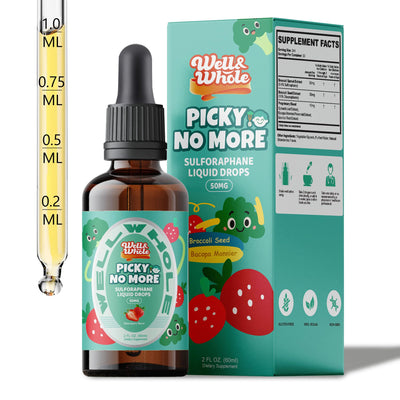
Putting it simply: if this is something you want to add to your routine, our Kids’ Black Walnut Digestive Support Drops, 14-in-1 Herbal Formula, Mixed Berry, Ages 1+, 2 fl oz and Sulforaphane Broccoli Supplement Liquid Drops for Kids with Sulforaphane, Glucoraphanin, Bacopa Monnieri are a good place to start. The wider Immune Support collection is worth a look, and the Digestive Support range covers related formats.
These statements have not been evaluated by the Food and Drug Administration. This product is not intended to diagnose, treat, cure, or prevent any disease. Talk to a healthcare professional before starting any new supplement, especially if you are pregnant, nursing, taking medication, or managing a health condition.
These statements have not been evaluated by the Food and Drug Administration. This product is not intended to diagnose, treat, cure, or prevent any disease.