Mucuna Pruriens: The Dopamine Herb Complete Guide
Discover Mucuna pruriens, the herb naturally containing L-Dopa. Learn how it may support dopamine production, mood, motivation, and brain health.

In the world of natural nootropics and brain health supplements, few ingredients have generated as much scientific interest as Mucuna pruriens. This tropical legume, also known as velvet bean, cowhage, or kapikacchu, has been used in traditional Ayurvedic medicine for centuries. Its claim to fame? It naturally contains L-Dopa (levodopa)—the direct precursor to dopamine, one of the brain's most important neurotransmitters.
Dopamine is often called the "feel-good" neurotransmitter, but its role goes far beyond pleasure. It drives motivation, focus, motor control, mood regulation, and cognitive function. When dopamine levels are optimal, we feel driven, alert, and emotionally balanced. When they're low, we may experience apathy, poor concentration, low mood, and reduced motivation.
This comprehensive guide explores the science of Mucuna pruriens, its L-Dopa content, how it works in the brain, potential benefits, safety considerations, and how to choose a quality supplement.
What Is Mucuna Pruriens?
Botanical Background
Mucuna pruriens is a tropical legume native to Africa and tropical Asia. It's a climbing shrub that produces pods covered in stinging hairs—hence the nickname "cowhage" (from the Hindi word "kawanch"). Despite its prickly exterior, the seeds inside the pods are a nutritional powerhouse, containing high concentrations of L-Dopa along with other bioactive compounds.
Traditional Use
In Ayurvedic medicine, Mucuna pruriens has been used for over a thousand years under the name "kapikacchu." Traditional applications included:
- Supporting nervous system health
- Promoting vitality and reproductive health
- Supporting mood and emotional balance
- Enhancing physical strength and endurance
Modern science has confirmed that many of these traditional uses align with Mucuna's L-Dopa content and its effects on dopamine pathways.
Modern Rediscovery
Western medicine identified L-Dopa from Mucuna pruriens in the 1930s. By the 1960s, synthetic L-Dopa became a breakthrough treatment for Parkinson's disease—a condition characterized by the loss of dopamine-producing neurons. Today, Mucuna pruriens supplements are used by healthy individuals seeking natural dopamine support for mood, motivation, and cognitive performance.
Understanding Dopamine: The Motivation Molecule
What Dopamine Does
Dopamine is a neurotransmitter—a chemical messenger that transmits signals between neurons. It's produced in several areas of the brain, including the substantia nigra and the ventral tegmental area. Dopamine serves multiple critical functions:
1. **Motivation and reward**: Dopamine is the brain's primary reward signal. It drives us to seek food, achievement, social connection, and other rewarding experiences. Research published in *Neuron* demonstrated that dopamine neurons fire not just when we receive a reward, but when we anticipate one—driving motivation.
2. **Motor control**: Dopamine is essential for smooth, coordinated muscle movements. The loss of dopamine-producing neurons in the substantia nigra is the primary cause of Parkinson's disease symptoms.
3. **Focus and attention**: Dopamine helps regulate attention and cognitive focus. Medications that increase dopamine signaling are commonly used for attention deficit conditions.
4. **Mood regulation**: While serotonin often gets the spotlight for mood, dopamine plays an equally important role. Low dopamine is associated with anhedonia—the inability to feel pleasure—as well as low motivation and depressive symptoms.
5. **Learning and memory**: Dopamine signals help the brain encode which behaviors and experiences are worth repeating. It's essential for reinforcement learning.
The Dopamine Pathway
Dopamine is synthesized from the amino acid tyrosine through a two-step process:
1. **Tyrosine → L-Dopa**: The enzyme tyrosine hydroxylase converts tyrosine to L-Dopa. This is the rate-limiting step—meaning it's the bottleneck that determines how much dopamine can be produced.
2. **L-Dopa → Dopamine**: The enzyme aromatic L-amino acid decarboxylase (AAAD) converts L-Dopa to dopamine.
This is where Mucuna pruriens comes in. By providing exogenous L-Dopa, Mucuna bypasses the rate-limiting first step, directly supplying the precursor that the brain converts to dopamine.
Why Not Just Take Dopamine?
Dopamine itself cannot cross the blood-brain barrier—the protective membrane that prevents many substances from entering the brain. However, L-Dopa can cross this barrier. Once inside the brain, L-Dopa is converted to dopamine by the AAAD enzyme. This is why L-Dopa (not dopamine itself) is used both medically and in supplementation.
L-Dopa Content in Mucuna Pruriens
Natural Concentration
Mucuna pruriens seeds are one of the richest natural sources of L-Dopa, typically containing 3–7% L-Dopa by weight. Some specially cultivated varieties may contain even higher concentrations.
Standardization in Supplements
Quality Mucuna pruriens supplements standardize their L-Dopa content to ensure consistent dosing. For example:
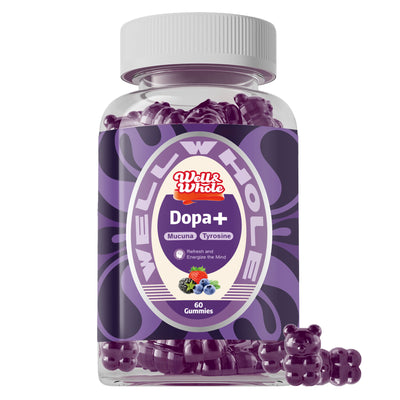
- well&whole Dopamine Gummies (Mucuna Pruriens 500mg) provide 500mg of Mucuna pruriens extract per serving
- well&whole Mucuna Pruriens Liquid Drops 500mg provide the same potency in a liquid format When choosing a Mucuna supplement, look for products that clearly state both the Mucuna pruriens extract amount and the standardized L-Dopa percentage.
How Mucuna Pruriens Works in the Brain
Step-by-Step Mechanism
1. **Ingestion**: You consume Mucuna pruriens extract, which contains L-Dopa
2. **Absorption**: L-Dopa is absorbed through the digestive tract into the bloodstream
3. **Crossing the blood-brain barrier**: Unlike dopamine, L-Dopa can cross the blood-brain barrier via an amino acid transporter
4. **Conversion to dopamine**: Inside the brain, the enzyme AAAD converts L-Dopa to dopamine
5. **Dopamine release**: The newly synthesized dopamine is stored in vesicles and released when neurons fire, enhancing dopamine signaling
The Peripheral Conversion Problem
Not all L-Dopa makes it to the brain. The AAAD enzyme exists throughout the body, not just in the brain. Approximately 70–80% of orally consumed L-Dopa is converted to dopamine in the periphery (outside the brain) before it can cross the blood-brain barrier.
This peripheral dopamine cannot enter the brain and can cause side effects like nausea and low blood pressure. In medical settings, L-Dopa is typically co-administered with a peripheral decarboxylase inhibitor (like carbidopa) to prevent this peripheral conversion.
In supplement form, some Mucuna pruriens products include natural co-factors that may help reduce peripheral conversion, though this effect is not as pronounced as with pharmaceutical inhibitors.
Natural Co-factors in Mucuna
Mucuna pruriens contains more than just L-Dopa. The whole extract includes:
- **Serotonin**: Another neurotransmitter that supports mood
- **Nicotinic acid (niacin)**: A B vitamin that supports nervous system function
- **Tryptamine derivatives**: Compounds that may support neurological function
- **Antioxidants**: Including flavonoids and phenolic compounds that protect neurons from oxidative stress
These co-occurring compounds may contribute to Mucuna's overall effects and may explain why some people report different experiences with whole Mucuna extract compared to isolated synthetic L-Dopa.
Potential Benefits of Mucuna Pruriens
1. Mood Support
Dopamine is a key player in mood regulation. Research published in the *Journal of Psychiatric Research* has shown that low dopamine signaling is associated with depressive symptoms, particularly anhedonia (loss of pleasure) and lack of motivation.
By providing L-Dopa—the direct precursor to dopamine—Mucuna pruriens may help support healthy dopamine levels and, in turn, support mood balance. A study in the *Journal of Evidence-Based Complementary & Alternative Medicine* noted that Mucuna pruriens supplementation supported mood parameters in animal models.
**Important note**: Mucuna pruriens is not a treatment for clinical depression. If you experience persistent low mood, consult a mental health professional.
2. Motivation and Drive
Dopamine is the neurochemical of motivation. When dopamine signaling is strong, we feel driven to pursue goals. When it's weak, we feel apathetic and unmotivated.
Research in *Behavioral Neuroscience* demonstrated that dopamine levels in the nucleus accumbens (the brain's reward center) directly predicted how much effort an animal was willing to exert for a reward. By supporting dopamine production, Mucuna pruriens may help maintain healthy motivation and drive.
3. Focus and Cognitive Performance
Dopamine plays a critical role in attention and cognitive focus. The prefrontal cortex—the brain region responsible for executive function, planning, and attention—relies heavily on optimal dopamine signaling.
Studies have shown that both too little and too much dopamine can impair prefrontal function, suggesting there's an "inverted U" relationship between dopamine and cognitive performance. Mucuna pruriens, by providing the building blocks for dopamine, may help support optimal dopamine levels for cognitive function.
4. Motor Function Support
The most well-established application of L-Dopa is in supporting motor function. In Parkinson's disease, the loss of dopamine-producing neurons leads to tremors, rigidity, and bradykinesia (slowness of movement).
While Mucuna pruriens supplements are not a treatment for Parkinson's disease (which requires medical management with precisely dosed L-Dopa and decarboxylase inhibitors), the L-Dopa content in Mucuna may support general motor function in healthy individuals.
5. Stress Management
Chronic stress can deplete dopamine levels. Research in *Psychoneuroendocrinology* showed that prolonged stress exposure reduced dopamine signaling in animal models. By providing L-Dopa, Mucuna pruriens may help support dopamine levels during periods of stress.
6. Reproductive Health
In Ayurvedic tradition, Mucuna pruriens has been used to support reproductive health. Modern research has explored this application. A study in *Fertility and Sterility* found that Mucuna pruriens supplementation supported healthy sperm parameters in men. While the exact mechanism is not fully understood, it may relate to dopamine's role in regulating reproductive hormones.
7. Antioxidant and Neuroprotective Effects
Mucuna pruriens contains antioxidant compounds that may help protect neurons from oxidative stress. A study in *Neurochemistry International* found that Mucuna pruriens extract exhibited neuroprotective properties in laboratory models, potentially through both its L-Dopa content and other antioxidant compounds.
Forms of Mucuna Pruriens Supplements
Gummy Format
well&whole Dopamine Gummies (Mucuna Pruriens 500mg) offer:
- Pre-measured, consistent dosing
- Pleasant taste without bitterness
- Easy to take and transport
- No need to measure or mix
Liquid Drops Format
well&whole Mucuna Pruriens Liquid Drops 500mg offer:
- Potentially faster absorption (liquid bypasses tablet disintegration)
- Flexible dosing
- Easy to add to beverages
- Good for people who dislike gummies or capsules
Choosing Between Formats
Both formats provide 500mg of Mucuna pruriens extract. The choice comes down to personal preference:
| Feature | Gummies | Liquid Drops |
| Convenience | High | Moderate |
| Absorption speed | Good | Potentially faster |
| Dosing flexibility | Fixed | Adjustable |
| Taste | Pleasant | Varies |
| Portability | High | Moderate |
Dosage Guidelines
Standard Supplementation
For general dopamine support, the typical recommendation is 500mg of Mucuna pruriens extract per day. This is the amount provided in both well&whole Dopamine Gummies and Mucuna Pruriens Liquid Drops.
Timing
- **Morning**: Many users prefer taking Mucuna in the morning to support daytime dopamine levels, motivation, and focus
- **Pre-workout**: Some athletes take Mucuna before exercise to support drive and intensity
- **Avoid evening use**: Because dopamine supports alertness, taking Mucuna late in the day may interfere with sleep for some individuals
Cycling
Some practitioners recommend cycling Mucuna pruriens—taking it for several weeks, then taking a break—to prevent tolerance. A common protocol is 5 days on, 2 days off, or 3 weeks on, 1 week off. However, there is no definitive research on the optimal cycling schedule.
Safety and Side Effects
General Safety
Mucuna pruriens has been consumed as a food in many cultures for centuries. As a supplement, it is generally well-tolerated when used as directed at standard doses.
Potential Side Effects
At standard supplement doses, side effects are uncommon but may include:
1. **Nausea**: The most common side effect, caused by peripheral dopamine production. Taking with food can help.
2. **Headache**: Possible, particularly at higher doses.
3. **Insomnia**: If taken too late in the day, the dopamine-supporting effects may interfere with sleep.
4. **Vivid dreams**: Some users report more vivid dreams, likely due to dopamine's effects on REM sleep.
5. **Mild digestive discomfort**: Usually resolves with continued use.
Who Should Avoid Mucuna Pruriens
- **Pregnant or breastfeeding women**: Safety has not been established
- **People taking MAO inhibitors**: Mucuna may interact with these medications
- **People with Parkinson's disease**: Should only use L-Dopa under medical supervision; Mucuna is not a substitute for prescribed medications
- **People with schizophrenia or psychotic disorders**: Dopamine dysregulation is involved in these conditions; consult a psychiatrist before use
- **Children**: Mucuna supplements are formulated for adults
Medication Interactions
| Medication | Potential Interaction |
| MAO inhibitors (MAOIs) | Dangerous interaction; avoid combination |
| L-Dopa / carbidopa | Additive effects; consult neurologist |
| Antipsychotic medications | May interfere with medication mechanism |
| Blood pressure medications | L-Dopa may lower blood pressure |
| Antidepressants |
Choosing a Quality Mucuna Pruriens Supplement
What to Look For
1. **Standardized L-Dopa content**: The label should state the percentage of L-Dopa or the amount per serving
2. **Extract vs. raw powder**: Standardized extracts are more consistent than raw seed powder
3. **Third-party testing**: Look for products tested for purity and contaminants
4. **Transparent labeling**: All ingredients and dosages should be clearly listed
5. **Reputable manufacturer**: Choose brands with quality manufacturing practices
well&whole Mucuna Products
Both Dopamine Gummies and Mucuna Pruriens Liquid Drops provide 500mg of Mucuna pruriens extract in their respective formats, offering consistent, reliable dosing.
Mucuna Pruriens in Context: The Broader Dopamine Ecosystem
Co-factors for Dopamine Production
Dopamine production doesn't happen in isolation. Several nutrients support the dopamine pathway:
- **Vitamin B6**: Required as a co-factor for the AAAD enzyme that converts L-Dopa to dopamine
- **Vitamin C**: Supports the enzyme tyrosine hydroxylase and protects dopamine from oxidation
- **Iron**: Required for tyrosine hydroxylase function
- **Folate**: Supports neurotransmitter synthesis
A well-rounded approach to dopamine support includes these co-factors alongside Mucuna pruriens.
Lifestyle Factors That Affect Dopamine
- **Exercise**: Aerobic exercise increases dopamine release and receptor density
- **Sleep**: Poor sleep depletes dopamine receptors
- **Diet**: Protein-rich foods provide tyrosine (the amino acid precursor to L-Dopa)
- **Stress management**: Chronic stress depletes dopamine
- **Limiting overstimulation**: Excessive social media, gaming, and sugar can dysregulate dopamine signaling
FAQ
Q: Is Mucuna pruriens the same as L-Dopa?
A: No. Mucuna pruriens is a plant that naturally contains L-Dopa. Supplements made from Mucuna pruriens provide L-Dopa along with other naturally occurring compounds. Synthetic L-Dopa is a purified pharmaceutical compound.
Q: Can Mucuna pruriens treat Parkinson's disease?
A: No. Parkinson's disease requires medical management with precisely dosed medications. Mucuna pruriens supplements are not a substitute for prescribed Parkinson's treatments. If you have Parkinson's, consult your neurologist before using any L-Dopa-containing supplement.
Q: How long does it take for Mucuna pruriens to work?
A: Some users report feeling effects within 30–60 minutes of taking Mucuna. For sustained mood and motivation support, consistent daily use over 2–4 weeks is typically recommended.
Q: Can I become dependent on Mucuna pruriens?
A: Mucuna pruriens is not considered addictive in the traditional sense. However, long-term use of L-Dopa may lead to downregulation of natural dopamine production. Cycling (taking breaks) is often recommended to prevent this.
Q: Should I take Mucuna with food?
A: Taking Mucuna with food, particularly a meal lower in protein, may improve absorption. High-protein meals may compete with L-Dopa for absorption due to amino acid competition at the intestinal transporter.
Q: Can I take Mucuna pruriens with caffeine?
A: Many people combine Mucuna with caffeine for enhanced focus and motivation. However, both can increase alertness, so avoid this combination in the evening. Start with lower doses to assess tolerance.
Q: What's the difference between gummies and liquid drops?
A: Both provide 500mg of Mucuna pruriens extract. Gummies are more convenient and better-tasting; liquid drops may offer faster absorption and more flexible dosing. Choose based on your preferences.
Q: Can women take Mucuna pruriens?
A: Yes. While some research has focused on male reproductive health, the dopamine-supporting benefits of Mucuna are relevant for both men and women. However, pregnant and breastfeeding women should avoid it.
Q: Will Mucuna pruriens show up on a drug test?
A: Mucuna pruriens is not a controlled substance and should not trigger standard drug tests. However, if you are subject to drug testing, inform the testing organization about all supplements you take.
Q: Can I take Mucuna pruriens every day?
A: Many people take Mucuna daily, but cycling is often recommended to prevent tolerance. A common approach is 5 days on, 2 days off. Consult your healthcare provider for personalized guidance.
Conclusion
Mucuna pruriens is one of nature's most remarkable gifts for brain health. As the richest natural source of L-Dopa—the direct precursor to dopamine—it offers a unique mechanism for supporting mood, motivation, focus, and overall cognitive function.
Whether you choose well&whole Dopamine Gummies for convenience and taste, or well&whole Mucuna Pruriens Liquid Drops for flexible dosing and potentially faster absorption, you're choosing a supplement grounded in both traditional wisdom and modern neuroscience.
Remember that dopamine support is part of a broader lifestyle picture. Exercise, quality sleep, stress management, and a nutrient-rich diet all play essential roles in maintaining healthy dopamine function. Mucuna pruriens complements these foundations—providing the raw material your brain needs to produce the motivation molecule.
Consult your healthcare provider before starting Mucuna pruriens, especially if you take medications or have underlying health conditions. With informed, responsible use, Mucuna pruriens may become a valuable ally in your quest for optimal brain health and vibrant motivation.
Related supplements
Putting it simply: if this is something you want to add to your routine, our Dopamine Gummies – Mucuna Pruriens Supplements Gummies 500mg with Mood Support and Mucuna Pruriens Liquid, Mucuna Pruriens Supplements 500MG, Fuel for Focus & Attention are a good place to start. The wider Mood Support collection is worth a look, and the Brain Health range covers related formats.
These statements have not been evaluated by the Food and Drug Administration. This product is not intended to diagnose, treat, cure, or prevent any disease.