Mucuna Pruriens FAQ: L-Dopa Content, Cycling, and Safety
Get answers to common questions about mucuna pruriens—L-Dopa content, cycling protocols, safety concerns, and how it supports dopamine and mood.

Mucuna pruriens—also known as velvet bean, cowhage, or kapikachhu—has generated significant interest in the wellness community for its unique ability to naturally deliver L-Dopa, the direct precursor to dopamine. As more people explore mucuna for mood, motivation, and neurological support, questions inevitably arise about its L-Dopa content, whether it should be cycled, and how to use it safely.
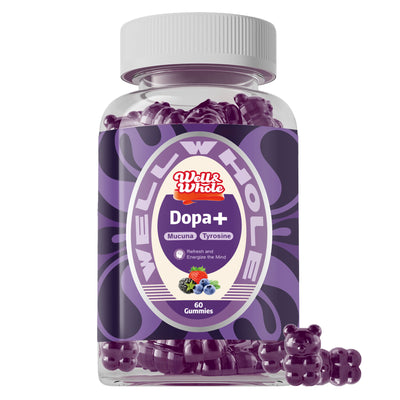
This FAQ article addresses the most common questions about mucuna pruriens, drawing on published research, traditional use, and practical considerations. Whether you're considering well&whole Dopamine Gummies or Mucuna Liquid Drops, this guide will help you make informed decisions.
Understanding Mucuna Pruriens
What Is Mucuna Pruriens?
Mucuna pruriens is a tropical legume native to Africa and Asia, now cultivated worldwide. It has been used in Ayurvedic medicine for centuries under the name kapikachhu, primarily as a nerve tonic, aphrodisiac, and adaptogen. The plant's most distinctive feature is its high concentration of L-Dopa (levodopa) in the seeds—the same compound used in pharmaceutical medications for Parkinson's disease, but delivered in a whole-plant matrix that includes additional beneficial compounds.
What Makes Mucuna Different from L-Dopa Medications?
While pharmaceutical L-Dopa (Sinemet, Madopar) is a isolated synthetic compound, mucuna pruriens delivers L-Dopa within a whole-plant matrix that includes:
- **Serotonin**: Another neurotransmitter precursor
- **Nicotine**: In trace amounts
- **N,N-dimethyltryptamine (DMT)**: In trace amounts
- **5-MeO-DMT**: In trace amounts
- **Beta-carboline compounds**: May modulate L-Dopa metabolism
- **Antioxidants**: Including various flavonoids and polyphenols
This whole-plant matrix may offer a different pharmacokinetic profile compared to isolated pharmaceutical L-Dopa, though the clinical significance of this difference is still being studied.
FAQ: L-Dopa Content
Q1: How much L-Dopa does mucuna pruriens contain?
The L-Dopa content of mucuna pruriens varies significantly depending on the species, growing conditions, harvesting time, and processing methods. Published studies report L-Dopa concentrations ranging from:
- **Whole seeds**: 3-6% L-Dopa by weight
- **Seed extracts**: 10-50% L-Dopa depending on extraction method
- **Standardized supplements**: Typically standardized to provide a specified L-Dopa amount per serving
Research published in the *Journal of Alternative and Complementary Medicine* analyzed multiple mucuna samples and found L-Dopa content ranging from 2.7% to 7.4% depending on the variety and processing (1).
Q2: Does the L-Dopa in mucuna work the same way as prescription L-Dopa?
The L-Dopa molecule itself is identical regardless of source. However, the context matters. Pharmaceutical L-Dopa is typically combined with a decarboxylase inhibitor (carbidopa or benserazide) to prevent peripheral conversion to dopamine before it reaches the brain. Mucuna's whole-plant matrix may naturally modulate L-Dopa metabolism through its beta-carboline compounds, though this has not been conclusively proven in clinical trials.
A study published in *Neurology* compared mucuna seed powder to standard L-Dopa/carbidopa in Parkinson's patients and found that mucuna provided faster onset and longer duration of action at a single dose, though this was a small, short-term study (2).
Q3: Can I calculate how much L-Dopa I'm getting from my mucuna supplement?
This depends on the product's standardization. Check the label for L-Dopa content per serving. If the product lists mucuna extract without specifying L-Dopa content, you may need to contact the manufacturer.Dopamine Gummies and Mucuna Liquid Drops provide clear serving information on their product pages.
Q4: Does extraction method affect L-Dopa content?
Yes. Water extraction may yield lower L-Dopa concentrations than alcohol extraction, as L-Dopa is water-soluble but the extraction efficiency varies with pH, temperature, and duration. Processing methods that involve heat may degrade some L-Dopa content. Quality manufacturers use controlled extraction conditions to preserve the compound profile.
FAQ: Cycling and Usage Protocols
Q5: Should I cycle mucuna pruriens?
Many herbalists and wellness practitioners recommend cycling mucuna—taking it for a period (typically 4-8 weeks) followed by a break (1-2 weeks). The rationale includes:
- **Downregulation concern**: Continuous L-Dopa supplementation may theoretically lead to downregulation of dopamine receptors, meaning they become less responsive over time
- **Tolerance**: Some users report diminishing effects with continuous daily use
- **Adaptogenic principle**: Many adaptogens are traditionally cycled to maintain their effectiveness
However, the scientific evidence for cycling mucuna specifically is limited. No clinical trials have directly compared continuous vs. cycled mucuna supplementation. The cycling recommendation is based primarily on theoretical concerns and user experience.
Q6: What's a typical cycling protocol?
Common cycling approaches include:
| Protocol | On Period | Off Period |
|----------|-----------|------------|
| Weekly cycle | 5 days | 2 days |
| Monthly cycle | 4 weeks | 1 week |
| Extended cycle | 6-8 weeks | 2 weeks |
The "5 days on, 2 days off" approach is popular because it's easy to remember (take weekdays, skip weekends) and provides regular breaks without long interruptions.
Q7: What happens if I don't cycle?
Some people use mucuna daily without cycling and report sustained benefits. The concern about receptor downregulation is theoretical and has not been demonstrated in human studies at typical supplement doses. However, if you notice diminishing effects over time, incorporating a cycling protocol may help restore responsiveness.
Q8: Can I take mucuna with other dopamine-supporting supplements?
Caution is warranted when combining multiple dopamine-supporting supplements, as excessive dopamine stimulation can cause side effects including anxiety, restlessness, and insomnia. Common combinations include:
- **Mucuna + L-tyrosine**: Both support dopamine production through different pathways (L-Dopa is a direct precursor, while L-tyrosine is a step further back in the pathway)
- **Mucuna + B6**: Vitamin B6 supports the conversion of L-Dopa to dopamine
If you're combining supplements, start with lower doses of each and monitor your response carefully.
FAQ: Safety
Q9: Is mucuna pruriens safe?
Mucuna pruriens has been used safely in Ayurvedic medicine for centuries and is generally well-tolerated at typical supplement doses. However, safety considerations include:
- **Dose-dependent effects**: Higher doses carry greater risk of side effects
- **Individual sensitivity**: Some people are more sensitive to L-Dopa than others
- **Underlying conditions**: Those with Parkinson's disease, psychiatric conditions, or cardiovascular issues need special consideration
- **Drug interactions**: Mucuna may interact with MAO inhibitors, antipsychotics, and blood pressure medications
A safety review published in the *Journal of Ethnopharmacology* noted that mucuna is generally safe at traditional doses, with side effects typically occurring only at high doses or in sensitive individuals (3).
Q10: What are the potential side effects of mucuna?
At typical supplement doses, most people experience minimal side effects. Potential effects to be aware of include:
- **Mild nausea**: L-Dopa can cause nausea, especially when taken on an empty stomach
- **Headache**: Some users report mild headaches during initial use
- **Insomnia**: Dopamine stimulation may affect sleep in some individuals
- **Increased heart rate**: L-Dopa can have mild cardiovascular effects
- **Vivid dreams**: Dopamine influences dream intensity
These effects are generally dose-dependent and often diminish with continued use or dose adjustment.
Q11: Can mucuna cause dopamine excess?
At typical supplement doses, mucuna is unlikely to cause dangerous dopamine excess in healthy individuals. However, excessive supplementation could theoretically lead to:
- **Anxiety or agitation**
- **Repetitive behaviors**
- **Manic-like symptoms in susceptible individuals**
If you experience any of these symptoms, reduce your dose or discontinue use and consult your healthcare provider.
Q12: Who should avoid mucuna pruriens?
The following individuals should exercise caution or avoid mucuna:
- **People taking MAO inhibitors**: Can dangerously amplify dopamine levels
- **People taking antipsychotic medications**: Mucuna may counteract dopamine-blocking medications
- **People with cardiovascular conditions**: L-Dopa can affect blood pressure and heart rate
- **People with psychiatric conditions**: Dopamine modulation may exacerbate certain conditions
- **Pregnant or nursing women**: Safety has not been established
- **Children**: Not recommended without pediatric guidance
Q13: Can mucuna replace Parkinson's medications?
No. Mucuna pruriens should never be used as a replacement for prescribed Parkinson's medications without explicit medical supervision. While some studies have explored mucuna as a complementary approach, the evidence is insufficient to support replacing standard treatment. Any changes to Parkinson's medication should be made under a neurologist's guidance.
FAQ: Practical Considerations
Q14: Should I take mucuna with food or on an empty stomach?
Taking mucuna with food, especially protein-containing meals, may reduce nausea but could also reduce absorption, as dietary amino acids compete with L-Dopa for transport across the intestinal wall. Many users find a compromise works best—taking mucuna with a light meal or between meals.
Q15: What time of day should I take mucuna?
Most people take mucuna in the morning or early afternoon, as the dopamine support it provides is energizing and may interfere with sleep if taken late in the day. Avoid taking mucuna within 4-6 hours of bedtime.
Q16: How do I choose between gummies and liquid drops?
Dopamine Gummies offer convenience, palatability, and pre-measured servings, making them ideal for daily use and travel. Mucuna Liquid Drops offer flexible dosing, potentially faster absorption, and a format that's easy to adjust. Both provide mucuna-derived L-Dopa support; the choice depends on your preferences.
Q17: Can I use mucuna for athletic performance?
Some athletes explore mucuna for motivation, focus, and drive during training, as dopamine plays a role in reward-seeking behavior and physical effort. However, there's limited clinical evidence for mucuna as a performance enhancer, and some sports organizations may restrict L-Dopa-containing supplements. Check your sport's regulations before use.
Q18: How long does it take to feel mucuna's effects?
Some users report noticing effects within 30-60 minutes of taking mucuna, particularly in terms of mood and focus. However, the full benefits may develop over days to weeks of consistent use. Individual responses vary significantly.
Conclusion
Mucuna pruriens offers a unique natural source of L-Dopa that has been used for centuries in Ayurvedic medicine and is increasingly studied in modern research. Understanding its L-Dopa content, considering cycling protocols, and following safety guidelines can help you use this botanical effectively and responsibly.
Whether you prefer the convenience of Dopamine Gummies or the flexible dosing of Mucuna Liquid Drops, incorporating mucuna into your wellness routine—with appropriate cycling and attention to your individual response—can support healthy dopamine function, mood, and motivation.
Always start with the recommended serving, monitor your response, and consult your healthcare provider if you have any underlying conditions or take medications that may interact with L-Dopa.
References
1. Misra L, Wagner H. (2007). L-Dopa concentration in different mucuna species. *Journal of Alternative and Complementary Medicine*, 13(6), 671-674.
2. Katzenschlager R, et al. (2004). Mucuna pruriens in Parkinson's disease: a double blind clinical and pharmacological study. *Journal of Neurology, Neurosurgery & Psychiatry*, 75(12), 1672-1677.
3. Manyam BV, et al. (2004). Dopa in Mucuna pruriens and its role in Ayurvedic medicine. *Journal of Ethnopharmacology*, 92(1), 63-73.
Related supplements
Should you decide to supplement, Dopamine Gummies – Mucuna Pruriens Supplements Gummies 500mg with Mood Support and Mucuna Pruriens Liquid, Mucuna Pruriens Supplements 500MG, Fuel for Focus & Attention are our formulation for this purpose. For a broader comparison, see the Mood Support and Brain Health collections.
These statements have not been evaluated by the Food and Drug Administration. This product is not intended to diagnose, treat, cure, or prevent any disease.