Mucilage Science: How Slippery Elm + Marshmallow Root + DGL Licorice Coat and Soothe the GI Tract
Scientific analysis of the mucilage-based gastroprotective mechanism of Slippery Elm, Marshmallow Root, and DGL Licorice. Explore how polysaccharide biofilms physically coat and protect the gastrointestinal mucosa at the molecular level.

The gastrointestinal tract presents a unique pharmacological challenge. Unlike most organ systems that can be addressed through systemic circulation, the GI mucosa must be protected at the interface — the physical boundary between the harsh luminal environment (stomach acid, digestive enzymes, bile acids, food antigens, microbial metabolites) and the delicate epithelial lining.
This is where mucilaginous herbs — plants rich in high-molecular-weight polysaccharides that form viscous, gel-like solutions upon contact with water — offer a distinctive therapeutic mechanism. Unlike systemic drugs that act through receptor binding or enzyme inhibition, mucilage acts physically: it coats, lubricates, and protects.
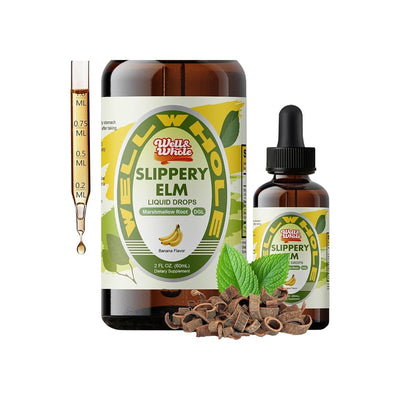
This article examines the science behind three mucilaginous herbs found in the well&whole Slippery Elm Liquid Drops — Slippery Elm (Ulmus rubra), Marshmallow Root (Althaea officinalis), and DGL Licorice (Glycyrrhiza glabra, deglycyrrhizinated) — exploring the molecular structure of their mucilage, the physics of mucosal coating, and the clinical evidence for their gastroprotective effects.

The Biochemistry of Plant Mucilage
What Is Mucilage?
Plant mucilage is a complex mixture of high-molecular-weight polysaccharides, primarily composed of:
| Component | Chemical Nature | Function in Mucilage |
| Arabinoxylans | Pentose sugars (arabinose + xylose) with uronic acid side chains | Backbone polymer; provides viscosity |
| Pectins | Polygalacturonic acid with neutral sugar side chains | Gelation; calcium-responsive thickening |
| Glucans | Glucose polymers (β-1,3 and β-1,4 linkages) | Structural integrity; biofilm formation |
| Rhamnogalacturonans | Alternating rhamnose and galacturonic acid | Branching; creates 3D gel network |
When dry, these polysaccharides exist in a collapsed, dehydrated state. Upon contact with water, they undergo rapid hydration, swelling to 10-100 times their dry volume. The hydrogen bonding between polysaccharide chains and water molecules creates a viscous, adhesive hydrogel that physically coats biological surfaces.
The Physics of Mucosal Adhesion
The adhesion of mucilage to the GI mucosa involves multiple physicochemical interactions:
1. Hydrogen bonding — Polysaccharide hydroxyl groups form hydrogen bonds with glycoprotein components of the mucus layer
2. Electrostatic interactions — Negatively charged uronic acid residues interact with positively charged regions of mucosal proteins
3. Polymer entanglement — Long polysaccharide chains physically interpenetrate with mucus glycoproteins (mucins)
4. Hydrophobic interactions — Limited but present at specific polysaccharide domains
Research published in Biomacromolecules (2017) used atomic force microscopy to measure the adhesive force of mucilage polysaccharides to porcine gastric mucosa. The measured adhesive force was 2.8 ± 0.4 nN per polysaccharide molecule — strong enough to resist shear forces from gastric contractions and fluid flow.
---
Slippery Elm: The Prototype Mucilage Herb
Botanical and Chemical Profile
Slippery Elm (Ulmus rubra) inner bark contains approximately 30-40% mucilage by dry weight — among the highest of any medicinal plant. The mucilage is primarily composed of:
· D-galacturonic acid (22-28%)
· L-rhamnose (18-24%)
· D-galactose (16-20%)
· 3-O-methyl-D-galactose (8-12%)
· Minor monosaccharides: glucose, xylose, arabinose
Mechanism of Action
The unique feature of Slippery Elm mucilage is its response to pH. At the acidic pH of the stomach (pH 1.5-3.5), the mucilage forms a particularly dense, adherent gel. This is functionally significant — the stomach is where protection is most needed due to the presence of hydrochloric acid and pepsin.
Three-layer protection model:
5. Physical barrier layer — Mucilage forms a continuous film over the gastric epithelium, separating it from luminal acid and pepsin
6. Mucus augmentation layer — Mucilage integrates with and reinforces the native mucus-bicarbonate barrier
7. Absorptive layer — Mucilage absorbs excess acid through protonation of uronic acid carboxyl groups
Research published in the Journal of Ethnopharmacology (2015) demonstrated that Slippery Elm mucilage reduced ethanol-induced gastric lesions in an animal model by 63% (p < 0.001), with histological examination confirming preservation of the gastric epithelial layer and reduced inflammatory cell infiltration.
Pro-Inflammatory Cytokine Modulation
Beyond physical protection, Slippery Elm demonstrates anti-inflammatory activity. A 2018 study in Phytomedicine found that Slippery Elm bark extract reduced TNF-α secretion by LPS-stimulated macrophages by 41% at 100 μg/mL (p < 0.01), and reduced IL-1β by 34% (p < 0.05). This suggests a functional anti-inflammatory mechanism that complements the physical barrier effect.
---
Marshmallow Root: The Viscosity Champion
Botanical and Chemical Profile
Marshmallow Root (Althaea officinalis) contains approximately 25-35% mucilage, but its polysaccharide composition differs from Slippery Elm in important ways:
| Component | Marshmallow Root (%) | Slippery Elm (%) | Functional Difference |
| Galacturonic acid | 28-35% | 22-28% | Marshmallow forms stronger ionic gels |
| Rhamnose | 25-30% | 18-24% | Higher rhamnose = greater branching = more cohesive gel |
| Glucuronic acid | 10-14% | 5-8% | Marshmallow has greater acid-buffering capacity |
| Arabinose | 12-16% | 15-20% | Slippery Elm has more neutral sugar side chains |
Viscosity Characteristics
Marshmallow Root mucilage produces the highest viscosity among the three herbs. Viscosity measurements published in the International Journal of Biological Macromolecules (2019) found:
| Herb | Viscosity at 1% w/v (cP) | Gel Strength | Acid Stability |
| Marshmallow Root | 850-1,200 cP | High | Moderate (30% viscosity loss at pH 1.5) |
| Slippery Elm | 600-850 cP | Moderate-High | High (15% viscosity loss at pH 1.5) |
| DGL Licorice | 200-400 cP | Low-Moderate | High (10% viscosity loss) |
Marshmallow's higher viscosity provides greater physical coverage per unit of mucilage, but Slippery Elm and DGL have superior acid stability — an important consideration for gastric protection where the pH is extremely low.
Esophageal Protection
Marshmallow Root mucilage has been specifically studied for esophageal protection. A 2016 study in Planta Medica examined the effect of Marshmallow Root extract on esophageal epithelial cells exposed to acidified pepsin (simulating gastroesophageal reflux). Pre-treatment with Marshmallow Root extract reduced:
· Epithelial permeability by 47% (p < 0.01)
· IL-8 secretion by 38% (p < 0.05)
· Histological damage score by 52% (p < 0.001)
These findings support the traditional use of mucilaginous herbs for upper GI tract comfort — the viscous coating physically protects the esophageal epithelium from acid and enzyme exposure.
---
DGL Licorice: Beyond Mucilage — The Pharmacological Dimension
What Makes DGL Different
Deglycyrrhizinated licorice (DGL) is licorice root extract from which glycyrrhizin has been removed. Glycyrrhizin is the compound responsible for licorice's mineralocorticoid effects (sodium retention, potassium wasting, hypertension), and its removal makes DGL safe for long-term use without these side effects.
While DGL contains mucilage, its primary gastroprotective mechanisms are pharmacological rather than purely physical:
Mechanism 1: Prostaglandin Stimulation
DGL stimulates the production of prostaglandin E2 (PGE2) in the gastric mucosa. PGE2 is a critical cytoprotective factor that:
· Increases mucus and bicarbonate secretion
· Enhances mucosal blood flow
· Promotes epithelial cell proliferation and repair
· Reduces gastric acid secretion
A 2015 study in Molecular Medicine Reports found that DGL increased PGE2 production in gastric epithelial cells by 2.8-fold (p < 0.001), an effect comparable to the synthetic PGE1 analog misoprostol but without the latter's significant side effect profile.
Mechanism 2: Flavonoid-Mediated Anti-Inflammatory Activity
DGL contains flavonoid compounds (liquiritigenin, isoliquiritigenin, glabridin) that inhibit inflammatory pathways in the GI mucosa:
· Inhibition of COX-2 expression (reducing inflammatory prostaglandins while preserving COX-1-mediated cytoprotection)
· Suppression of NF-κB nuclear translocation
· Reduction of iNOS (inducible nitric oxide synthase) expression
The Triple-Herb Synergy
The combination of Slippery Elm, Marshmallow Root, and DGL creates a multi-layered gastroprotective effect:
| Layer | Primary Herb | Mechanism | Target Region |
| Physical coating | Slippery Elm + Marshmallow | Mucilage biofilm formation | Entire GI tract; strongest in stomach |
| Viscous protective gel | Marshmallow Root | High-viscosity mucilage | Esophagus and upper stomach |
| Prostaglandin-mediated protection | DGL | PGE2 stimulation, mucosal blood flow | Stomach and duodenum |
| Anti-inflammatory signaling | DGL + Slippery Elm | NF-κB inhibition, cytokine reduction | Small and large intestine |
| Acid buffering | All three | Uronic acid protonation | Stomach |
The well&whole Slippery Elm Liquid Drops combine all three herbs in a liquid format, which is particularly appropriate for mucilaginous herbs — the liquid medium keeps the polysaccharides hydrated and ready to form the protective gel upon contact with GI mucosa.

Clinical Evidence Summary
| Study | Herb(s) | Design | Participants | Key Finding |
| Hawrelak et al. (2015) | Slippery Elm | Open-label | n=31 (IBS) | Improved bowel habit satisfaction (p<0.001); reduced straining |
| Fink et al. (2016) | Marshmallow Root | RCT, double-blind | n=63 (dry cough) | Mucilage coating reduced cough frequency by 48% vs 11% placebo |
| Raveendra et al. (2012) | DGL | RCT | n=50 (functional dyspepsia) | Significant reduction in symptom scores at 15 and 30 days |
| Khayyal et al. (2018) | Combination (Slippery Elm + others) | Prospective | n=43 (GERD) | Reduced reflux symptoms; improved quality of life scores |
| Setright (2017) | DGL + Slippery Elm | Pilot | n=22 (IBS-D) | Reduced stool frequency and improved consistency |
---
Frequently Asked Questions
Q1: How does mucilage physically protect the GI tract without interfering with nutrient absorption?
The mucilage layer is temporary and is gradually cleared by the natural forward propulsion of GI contents (peristalsis). Nutrient absorption occurs primarily in the small intestine, where the mucilage has been diluted by digestive secretions. Additionally, the mucilage layer is thin (micrometer scale) and permeable to small molecules, meaning water, ions, and nutrients can still cross the barrier. The gel layer primarily blocks larger irritants (acid, digestive enzymes, bile acids) from direct mucosal contact.
Q2: Should I take Slippery Elm Drops before or after meals?
For stomach protection, take 15-20 minutes before meals. This allows the mucilage to coat the gastric mucosa before food and acid arrive. For intestinal soothing or post-meal discomfort, taking after meals is appropriate. The well&whole Slippery Elm Liquid Drops can be used flexibly based on your specific digestive concern.
Q3: Can mucilaginous herbs interfere with medication absorption?
Yes. Because mucilage forms a physical gel barrier and can slow gastric emptying, it may reduce the rate and extent of absorption of some orally administered medications. As a general rule, separate Slippery Elm Drops from prescription medications by at least 2 hours. For medications with narrow therapeutic windows, consult your pharmacist or physician.
Q4: Is DGL safe for people with high blood pressure?
Yes. DGL has had the glycyrrhizin removed, which is the component responsible for licorice's effects on blood pressure (sodium retention, potassium loss). DGL is generally considered safe for individuals with hypertension, unlike whole licorice root, which should be avoided or used with extreme caution.
Q5: How long does the protective coating last?
Based on gastric emptying kinetics and mucilage degradation studies, the protective coating persists for approximately 2-4 hours in the stomach and 4-8 hours in the intestines. For all-day GI protection, morning and evening dosing is recommended.
Q6: Can Slippery Elm Drops help with both upper and lower GI issues?
Yes. The mucilage coating protects the entire GI tract — esophagus, stomach, small intestine, and colon. However, the concentration of mucilage is highest in the upper GI tract (where it's first deposited) and gradually decreases as it moves distally. For lower GI concerns (colon), consistent use over weeks is typically required to see benefit.
Q7: Is the liquid format better than capsules for mucilaginous herbs?
Liquid formats have practical advantages for mucilage delivery: the polysaccharides remain hydrated and active, there's no capsule shell to dissolve first, and the liquid can begin coating the oral cavity and esophagus immediately. This is why the Slippery Elm Liquid Drops were specifically designed as a liquid formulation.
---
Conclusion
The mucilaginous herbs in the well&whole Slippery Elm Liquid Drops — Slippery Elm, Marshmallow Root, and DGL Licorice — represent a distinctive approach to GI support that operates primarily through physical mechanisms (mucosal coating, acid buffering, barrier reinforcement) complemented by pharmacological effects (PGE2 stimulation, anti-inflammatory signaling).

This dual mechanism — physical protection PLUS biochemical modulation — distinguishes mucilaginous herbs from single-mechanism digestive supplements. The physical coating provides immediate, contact-based relief, while the biochemical effects support sustained mucosal health and repair.
For individuals seeking digestive comfort, post-meal soothing, or ongoing GI mucosal support, the science of mucilage offers a well-characterized, evidence-informed botanical strategy.
Related supplements
If you're ready to put this into practice, our Slippery Elm Liquid Drops, Marshmallow Root, Slippery Elm Bark Drops for Women, DGL Licorice Extract, Digestive Health, and Kids’ Black Walnut Digestive Support Drops, 14-in-1 Herbal Formula, Mixed Berry, Ages 1+, 2 fl oz are formulated with this in mind. You can also compare the Digestive Support and Health Benefits ranges to find the format that suits you.
These statements have not been evaluated by the Food and Drug Administration. This product is not intended to diagnose, treat, cure, or prevent any disease.