Milk Thistle, NAC, Dandelion: An Ingredient Breakdown

Milk thistle, NAC and dandelion support the liver through three different mechanisms: milk thistle provides antioxidant and membrane support, NAC supplies the raw material for glutathione, and dandelion is a traditional bitter associated with bile production. Understanding which mechanism each one addresses is the fastest way to read any liver formula and judge whether it is doing something coherent.
No supplement "detoxes" your liver — the liver does that continuously on its own. What these three ingredients can do is support distinct liver pathways: antioxidant defence (milk thistle), glutathione synthesis (NAC) and bile production (dandelion).
Start with what the liver actually does
The liver filters blood arriving from the digestive tract, produces bile, stores glycogen, synthesises proteins, and chemically converts compounds into forms the body can use or excrete. It runs continuously, and it does not accumulate a backlog that a pill flushes out. Once you accept that, the honest question becomes narrow and useful: which liver pathway does this ingredient touch, and what is the evidence for it?
Milk thistle: the best-studied botanical
Milk thistle's active complex is silymarin, a group of flavonolignans extracted from the seed. Mechanistically it acts as an antioxidant, supports cell membrane stability, and shows mild anti-inflammatory activity in experimental models.
Human research is more substantial here than for most liver botanicals. Several trials in specific liver contexts have reported modest improvements in liver enzyme markers. The pattern is consistent but limited: silymarin looks supportive rather than curative, and study quality varies considerably. It is the ingredient most liver formulas are built around, and reasonably so.
NAC: feeding the glutathione system
N-acetylcysteine is a modified form of the amino acid cysteine, and cysteine is the rate-limiting building block for glutathione — the antioxidant the liver relies on most heavily. Supplying NAC gives the liver more raw material to make its own glutathione.
This is the most biologically direct of the three mechanisms. Rather than supplying an antioxidant that has to survive digestion intact, NAC supplies a precursor the cell uses itself. It is also why many formulators prefer NAC to oral glutathione, which is poorly absorbed.
Dandelion: the traditional bitter
Dandelion root and leaf have a long history in European and traditional Chinese herbal practice, most often as a bitter — a category of herbs used to encourage digestive secretions, bile among them. The traditional use is extensive; the clinical trial base is thin.
That is not a dismissal. Plenty of long-used botanicals have weak trial data simply because nobody has funded large studies on an unpatentable weed. The honest framing is traditional use for bile and digestive support, with limited clinical confirmation.
Three ingredients, three mechanisms
| Ingredient | Primary mechanism | Evidence character | Why it is included |
|---|---|---|---|
| Milk thistle (silymarin) | Antioxidant, membrane stabilisation | Several human trials, modest effect sizes | General liver and antioxidant support |
| NAC | Glutathione precursor | Strong mechanistic basis | Supporting the liver's own antioxidant system |
| Dandelion | Bitter, traditional bile support | Long traditional use, thin clinical data | Digestive and bile-flow support |
Why stacks beat single ingredients here
Each of the three touches a different part of liver function. A formula containing only milk thistle covers antioxidant support. One that also includes NAC supports glutathione synthesis on top of that. Adding dandelion or artichoke brings in the bile side. Because the liver's workload is genuinely multi-pathway, a coherent stack is more defensible than a very large dose of any single ingredient — provided the formula states its amounts rather than hiding behind a proprietary blend.
How to read a liver formula label
Three checks separate a defensible formula from an expensive one:
- Are amounts disclosed? A proprietary blend that lists six ingredients under a single total tells you nothing about whether any one of them is present at a meaningful level.
- Is the milk thistle standardised? Silymarin concentration varies widely between products. A label quoting a standardisation percentage is a better sign than one quoting raw herb weight.
- Does it cover more than one mechanism? A single-ingredient product is not wrong, but a formula claiming broad support should touch antioxidant defence and bile, not just one of them.
Format comes last. A well-dosed capsule beats a pleasant-tasting liquid you forget to take, and the reverse is equally true — consistency is the variable that actually decides whether any of this matters.
Liquid or capsule?
Liquids allow finer dose adjustment and avoid swallowing pills, which matters if you already take several things daily. Gummies and capsules win on convenience and portability. Neither is inherently more effective; the deciding factor is almost always whether you will actually take it every day.
Key takeaways
- The liver detoxes itself continuously — supplements support pathways, they do not perform the detox.
- Milk thistle offers antioxidant and membrane support with the strongest human data of the three.
- NAC works by supplying cysteine, the rate-limiting precursor for glutathione.
- Dandelion is a traditional bitter with a long use history and limited clinical data.
- Stacks covering several mechanisms are more defensible than one large dose.
Frequently asked questions
Can I take all three together?
Yes — they are routinely combined and their mechanisms do not overlap. Many liver formulas, including ours, include several of them alongside TUDCA and artichoke.
Which single ingredient should I start with?
If you want the best-studied option, milk thistle. If your interest is antioxidant capacity specifically, NAC has the more direct mechanism.
Is NAC the same as glutathione?
No. NAC is a precursor — the raw material your cells use to make glutathione. Oral glutathione itself is poorly absorbed, which is why precursors are more commonly used.
How long should a liver supplement be taken?
There is no standard duration. Follow the label, and treat any change in liver markers as something to review with a clinician over months rather than weeks.
Related supplements
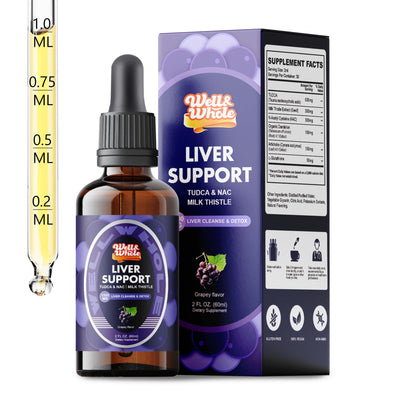
If you're ready to put this into practice, our Liver Support Liquid Drops Supplement | TUDCA Drops Liver Cleanse & Detox with Milk Thistle, NAC, Dandelion, Artichoke & Glutathione for Detox and TUDCA 1000mg Gummies with Milk Thistle 500mg for Adults are formulated with this in mind. You can also compare the Liver Support and Milk Thistle ranges to find the format that suits you.
These statements have not been evaluated by the Food and Drug Administration. This product is not intended to diagnose, treat, cure, or prevent any disease. Talk to a healthcare professional before starting any new supplement, especially if you are pregnant, nursing, taking medication, or managing a health condition.
These statements have not been evaluated by the Food and Drug Administration. This product is not intended to diagnose, treat, cure, or prevent any disease.