Milk Thistle and Liver Health: Silymarin Science Explained
Discover the science behind milk thistle and silymarin for liver health. Learn how this ancient herb supports liver cells, reduces enzymes, and works.

Milk thistle (Silybum marianum) is arguably the most recognized herb in liver health—featured in traditional European medicine for over 2,000 years and now supported by a body of modern clinical research. Its active compound, silymarin, has been studied in hundreds of trials examining antioxidant defense, cell membrane protection, anti-inflammatory modulation, and liver enzyme improvement.
Yet despite its popularity, many people don't understand *how* milk thistle works, what the research actually shows, or how it fits into a comprehensive liver support strategy.
This article explains the science behind silymarin—its mechanisms, evidence, limitations, and role in well&whole's Liver Support Liquid Drops and TUDCA Gummies.
What Is Milk Thistle?
Milk thistle is a flowering plant native to the Mediterranean region, now grown worldwide. The name comes from the milky-white veins on its leaves—a visual feature that historically linked the plant to breast-feeding and, symbolically, to nurturing and protection.
The medicinal part is the seed, which contains the active compound complex called **silymarin**. Silymarin is not a single molecule but a flavonoid complex consisting primarily of:
- **Silybin (also called silibinin)** — 50-70% of silymarin content; the most biologically active component
- **Silydianin** — approximately 10%
- **Silychristin** — approximately 20%
- **Other flavonolignans** — trace amounts
Of these, silybin is the compound most frequently referenced in research and the one primarily responsible for milk thistle's liver-supporting effects.
| **Component** | **% of Silymarin** | **Primary Activity** |
|---|---|---|
| Silybin A & B | 50-70% | Antioxidant, membrane stabilization, anti-inflammatory |
| Silychristin | ~20% | Antioxidant |
| Silydianin | ~10% | Antioxidant |
| Taxifolin | Trace | Antioxidant precursor |
How Silymarin Works: Four Key Mechanisms
1. Antioxidant Defense — Free Radical Scavenging
Silymarin is a potent direct antioxidant. It scavenges reactive oxygen species (ROS) and free radicals before they can damage liver cell membranes, proteins, and DNA.
Research by Pradhan and Girish (2006) in *Current Science* demonstrated that silymarin's antioxidant capacity is comparable to well-known antioxidants like vitamin E and quercetin—but it operates through distinct chemical pathways, providing complementary protection.
Key antioxidant actions:
- **Direct radical scavenging**: Neutralizes hydroxyl radicals and superoxide anions
- **Iron chelation**: Binds excess free iron that catalyzes oxidative reactions
- **Glutathione sparing**: By neutralizing some free radicals directly, silymarin reduces the demand on glutathione, preserving your liver's master antioxidant reserves
2. Cell Membrane Stabilization
Silymarin interacts with liver cell (hepatocyte) membranes in a unique way: it inserts into the lipid bilayer and alters membrane permeability, making it harder for toxins to enter and easier for cellular components to stay protected.
This membrane-stabilizing effect was demonstrated by Letteron et al. (1990) in *Biochemical Pharmacology*, who showed that silymarin prevented toxin-induced membrane disruption in liver cells. The mechanism involves silybin's interaction with membrane phospholipids, creating a more resilient cellular boundary.
Think of it as reinforcing the walls of your liver's houses—making it harder for intruders (toxins) to break in while keeping the interior protected.
3. Anti-Inflammatory Modulation
Chronic inflammation is a driving force in liver disease progression—from fatty liver to more serious conditions. Silymarin modulates several inflammatory signaling pathways:
- **NF-κB suppression**: NF-κB is a master inflammatory switch. Silymarin inhibits its activation, reducing the cascade of inflammatory cytokines that damage liver cells (Manna et al., 1999, *Journal of Immunology*)
- **COX-2 inhibition**: Silymarin reduces cyclooxygenase-2 expression, limiting the production of inflammatory prostaglandins
- **TNF-α reduction**: Tumor necrosis factor alpha is a key inflammatory cytokine in liver disease; silymarin helps dampen its production
This anti-inflammatory action is particularly important because inflammation transforms simple fat accumulation in the liver into progressive damage.
4. Protein Synthesis and Regenerative Support
One of milk thistle's most intriguing properties is its apparent ability to support liver regeneration. Silymarin has been shown to stimulate ribosomal RNA synthesis, which is essential for protein production in liver cells.
A study by Sonnenbichler and Scalera (1995) in *Journal of Hepatology* found that silybin stimulated ribosomal RNA polymerase I activity, potentially enhancing the liver's natural regenerative capacity. The liver is already the body's most regenerative organ—silymarin may help optimize this built-in repair mechanism.
The Evidence: What Clinical Studies Show
Liver Enzyme Reduction
Multiple meta-analyses have examined milk thistle's effect on liver enzyme markers (ALT and AST)—standard indicators of liver stress.
A comprehensive 2020 meta-analysis by Abenavoli et al. in *Phytotherapy Research*, analyzing 18 randomized controlled trials, found that silymarin supplementation was associated with significant reductions in both ALT and AST levels compared to placebo.
Key findings:
- **ALT reduction**: Statistically significant decreases across multiple study populations
- **AST reduction**: Significant reductions, though slightly less consistent than ALT
- **Duration effect**: Benefits increased with longer supplementation periods (8+ weeks)
Fatty Liver (NAFLD) Support
NAFLD is the most common liver condition in Western countries, affecting approximately 25% of the population. Several studies have examined silymarin's role in NAFLD management:
- A 2013 study in *World Journal of Hepatology* reported that silymarin supplementation for 12 weeks was associated with improved liver enzyme levels and reduced inflammatory markers in NAFLD patients
- A 2017 systematic review in *Medicine* found that silymarin combined with lifestyle modifications showed greater improvement in NAFLD markers than lifestyle changes alone
Alcohol-Related Liver Support
Silymarin has been studied extensively in alcohol-related liver conditions:
- A 2012 meta-analysis in *Cochrane Database of Systematic Reviews* reviewed 18 studies on milk thistle for alcoholic liver disease, noting trends toward reduced mortality and improved liver enzyme profiles
- The evidence is strongest for early-stage alcohol-related liver changes; benefits diminish in advanced disease
Limitations of the Evidence
While the overall body of research is positive, it's important to acknowledge limitations:
- **Study quality varies**: Some older trials had methodological weaknesses
- **Standardization challenges**: Different products use varying silymarin concentrations and extraction methods
- **Mixed results in advanced disease**: Benefits are more consistent in early-to-moderate liver concerns
- **Bioavailability concerns**: Pure silymarin has relatively low oral bioavailability (~30%), which has led to development of enhanced formulations
Bioavailability: The Milk Thistle Absorption Challenge
One of the most discussed aspects of milk thistle supplementation is its oral bioavailability. Pure silymarin has limited absorption due to:
- **Poor water solubility**: Silymarin is lipophilic (fat-loving), making it hard to dissolve in the aqueous environment of the gut
- **Rapid metabolism**: Much of absorbed silybin is quickly metabolized and eliminated
- **Low intestinal permeability**: The compound doesn't easily cross the intestinal wall
Solutions to the Bioavailability Problem
Several approaches have been developed to improve silymarin absorption:
| **Approach** | **How It Works** | **Result** |
|---|---|---|
| Phytosome (silybin-phosphatidylcholine complex) | Binds silybin to phospholipids for better membrane crossing | Significantly improved absorption |
| Liposomal delivery | Encloses silybin in lipid bubbles | Enhanced bioavailability |
| Liquid formulation | Dissolves silymarin in carrier solution | Faster dissolution than capsules |
| Co-administration with bile acids | TUDCA and similar bile acids improve fat-soluble compound absorption | Synergistic absorption boost |
This last point is particularly relevant: **TUDCA, a bile acid, may improve the absorption of fat-soluble compounds like silymarin** by enhancing bile flow and fat emulsification. This is one reason combining TUDCA and milk thistle—as in well&whole's products—is scientifically strategic.
Milk Thistle in well&whole Products
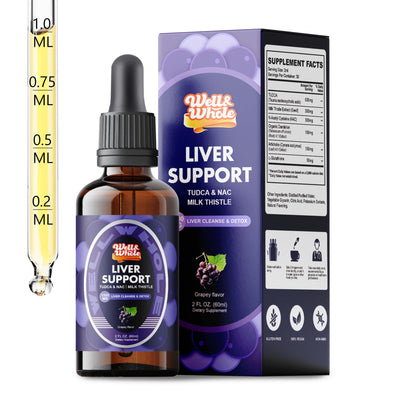
Liver Support Liquid Drops (P12) — $19.99
Milk thistle is one of six ingredients in this comprehensive formula, alongside TUDCA, NAC, dandelion, artichoke, and glutathione. In this context, milk thistle provides:
- Direct antioxidant silymarin (complements NAC's glutathione production)
- Cell membrane stabilization (complements TUDCA's cellular protection)
- Anti-inflammatory modulation (complements glutathione's redox regulation)
The liquid format may also support faster silymarin dissolution compared to capsule forms.
TUDCA 1000mg Gummies with Milk Thistle (P21) — $22.98
These gummies pair TUDCA with milk thistle in a focused two-ingredient combination. The rationale:
- **TUDCA** addresses bile flow and ER stress
- **Milk thistle** provides antioxidant defense and membrane stabilization
- Together, they cover two major liver support pathways
- **Absorption synergy**: TUDCA's bile-promoting properties may enhance silymarin absorption
Silymarin vs. Other Liver Antioxidants
| **Compound** | **Primary Mechanism** | **Unique Advantage** |
|---|---|---|
| Silymarin (milk thistle) | Direct radical scavenging, membrane stabilization | Membrane protection + regeneration support |
| NAC | Glutathione precursor | Sustained antioxidant production |
| Glutathione | Direct antioxidant, Phase II detox | Immediate defense + toxin conjugation |
| TUDCA | Bile flow, ER stress reduction | Addresses mechanical liver function |
Each compound has a distinct role—which is why combining them creates more comprehensive coverage than any single ingredient alone.
FAQ
Q1: What is the difference between milk thistle and silymarin?
Milk thistle is the whole plant (Silybum marianum). Silymarin is the active compound complex extracted from milk thistle seeds. When you take a "milk thistle supplement," you're primarily getting silymarin.
Q2: What does silybin do for the liver?
Silybin—the main component of silymarin—scavenges free radicals, stabilizes liver cell membranes, reduces inflammation (via NF-κB suppression), and may support the liver's natural regenerative processes.
Q3: How much milk thistle should I take for liver support?
Doses in clinical studies typically range from 140-420mg of silymarin daily. Follow the label directions on your supplement, and consult your healthcare provider for personalized recommendations.
Q4: Does milk thistle improve liver enzymes?
Multiple meta-analyses, including Abenavoli et al. (2020), have found that silymarin supplementation is associated with significant reductions in ALT and AST liver enzyme markers.
Q5: Can milk thistle help with fatty liver?
Research suggests silymarin may support liver health in NAFLD. A 2013 study in *World Journal of Hepatology* reported improved liver enzymes and inflammatory markers with silymarin supplementation. However, it should complement—not replace—diet and lifestyle changes.
Q6: Why is milk thistle combined with TUDCA in well&whole's products?
The combination is strategic: TUDCA supports bile flow (and may improve silymarin absorption), while milk thistle provides antioxidant and membrane protection. Together, they address different pathways of liver function.
Q7: Is milk thistle safe?
Milk thistle has a long safety record. The most common side effect is mild gastrointestinal discomfort. Rare allergic reactions can occur in people sensitive to plants in the Asteraceae family.
Q8: How long does it take for milk thistle to work?
Clinical studies showing benefits typically span 8-12 weeks of consistent supplementation. Some users report feeling differences within 2-4 weeks. Consistency matters more than speed.
Q9: Can I take milk thistle with other liver supplements?
Yes—milk thistle is commonly combined with NAC, TUDCA, glutathione, and other liver-supporting compounds. well&whole's products already include these combinations.
Q10: Does milk thistle interact with medications?
Milk thistle may interact with certain medications metabolized by the liver's CYP450 enzyme system, potentially affecting their clearance. Always consult your healthcare provider if you take prescription medications.
Conclusion
Milk thistle and its active compound silymarin represent one of the best-studied botanicals in liver health. With mechanisms spanning antioxidant defense, cell membrane stabilization, anti-inflammatory modulation, and possible regenerative support, silymarin addresses multiple pathways that single-target supplements miss.
In well&whole's products, milk thistle isn't a standalone hero—it's part of a team. In Liver Support Liquid Drops, it works alongside TUDCA, NAC, dandelion, artichoke, and glutathione for six-pathway coverage. In TUDCA 1000mg Gummies with Milk Thistle, it pairs with TUDCA for focused bile + antioxidant support.
The science is clear: milk thistle works best not alone, but as part of a comprehensive strategy. well&whole delivers exactly that.
Related supplements
Putting it simply: if this is something you want to add to your routine, our Liver Support Liquid Drops Supplement | TUDCA Drops Liver Cleanse & Detox with Milk Thistle, NAC, Dandelion, Artichoke & Glutathione for Detox and TUDCA 1000mg Gummies with Milk Thistle 500mg for Adults are a good place to start. The wider Liver Support collection is worth a look, and the Milk Thistle range covers related formats.
These statements have not been evaluated by the Food and Drug Administration. This product is not intended to diagnose, treat, cure, or prevent any disease.