Magnesium Taurate vs Glycinate: Which Fits Your Goal?

Short answer: magnesium glycinate is usually the better pick for sleep and relaxation, while magnesium taurate is usually the better pick for heart and circulatory goals. Both are chelated forms that supply the same mineral. The difference is the amino acid each one is bound to, and that carrier changes how the magnesium behaves, how well it is tolerated, and which goals people tend to use it for.
If your main goal is sleep, choose magnesium glycinate. If your main goal is cardiovascular or circulatory support, choose magnesium taurate. If you are simply correcting a low intake, either works — the number that matters is the elemental magnesium per serving, not the name on the front of the bottle.
Both forms solve the same problem
Magnesium ions do not travel well through the digestive tract on their own. In supplements they are almost always bound to a carrier, either an organic acid or an amino acid. That carrier determines three practical things: how much of the magnesium is absorbed, what happens to it once it is in the bloodstream, and how likely it is to cause loose stools.
Cheap forms like magnesium oxide are poorly absorbed, which is exactly why they are the ones most likely to send you to the bathroom. Chelated forms bound to amino acids are absorbed through a different route and are far gentler. Glycinate and taurate both belong to this gentler group, which is why the choice between them is not really about absorption — it is about what you want the second half of the molecule to do.
Magnesium glycinate: the calming carrier
Glycine is the simplest amino acid and also a neurotransmitter with inhibitory, quieting activity in the central nervous system. When magnesium is bound to glycine, you get two things at once: the mineral and an amino acid associated with relaxation.
That is the reason glycinate dominates the sleep category, and the reason it is often recommended to people who find other magnesium types oddly stimulating rather than settling. If you want one magnesium for a night-time routine, this is the conventional starting point.
Magnesium taurate: the cardiovascular carrier
Taurine is one of the most abundant amino acids in human tissue, and the body concentrates it in the heart, the retina and the brain. It is involved in cell volume regulation, calcium handling and the electrical stability of cardiac muscle.
Because of that distribution, magnesium taurate is the form most often chosen by people whose interest is cardiovascular and vascular tone rather than sleep. It tends to be better tolerated than oxide or citrate, so for someone who wants a daily magnesium that does not double as a laxative and who is not specifically chasing a sleep effect, taurate is a reasonable default.
Side by side
| Magnesium glycinate | Magnesium taurate | |
|---|---|---|
| Carrier amino acid | Glycine | Taurine |
| Where the carrier is concentrated | Central nervous system | Heart, retina, brain |
| Typical goal | Sleep, relaxation, muscle ease | Heart and circulatory support, daily magnesium |
| Digestive tolerance | Good | Good |
| Elemental magnesium | Roughly 11-14% by weight | Roughly 8-10% by weight |
| Commonly paired with | Apigenin, vitamin B6 | CoQ10, hawthorn |
Note the second-to-last row. Both compounds contain far less elemental magnesium than the headline number on the label suggests. A 1800 mg serving of magnesium taurate does not deliver 1800 mg of magnesium — it delivers the compound, of which roughly 8-10% is the mineral itself.
Choosing by goal, not by marketing
- Sleep is the priority. Start with glycinate. It is the more conventional and better-evidenced choice for a night-time routine.
- Heart and circulation are the priority. Taurate is the form usually selected for this, because taurine is concentrated in cardiac tissue.
- You simply want daily magnesium. Pick whichever you will take consistently, then check the elemental magnesium figure on the panel.
- Previous magnesium upset your stomach. Both are gentler than oxide or citrate. Start low and split the dose across the day.
What the evidence does and does not say
Magnesium itself is well studied: it participates in hundreds of enzyme reactions, and low intake is common in Western diets. What is much thinner is head-to-head human research comparing glycinate with taurate for specific outcomes. Most of the "which form" advice rests on where the carrier amino acid is concentrated in the body and on tolerability, not on large comparative trials. That is an honest limit, and it is why choosing by goal is more useful than arguing that one form is simply better.
Key takeaways
- Glycinate and taurate both supply magnesium well and are gentler than oxide or citrate.
- The carrier amino acid shapes the typical use case: glycine for calm and sleep, taurine for heart and circulation.
- Compare products on elemental magnesium per serving, not total compound weight.
- No large head-to-head human trials settle the debate, so choose by goal and by tolerability.
Frequently asked questions
Can I take magnesium glycinate and magnesium taurate together?
Yes, and some people do — one in the evening and one earlier in the day. The practical limit is total elemental magnesium from all sources, so add up the milligram figures rather than counting servings.
Which form is better for heart rhythm?
Magnesium taurate is the form most often chosen for cardiovascular goals because taurine is concentrated in cardiac tissue. That is a rationale rather than proven superiority, and any heart rhythm concern belongs with a clinician.
Is one of them more likely to cause diarrhoea?
Both are much better tolerated than magnesium oxide or citrate. If you are sensitive, start with a low dose and take it with food rather than on an empty stomach.
How long before I notice anything?
Magnesium repletion is slow. Most people assess a change over several weeks of consistent daily use rather than after a few doses.
Related supplements
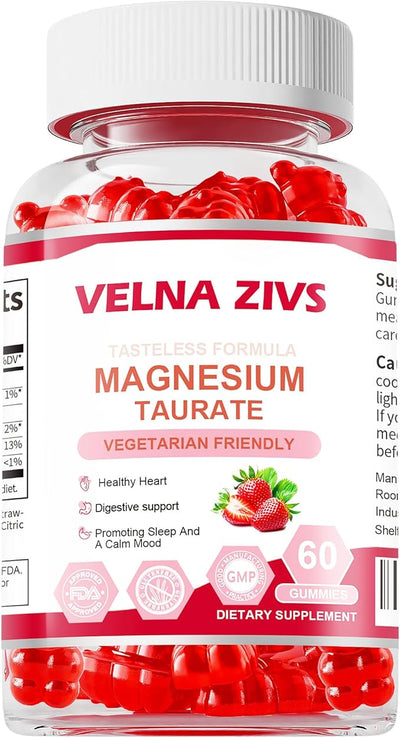
Where to begin? Our Magnesium Taurate Gummies 1800mg, Magnesium Taurate Supplement, High Absorption& chewable for Kid and Adults, is a sensible place to start, and the Magnesium Taurate collection lays out the other formats side by side with Magnesium.
These statements have not been evaluated by the Food and Drug Administration. This product is not intended to diagnose, treat, cure, or prevent any disease. Talk to a healthcare professional before starting any new supplement, especially if you are pregnant, nursing, taking medication, or managing a health condition.