Liver Support Supplements for Women over 50

Short answer: liver support supplements for women over 50 are worth considering only after the bigger inputs are handled — alcohol, blood sugar, weight and a medication review. Of the ingredients commonly used, milk thistle, NAC, glutathione and dandelion have the longest history and the most plausible mechanisms. None of them replaces a liver function test or a clinician’s read of your results.
The liver does not get quieter with age, but the load on it changes. Women in their fifties and beyond often take more medications than they did at thirty, carry more adipose tissue around the midsection, and metabolise some substances differently. That combination is what makes liver health worth a deliberate look — not the urge to buy something called a cleanse.
What the liver is actually doing
The liver runs hundreds of reactions, and most of what people call detox is simply those reactions working. Phase I enzymes chemically modify substances so they can be handled; phase II enzymes then conjugate them — attaching a molecule such as glutathione, sulphate or glycine — so they can leave the body in bile or urine. This is a detox pathway in the literal sense, and it is a permanent feature of hepatic metabolism rather than something you switch on with a drink.
Why the conversation changes after 50
- Medication load. More prescriptions means more for the liver to process, and more chances for interactions.
- Body composition. Fat distribution shifts after menopause, and fat accumulating in the liver is one of the most common findings on routine blood work.
- Blood sugar. Insulin resistance and fatty liver travel together, which is why metabolic markers matter for liver health.
- Muscle loss. Less muscle means less capacity to handle glucose and a different protein picture, both of which feed back into liver fat.
Key takeaways
- Liver health after 50 is mostly about alcohol, blood sugar, weight and medications — not about which capsule you choose.
- Milk thistle (silymarin), NAC, glutathione and dandelion are the ingredients with the longest use and the most studied mechanisms.
- Liver enzymes on a standard blood panel are the sensible way to know whether anything needs attention.
- “Liver cleanse” is a marketing phrase, not a physiological category; no product clears the liver on your behalf.
- Anyone with a diagnosed liver condition should add nothing without their clinician’s input.
What the evidence supports
| Ingredient | Mechanism and use | Practical notes |
|---|---|---|
| Milk thistle (silymarin) | Traditional liver herb; studied for antioxidant activity in liver cells | Most studied as an extract standardised to silymarin |
| NAC | Supplies cysteine, the rate-limiting building block of glutathione | Common in respiratory and liver-support formulas |
| Glutathione | Central antioxidant used in phase II conjugation | Oral absorption is limited; some formulas use precursors |
| Dandelion | Traditional bitter used as a gentle diuretic and digestive aid | Often paired with artichoke in liver blends |
| TUDCA | Bile acid studied for bile flow and liver enzyme support | A more specialised ingredient; clinician input is sensible |
What these have in common is a plausible mechanism and a long record of traditional use. What they do not have is evidence that they reverse liver disease. Read claims carefully: “supports normal liver function” and “reverses fatty liver” are not the same sentence, and only one of them is defensible.
What matters more than any capsule
Alcohol is the single largest modifiable input, and the effect is dose-dependent — less is genuinely better, not just “moderate”. Blood sugar control comes next, because insulin resistance is the engine behind most liver fat. Then weight and waist, where even a modest reduction changes liver findings on imaging. Then medication review: some common prescriptions are harder on the liver than others, and that is a conversation to have with the prescriber rather than to solve with supplements. Fibre, vegetables, coffee and consistent movement all show up favourably in the liver literature, which is another way of saying the boring inputs are the strong ones.
How to choose and stay safe
Start with blood work, so you are not guessing. If liver enzymes are normal and you simply want to support normal function, a simple formula is enough — milk thistle with NAC or a dandelion and artichoke blend. Look for a stated amount per ingredient, third party testing, and no proprietary blend. Take it consistently rather than in bursts, and stop and ask if you notice digestive upset, unusual bruising, or changes in how a prescription makes you feel. Consistency, safe sourcing and a review of the real inputs will do more for liver health than any single ingredient ever will.

Frequently asked questions
Do I need a liver cleanse after 50?
No. “Liver cleanse” is a marketing phrase rather than a physiological category. The liver already runs continuous phase I and phase II detox pathways, and no product performs that work on your behalf. What actually reduces the liver’s load is less alcohol, steadier blood sugar, a healthier weight and a review of your medications.
Which liver supplement ingredients are worth considering?
Milk thistle standardised to silymarin has the longest research record, and NAC is useful because it supplies cysteine, the building block of glutathione. Glutathione itself is central to phase II conjugation but absorbs poorly by mouth. Dandelion and artichoke are traditional bitters often paired with them, and TUDCA is a more specialised bile acid ingredient best used with clinical input.
How would I know if my liver needs attention?
A standard blood panel that includes liver enzymes is the starting point, and it is read alongside alcohol intake, weight, blood sugar markers and medication history. Symptoms of liver problems are often vague or absent until changes are well established, which is exactly why routine blood work — rather than how you feel — is the sensible trigger for a conversation.
Can supplements interact with my prescriptions?
Yes, and it is worth checking. Milk thistle and NAC can affect how some drugs are metabolised, and anything taken alongside a prescription for a diagnosed liver condition should be cleared with the prescriber. Bring the actual bottles to the appointment; “I take a liver supplement” is not enough information for a clinician to work with.
Related supplements
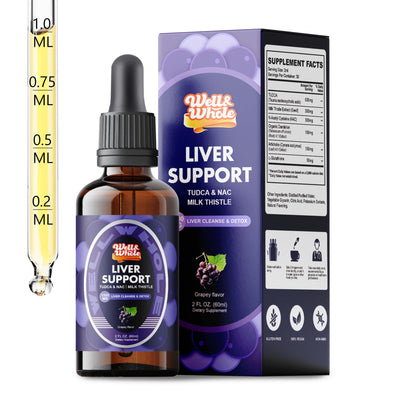
If you're ready to put this into practice, our Liver Support Liquid Drops Supplement | TUDCA Drops Liver Cleanse & Detox with Milk Thistle, NAC, Dandelion, Artichoke & Glutathione for Detox and TUDCA 1000mg Gummies with Milk Thistle 500mg for Adults are formulated with this in mind. You can also compare the Liver Support and Milk Thistle ranges to find the format that suits you.
These statements have not been evaluated by the Food and Drug Administration. This product is not intended to diagnose, treat, cure, or prevent any disease. Talk to a healthcare professional before starting any new supplement, especially if you are pregnant, nursing, taking medication, or managing a health condition.
These statements have not been evaluated by the Food and Drug Administration. This product is not intended to diagnose, treat, cure, or prevent any disease.