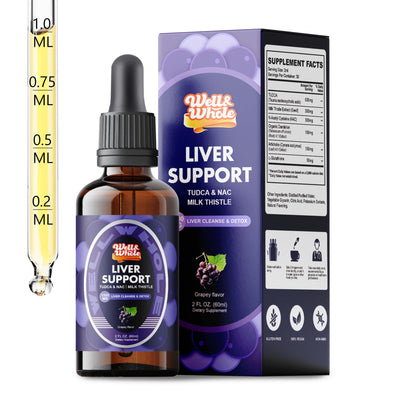
Liver Support Liquid Drops: Why 6 Ingredients Beat 1
Discover why a 6-ingredient liver support formula outperforms single-ingredient supplements. TUDCA, NAC, milk thistle, dandelion, artichoke, glutathione explained.

Walk into any supplement store and you'll see shelves of single-ingredient liver products: standalone milk thistle, standalone TUDCA, standalone NAC. Each one targets a specific pathway of liver function—and each one has legitimate science behind it.
But your liver doesn't operate through one pathway. It's a multi-system organ handling detoxification, bile production, antioxidant defense, protein synthesis, and metabolic regulation simultaneously. Supporting just one mechanism leaves gaps.
That's the premise behind well&whole's Liver Support Liquid Drops —a six-ingredient formula that addresses liver health through multiple, complementary mechanisms. This article examines why a multi-ingredient approach may outperform single-ingredient supplementation, breaking down each compound's role and how they work together.

The Problem with Single-Ingredient Liver Supplements
One Pathway, One Benefit
Single-ingredient supplements are easy to study, easy to market, and easy to dose. But they address only one aspect of liver function:
- **TUDCA alone** supports bile flow and reduces ER stress
- **NAC alone** boosts glutathione production
- **Milk thistle alone** provides antioxidant silymarin
- **Dandelion alone** promotes traditional bile stimulation
Each is valuable. None is complete.
The Coverage Gap
Think of liver health like a house with six doors. Locking one door still leaves five entry points for trouble. A comprehensive formula locks all six—or at least reinforces each one significantly.
Research increasingly supports the multi-target approach. A 2021 review in *Nutrients* noted that "combination strategies addressing multiple pathological pathways simultaneously show greater efficacy than single-agent interventions in liver support models" (Ferramosca et al., 2021).
Cost and Convenience of Stacking
Buying six separate supplements to cover all pathways costs significantly more and requires tracking six different dosing schedules. A single formula combining all six ingredients at appropriate levels offers both financial savings and daily simplicity.
The Six Ingredients: What Each One Does
Let's examine each compound in well&whole's Liver Support Liquid Drops and the specific pathway it addresses.
1. TUDCA (Tauroursodeoxycholic Acid) — Bile Flow & Cellular Protection
**Pathway**: Bile flow regulation, ER stress reduction, mitochondrial support
TUDCA is a water-soluble bile acid that helps maintain healthy bile flow from the liver. When bile becomes sluggish—sometimes called cholestasis—liver cells face increased pressure and toxin accumulation. TUDCA's bile-thinning properties keep flow moving.
Beyond bile, TUDCA has been shown to reduce endoplasmic reticulum (ER) stress, a condition where cells struggle to fold proteins properly. ER stress is implicated in numerous liver conditions, from fatty liver to alcohol-related damage. A landmark study in *Hepatology* (2004) demonstrated TUDCA's association with improved liver enzyme profiles.
Additionally, TUDCA supports mitochondrial membrane integrity—the energy-producing structures within every cell (Cortez et al., 2020, *Cell Death & Disease*).
**Why single TUDCA isn't enough**: TUDCA excels at bile and cellular mechanics but doesn't directly address antioxidant depletion or toxin conjugation—roles filled by other ingredients in the formula.
2. NAC (N-Acetyl Cysteine) — Glutathione Production
**Pathway**: Antioxidant replenishment, toxin conjugation, acetaminophen defense
NAC is the most well-established precursor to glutathione—your body's master antioxidant. Glutathione is critical for Phase II detoxification in the liver, where toxins are conjugated (bound to other molecules) for safe elimination.
The liver's glutathione stores can become depleted under oxidative stress, alcohol exposure, or heavy toxin loads. NAC replenishes these stores by providing cysteine—the rate-limiting amino acid for glutathione synthesis.
NAC has such strong evidence that it's used in hospital settings for acetaminophen (Tylenol) overdose—the leading cause of acute liver failure in the US. A 2008 review in *American Journal of Respiratory and Critical Care Medicine* confirmed NAC's role in restoring hepatic glutathione and reducing liver injury.
**Why NAC alone isn't enough**: NAC boosts glutathione production but doesn't directly promote bile flow or address the cellular stress mechanisms that TUDCA covers.
3. Milk Thistle (Silymarin) — Antioxidant Defense & Cell Membrane Support
**Pathway**: Free radical scavenging, cell membrane stabilization, anti-inflammatory modulation
Milk thistle's active compound, silymarin, is one of the most researched liver botanicals in existence. A 2020 meta-analysis in *Phytotherapy Research* analyzing 18 clinical trials found that silymarin supplementation was associated with significant reductions in liver enzyme markers (ALT and AST).
Silymarin works through several mechanisms:
- **Antioxidant activity**: Directly scavenges free radicals before they damage liver cells
- **Membrane stabilization**: Helps maintain the integrity of hepatocyte (liver cell) membranes
- **Protein synthesis stimulation**: May support the liver's ability to regenerate damaged tissue
- **Anti-inflammatory effects**: Modulates inflammatory signaling pathways
**Why milk thistle alone isn't enough**: Silymarin provides excellent antioxidant protection but doesn't address bile flow (TUDCA's domain) or glutathione replenishment (NAC's domain).
4. Dandelion Root — Traditional Bile Stimulation & Diuretic Support
**Pathway**: Bile production stimulation, gentle diuretic action, traditional liver tonic
Dandelion root has been used in traditional medicine systems for centuries as a liver tonic. Modern research is beginning to validate these traditional uses. A 2015 study in *International Journal of Molecular Sciences* demonstrated that dandelion root extract exhibited protective effects against liver damage in animal models, attributed to its antioxidant and anti-inflammatory properties.
Dandelion root supports liver health through:
- **Choleretic action**: Stimulates bile production by the liver
- **Cholagogue action**: Promotes bile release from the gallbladder
- **Diuretic properties**: Supports kidney function and fluid balance, complementing the liver's detoxification role
- **Nutrient density**: Contains vitamins A, C, and K, plus minerals like iron and potassium
**Why dandelion alone isn't enough**: Traditional and emerging evidence supports dandelion's role, but it lacks the specific ER stress and glutathione pathways addressed by TUDCA and NAC.
5. Artichoke Extract (Cynarin) — Bile & Cholesterol Metabolism
**Pathway**: Bile production, cholesterol metabolism, hepatoprotective effects
Artichoke extract is rich in cynarin—a compound that supports bile production and cholesterol metabolism. A 2018 study in *Phytotherapy Research* found that artichoke leaf extract significantly improved liver enzyme levels and lipid profiles in subjects with non-alcoholic fatty liver disease (NAFLD).
Cynarin's mechanisms include:
- **Stimulating bile secretion**: Increases the volume and flow of bile
- **Cholesterol regulation**: Helps the liver process and eliminate excess cholesterol through bile
- **Antioxidant activity**: Protects liver cells from oxidative damage
- **Regenerating effects**: May support liver cell regeneration
Artichoke also contains flavonoids like luteolin and apigenin that contribute additional antioxidant support.
**Why artichoke alone isn't enough**: Artichoke excels at bile and cholesterol pathways but doesn't provide the direct glutathione replenishment or ER stress relief found in other formula ingredients.
6. Glutathione — The Master Antioxidant, Directly Delivered
**Pathway**: Direct antioxidant defense, Phase II detoxification, redox balance
Glutathione is a tripeptide (glutamate-cysteine-glycine) present in virtually every cell, with the highest concentrations in the liver. It's the body's primary intracellular antioxidant and is essential for Phase II detoxification—conjugating toxins for elimination.
While NAC *produces* glutathione (the precursor approach), delivering glutathione *directly* provides immediate antioxidant capacity. The debate over oral glutathione absorption continues, but emerging research supports its bioavailability. A 2018 study in *Nutrients* found that oral glutathione supplementation was associated with improved biomarkers of oxidative stress in human subjects.
Direct glutathione delivery:
- **Provides immediate antioxidant capacity** without waiting for synthesis
- **Supports Phase II conjugation** of toxins, heavy metals, and metabolic waste
- **Maintains redox balance**—the ratio of oxidized to reduced glutathione is a key marker of cellular health
- **Complements NAC**: NAC builds the supply; direct glutathione adds to the reserve
**Why both glutathione AND NAC are needed**: NAC is the production engine, but under heavy oxidative load, the engine can't keep up. Direct glutathione supplementation adds fuel while NAC keeps the tank refilling.
Synergy: How the Six Ingredients Work Together
The real power of a multi-ingredient formula isn't just breadth—it's synergy. These compounds interact in ways that amplify each other's effects.
The Bile Flow Triangle: TUDCA + Dandelion + Artichoke
All three ingredients support bile flow, but through different mechanisms:
- **TUDCA** thins bile and maintains its flow (hydrophilic bile acid)
- **Dandelion** stimulates bile production (choleretic)
- **Artichoke** promotes bile secretion and cholesterol processing (cynarin)
Together, they address production, flow, and composition—the three dimensions of healthy bile function.
The Antioxidant Shield: NAC + Milk Thistle + Glutathione
This trio creates layered antioxidant protection:
- **NAC** builds glutathione stores (long-term supply)
- **Glutathione** provides immediate antioxidant defense (short-term action)
- **Milk thistle** adds silymarin—a separate antioxidant compound that scavenges free radicals through different chemical mechanisms
Multiple antioxidant pathways mean broader coverage against different types of oxidative stress.
The Cellular Protection Network: TUDCA + NAC + Milk Thistle
- **TUDCA** reduces ER stress and protects mitochondria
- **NAC** replenishes the glutathione that mitochondria depend on
- **Milk thistle** stabilizes cell membranes against oxidative assault
Each protects different cellular structures, creating a comprehensive shield.
Comparison: Multi-Ingredient vs. Single-Ingredient
| **Dimension** | **Single-Ingredient** | **Multi-Ingredient ** |
| Pathways covered | 1-2 | 6+ |
| Antioxidant breadth | Narrow (one mechanism) | Broad (three mechanisms) |
| Bile support | Limited (one angle) | Comprehensive (three angles) |
| Dosing convenience | Simple | Simple (one product) |
| Cost to cover all pathways | High (5-6 separate products) | Low (one formula) |
| Synergy potential | None | Significant |
| Dosing flexibility | Fixed | Adjustable (liquid drops) |
The Economics: Why One Bottle Beats Six
To replicate the coverage of well&whole's Liver Support Liquid Drops with separate products, you'd need:
| **Ingredient** | **Standalone Cost (Market Avg)** |
|---|---|
| TUDCA supplement | $25-40 |
| NAC supplement | $10-20 |
| Milk Thistle supplement | $10-15 |
| Dandelion Root supplement | $10-15 |
| Artichoke Extract supplement | $15-20 |
| Glutathione supplement | $20-35 |
| **Total** | **$90-135** |
well&whole's six-ingredient formula: . That's approximately 80-85% savings compared to purchasing each ingredient separately.
Who Benefits Most from a Multi-Ingredient Approach?
A comprehensive liver formula is particularly valuable for:
- **People with multiple liver concerns** who need broad support
- **Those recovering from oxidative stress** (alcohol, medication exposure, environmental toxins)
- **Users over 40** whose liver efficiency naturally declines
- **Anyone wanting proactive support** without managing 5-6 separate supplement schedules
- **Budget-conscious consumers** who want maximum coverage per dollar
FAQ
Q1: Can I take Liver Support Liquid Drops alongside a standalone TUDCA product?
It's possible, but monitor your total TUDCA intake. Consult your healthcare provider about combining liver supplements to ensure appropriate dosing levels.
Q2: Do all six ingredients absorb well in liquid form?
Liquid delivery generally supports efficient absorption for these compounds. well&whole's formula is designed with bioavailability in mind, using appropriate concentrations of each ingredient.
Q3: Why not just take higher-dose milk thistle instead of multiple ingredients?
Higher doses of one ingredient still address only one pathway. Liver health involves bile flow, antioxidant defense, toxin conjugation, cellular protection, and more. A multi-ingredient formula covers more ground.
Q4: Is there research on combination liver formulas specifically?
Growing research supports the multi-target approach. Ferramosca et al. (2021) in *Nutrients* reviewed evidence that combination strategies addressing multiple pathways show greater efficacy than single-agent interventions.
Q5: How long should I take Liver Support Drops before noticing effects?
Liver support is generally a long-term strategy. Some users report feeling differences within 2-4 weeks; others may need 8-12 weeks. Consistency is more important than speed.
Q6: Can I adjust the dose of Liver Support Drops?
Yes—liquid drops allow dose adjustment using the dropper. Start with the recommended serving and adjust based on your response and healthcare provider guidance.
Q7: Are there any interactions between the six ingredients?
The ingredients in the formula are selected to be complementary, not conflicting. They address different pathways and work synergistically. However, always consult your healthcare provider about potential interactions with medications you take.
Q8: Why include both NAC and glutathione—aren't they redundant?
They're complementary, not redundant. NAC is the *production engine* for glutathione; direct glutathione provides *immediate reserves*. Under heavy oxidative load, production alone can't keep up—having both supply and production maximizes antioxidant capacity.
Q9: Is this formula safe for daily, ongoing use?
The ingredients in Liver Support Drops are commonly used in daily supplementation. Follow label directions and consult your healthcare provider, especially if you have existing liver conditions.
Q10: What makes liquid drops better than capsules for a multi-ingredient formula?
Liquid drops allow faster absorption, dose flexibility, and the ability to combine multiple ingredients in a single, easy-to-take format without capsule size limitations.
Conclusion
Single-ingredient liver supplements have their place—particularly for targeted, research-specific applications. But for comprehensive, everyday liver support, a multi-ingredient formula addresses the reality that your liver operates through multiple pathways simultaneously.
well&whole's **Liver Support Liquid Drops** combine TUDCA, NAC, milk thistle, dandelion, artichoke, and glutathione in a single, liquid-delivery formula that covers bile flow, antioxidant defense, toxin conjugation, cellular protection, and traditional liver tonic support—all for $19.99.
Six ingredients. Six pathways. One formula. That's the math that makes multi-ingredient liver support the smarter choice for most users.
Related supplements
If you're ready to put this into practice, our Liver Support Liquid Drops Supplement | TUDCA Drops Liver Cleanse & Detox with Milk Thistle, NAC, Dandelion, Artichoke & Glutathione for Detox and TUDCA 1000mg Gummies with Milk Thistle 500mg for Adults are formulated with this in mind. You can also compare the Liver Support and Milk Thistle ranges to find the format that suits you.
These statements have not been evaluated by the Food and Drug Administration. This product is not intended to diagnose, treat, cure, or prevent any disease.