L-Theanine: The Calm Focus Amino Acid — From Tea Leaves to Nootropic Stardom
L-theanine is the amino acid behind tea's calming effect. Discover how L-theanine promotes relaxation without sedation, supports focus, reduces stress, and improves sleep quality.

L-theanine is one of those rare compounds that does exactly what its reputation suggests — and the evidence, while still accumulating, largely supports it. Found almost exclusively in the leaves of Camellia sinensis (the tea plant) and a few mushroom species, L-theanine is the amino acid responsible for the uniquely calming yet non-sedating effect of green tea — the feeling of alert relaxation that Japanese Zen monks have leveraged for centuries during extended meditation sessions.
Unlike many supplements that promise euphoria or dramatic cognitive transformation, L-theanine offers something more grounded: a reduction in the mental noise of stress and anxiety, paired with a subtle sharpening of focus. It does not sedate, stimulate, or alter consciousness — it simply quiets the brain's stress circuits, allowing you to operate closer to your cognitive baseline under conditions that would otherwise impair it.
What Is L-Theanine?
A Unique Amino Acid
L-theanine is a non-protein amino acid — meaning it is not used to build proteins like most dietary amino acids. Structurally, it resembles glutamate, the brain's primary excitatory neurotransmitter, and GABA, its primary inhibitory neurotransmitter. This structural similarity is central to L-theanine's mechanism of action.
In tea leaves, L-theanine is produced in the roots and transported to the leaves, where it accumulates — particularly in shade-grown tea varieties like gyokuro and matcha. The shading process increases L-theanine content by reducing its conversion to catechins (the antioxidant polyphenols in tea), yielding a smoother, sweeter, and more calming tea.
What It Is Not
L-theanine is not:
· A sedative — it does not cause drowsiness
· A stimulant — it does not increase energy or arousal
· A cognitive enhancer in the traditional sense — it does not boost raw processing power
· Psychoactive — it does not alter perception or consciousness
It is, rather, a stress attenuator — a compound that reduces the cognitive and physiological effects of stress, allowing your brain to function nearer to its true capacity when under pressure.
How L-Theanine Works
Alpha Brain Wave Promotion
L-theanine's most distinctive effect is its ability to increase alpha brain wave activity — the brainwave pattern associated with a state of "relaxed alertness," similar to what is observed during meditation or the moments just before falling asleep.
A 2008 study in the *Asia Pacific Journal of Clinical Nutrition* found that 200 mg of L-theanine significantly increased alpha wave activity within 30–40 minutes of ingestion, with effects persisting for approximately 4 hours. This alpha wave increase was observed across the entire cortex, suggesting a generalized state of relaxation rather than a sedative effect confined to sleep centers.
Glutamate and GABA Modulation
L-theanine's molecular structure allows it to interact with glutamate and GABA receptors:
· **Glutamate**: L-theanine acts as a weak antagonist at AMPA and NMDA glutamate receptors, modestly reducing excitatory neurotransmission — essentially turning down the volume on the brain's "excitatory" signal.
· **GABA**: L-theanine increases GABA levels in the brain, enhancing inhibitory neurotransmission — turning up the volume on the brain's "calming" signal.
The net effect is a shift in the excitation-inhibition balance toward calm without the sedation associated with direct GABA agonists (benzodiazepines, alcohol, barbiturates).
Additional Mechanisms
· L-theanine increases brain levels of serotonin, dopamine, and glycine — neurotransmitters associated with mood, reward, and relaxation.
· It increases BDNF (brain-derived neurotrophic factor), supporting neuroplasticity.
· It has demonstrated neuroprotective effects in preclinical models — reducing glutamate-induced excitotoxicity, a mechanism of neuronal damage in stroke, neurodegenerative diseases, and traumatic brain injury.
Clinical Evidence
Stress and Anxiety Reduction
The most consistent finding in L-theanine research is its ability to reduce the physiological and subjective effects of acute stress:
A 2019 randomized controlled trial in *Nutrients* gave 200 mg of L-theanine or placebo to healthy adults and measured their response to a standardized stress task (mental arithmetic under time pressure). The L-theanine group showed:
· Significantly reduced subjective stress ratings
· Reduced salivary alpha-amylase (a biomarker of sympathetic nervous system activation)
· Reduced heart rate during the stress task
· Enhanced heart rate variability (a measure of parasympathetic tone)
A 2016 systematic review in *Nutrition Reviews* confirmed that L-theanine consistently reduces stress and anxiety measures in human trials, with effects most pronounced in individuals with high baseline stress.
Focus and Cognitive Performance
L-theanine's effects on focus are more nuanced than its stress effects:
· Alone, L-theanine improves attention and reaction time modestly under conditions of stress or fatigue — but the effects are small.
· Combined with caffeine, L-theanine's cognitive effects become significantly more pronounced — and this is arguably its most important practical application.
The L-Theanine + Caffeine Synergy:
A 2008 study in *Biological Psychology* found that the combination of 100 mg L-theanine + 50 mg caffeine (roughly the ratio found in 2–3 cups of green tea) improved:
· Speed of visual information processing
· Reaction time on attention-switching tasks
· Accuracy on cognitive performance measures
· Subjective alertness while reducing the "jitteriness" associated with caffeine alone
This synergy is now one of the most well-replicated findings in the nootropic literature. The mechanism is thought to involve L-theanine's ability to attenuate caffeine's vasoconstrictive and sympathomimetic effects while preserving caffeine's cognitive benefits.
A 2010 study in *Psychopharmacology* found that L-theanine improved performance specifically on tasks requiring the ability to switch attention between stimuli — a cognitive function relevant to complex, multi-tasking environments.
Sleep Quality
L-theanine does not directly induce sleep (unlike sedatives), but it supports sleep indirectly by reducing stress and promoting alpha-wave relaxation:
· The 2019 *Nutrients* study found that 200 mg of L-theanine before bed improved sleep quality, reduced nighttime awakenings, and did not cause morning grogginess — a critical advantage over sedative sleep aids.
· A 2015 study in *Pharmaceutical Biology* found similar sleep quality improvements in boys with ADHD, a population with notoriously high sleep disturbance rates.
L-theanine's sleep effects are most notable for what they are *not*: sedative. Users report feeling naturally sleepy rather than drugged, and morning alertness is preserved.
L-Theanine vs. Other Calming Supplements
L-theanine's niche is clear: daytime stress reduction and focus support without sedation. It is the supplement for someone who needs to remain alert and functional while managing stress — a scenario that describes a significant portion of the working population.
Dosing and Practical Use
What to Look For
L-theanine derived from green tea fermentation (using the enzyme glutaminase) is the most common form. Suntheanine is a branded form of L-theanine produced through a patented fermentation process that yields pure L-isomer (the biologically active form) — it is the form used in many clinical trials and is considered the gold standard.
Safety
L-theanine has an excellent safety profile:
· No serious adverse events reported in clinical trials
· No known drug interactions of clinical significance
· Side effects at typical doses (100–400 mg) are rare
· High doses (1,000+ mg) may cause mild headache or gastrointestinal effects in some individuals
· Generally recognized as safe (GRAS) by the FDA
FAQ
Q1: Does L-theanine make you sleepy?
No — this is one of the central misunderstandings about L-theanine. It is relaxing but not sedating. At 200 mg, it increases alpha brain waves (relaxed alertness) without promoting delta waves (deep sleep). It is appropriate for daytime use when you need to be alert but calm.
Q2: Why is L-theanine more effective with caffeine?
Caffeine increases alertness but also anxiety, jitteriness, and vasoconstriction — side effects that L-theanine attenuates. L-theanine promotes calm but can slightly reduce arousal on its own — an effect that caffeine offsets. Together, they produce alert calm rather than jittery energy or drowsy relaxation. This is the combination found naturally in tea and now deliberately in many nootropic stacks.
Q3: Can I take L-theanine every day?
Yes. L-theanine has been studied in daily doses for periods of up to 8 weeks with excellent safety and tolerability. It does not cause tolerance or withdrawal. Many people incorporate it as a daily supplement for stress management — effectively replacing the "glass of wine after work" ritual with a supplement that reduces stress without impairing function.
Q4: How does L-theanine from supplements compare to green tea?
A cup of green tea contains approximately 5–25 mg of L-theanine — well below the 100–200 mg doses used in clinical trials. Matcha (which involves consuming the entire tea leaf rather than an infusion) provides higher amounts — roughly 20–40 mg per serving — but still below therapeutic doses for acute effects. Supplements are more practical for targeted therapeutic use, while tea provides a pleasant, lower-dose daily ritual.
Q5: Can L-theanine help with ADHD?
There is modest evidence for L-theanine in ADHD, primarily through its ability to improve sleep quality (common in ADHD) and reduce hyperactivity and restlessness. A 2015 study found L-theanine improved sleep in boys with ADHD. The effects on attention and impulsivity are likely mild compared to stimulant medications and are best viewed as adjunctive.
Q6: Is L-theanine safe during pregnancy?
L-theanine has not been adequately studied in pregnancy. Moderate tea consumption during pregnancy is generally considered acceptable, but L-theanine supplements at therapeutic doses lack safety data for this population. Avoid during pregnancy unless specifically recommended by an obstetrician.
Q7: What is the difference between L-theanine and Suntheanine?
Suntheanine is a branded, patented form of L-theanine produced through a fermentation process that yields 100% pure L-isomer (the biologically active form). Many clinical trials have used Suntheanine specifically. Unbranded L-theanine may contain a mix of L- and D-isomers (only the L-form is active) and may vary in purity. Suntheanine is generally considered the gold standard for quality assurance.
Q8: Can L-theanine help with blood pressure?
L-theanine has shown modest blood-pressure-lowering effects in some studies, particularly when blood pressure is elevated by stress. The mechanism likely involves its anxiolytic and sympatholytic (reducing sympathetic nervous system activity) properties. The effect is small and should not be relied upon as a primary treatment for hypertension.
Conclusion
L-theanine does not promise transformation. It does not promise to make you smarter, happier, or more productive in any direct sense. What it offers — and what the evidence supports — is a reduction in the anxiety and stress-induced cognitive interference that prevents your brain from functioning at its natural capacity. Under pressure, you may be far more capable than you feel, and L-theanine appears to close that gap.
This makes L-theanine one of the more pragmatically useful supplements in the cognitive and stress management space. It is safe enough for daily use, effective within a single dose, compatible with caffeine and other supplements, and free from sedation or impairment. For the stressed professional, the anxious student, or anyone seeking the calm focus that tea drinkers have known for centuries, L-theanine delivers — without over-promising.
At well&whole, we value supplements that support your mind without altering it — and L-theanine exemplifies that principle. Explore our L-Theanine supplements for a tool that supports calm, focus, and sleep — on your terms.
Related supplements
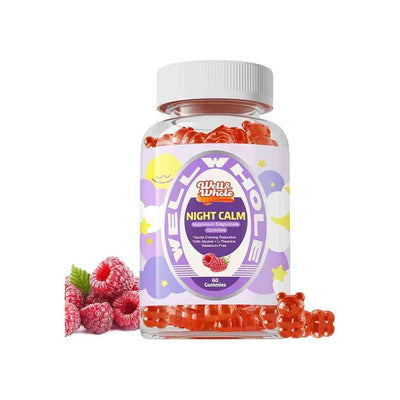
Putting it simply: if this is something you want to add to your routine, our Magnesium Bisglycinate Gummies with Apigenin & B6, Melatonin Free, 60 Ct | Gentle on Stomach, Chelated with Glycine, Night Calm Routine is a good place to start. The wider Brain Health collection is worth a look, and the Mood Support range covers related formats.
These statements have not been evaluated by the Food and Drug Administration. This product is not intended to diagnose, treat, cure, or prevent any disease.