L-Lysine 1000mg: Complete Guide to the Essential Amino Acid
Discover everything about L-lysine 1000mg—an essential amino acid for immunity, skin, and tissue repair. Compare gummies and liquid drops for absorption.

L-lysine is one of the nine essential amino acids your body cannot manufacture on its own—meaning you must obtain it through diet or supplementation. While lysine is often associated with cold sore management, its role in human health extends far beyond that single application. From collagen formation to immune function to calcium absorption, L-lysine is a foundational nutrient that affects multiple systems throughout your body.
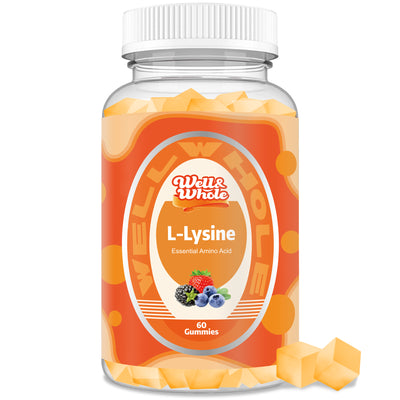
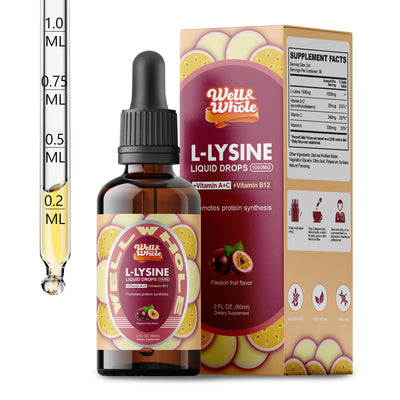
well&whole offers L-lysine in two format: L-Lysine 1000mg Gummies and L-Lysine Liquid Drops 1000mg . Both deliver the same essential amino acid, but each format offers distinct advantages.
This complete guide covers L-lysine's biochemistry, physiological roles, research evidence, and practical considerations—giving you the information needed to make informed decisions about lysine supplementation.
What Is L-Lysine?
The Essential Amino Acid
L-lysine (abbreviated Lys or K) is an essential amino acid in the α-amino group. "Essential" means your body cannot synthesize it from other compounds—you must consume it through food or supplements. The "L-" prefix denotes the biologically active stereoisomer (the form your body can use).
Chemical Properties
- **Molecular formula**: C₆H₁₄N₂O₂
- **Molecular weight**: 146.19 g/mol
- **Classification**: Essential, basic (positively charged at physiological pH)
- **Codons**: AAA, AAG
- **Key feature**: Contains an ε-amino group that participates in various biochemical reactions
This ε-amino group (the amino group on the side chain, not the α-amino group) is what makes lysine chemically distinctive. It participates in cross-linking reactions in collagen, enzyme catalysis, and protein-protein interactions.
Dietary Sources
Lysine is found in protein-rich foods:
| Food | Lysine Content (mg/100g) |
|------|--------------------------|
| Chicken breast | 2,400 |
| Beef | 2,200 |
| Fish (cod) | 2,100 |
| Eggs | 900 |
| Dairy (cheese) | 1,600 |
| Soybeans | 2,600 |
| Lentils | 1,700 |
| Spirulina | 3,100 |
**The challenge**: Plant-based diets tend to be lower in lysine compared to animal-based diets. Grains (wheat, rice, corn) are particularly lysine-poor, while legumes are lysine-rich. This means vegetarians and vegans need to pay particular attention to lysine intake through legumes, quinoa, and supplementation if needed.
L-Lysine's Physiological Roles
1. Collagen Formation and Cross-Linking
Lysine plays a critical structural role in collagen—the most abundant protein in your body, comprising approximately 30% of total body protein.
The Cross-Linking Process:
Collagen fibers gain their strength through cross-linking—a chemical process where lysine residues are enzymatically modified:
1. **Lysyl oxidase** converts specific lysine residues in collagen to allysine (an oxidized form)
2. **Allysine residues** react with other lysine or allysine residues, forming covalent cross-links
3. **These cross-links** provide the tensile strength that makes collagen fibers resilient
Without adequate lysine, this cross-linking process is impaired, potentially weakening connective tissue throughout the body—including skin, bone, cartilage, tendons, and blood vessel walls.
Research in the *Journal of Biological Chemistry* documented the essential role of lysine-derived cross-links in collagen stability, showing that impaired cross-linking resulted in significantly weaker collagen fibers (1).
2. Immune Function
Lysine supports immune function through several mechanisms:
- **Antibody production**: Antibodies (immunoglobulins) are proteins that require lysine for proper structure and function
- **Antiviral activity**: Research suggests lysine may inhibit viral replication, particularly of herpes simplex virus (HSV), by competing with arginine (see the cold sore section below)
- **Immune cell function**: Lysine is involved in the production and activity of various immune cells
- **Carnitine synthesis**: Lysine is a precursor to carnitine, which supports cellular energy production in immune cells
3. Calcium Absorption and Bone Health
Lysine enhances intestinal calcium absorption and renal calcium conservation. A study published in the *Journal of Nutrition* demonstrated that lysine supplementation significantly increased calcium absorption in both animal and human subjects (2). The mechanism involves:
- Lysine forms chelates with calcium, improving its solubility and absorption in the intestine
- Lysine reduces renal calcium excretion, helping the body retain absorbed calcium
- Lysine supports collagen formation in bone matrix (bone is approximately 90% collagen by protein content)
4. Carnitine Synthesis
Lysine, together with methionine, is a precursor for carnitine synthesis. Carnitine is essential for transporting fatty acids into mitochondria for energy production. This connection between lysine and carnitine means lysine indirectly supports:
- Fat metabolism and energy production
- Heart function (the heart relies heavily on fatty acid oxidation for energy)
- Exercise performance and recovery
5. Angiotensin and Blood Pressure Regulation
Lysine has been studied for its potential role in blood pressure regulation. Research in the *Journal of Hypertension* found that lysine supplementation reduced blood pressure in hypertensive animal models, possibly through inhibition of angiotensin-converting enzyme (ACE) activity (3).
6. Stress and Anxiety
Emerging research suggests lysine may have anti-anxiety properties. A study published in *Biomedical Research* found that lysine supplementation reduced anxiety responses in both animal models and human subjects with high baseline anxiety (4). The proposed mechanism involves lysine's role as a partial serotonin receptor 4 (5-HT4) antagonist.
L-lysine for Cold Sores: The Arginine-Lysine Balance
The Mechanism
Herpes simplex virus (HSV-1, which causes most cold sores) requires arginine for replication. Lysine competes with arginine for transport into cells and for incorporation into viral proteins. When lysine levels are high relative to arginine, viral replication may be impaired.
The lysine-arginine ratio concept:
- **High arginine / low lysine environments** promote HSV replication
- **High lysine / low arginine environments** may inhibit HSV replication
- **Foods high in arginine**: Chocolate, nuts (especially peanuts), seeds, gelatin
- **Foods high in lysine**: Dairy, fish, meat, legumes
Clinical Evidence
A review in *Alternative Medicine Review* analyzed multiple clinical studies and found that lysine supplementation (typically 1,000-3,000 mg daily) was associated with reduced cold sore frequency, severity, and healing time in many studies, though results were not universally positive (5).
The most consistent finding was that lysine was most effective when combined with a low-arginine diet—simply supplementing lysine while continuing to eat high-arginine foods produced less consistent results.
L-lysine 1000mg: Dosing Considerations
Recommended Daily Intake
The recommended dietary allowance (RDA) for lysine varies by age:
| Age Group | RDA (mg/kg/day) | Approximate Daily RDA |
|-----------|------------------|-----------------------|
| Adults 19+ | 30 | ~2,100 mg (70 kg adult) |
| Children 4-13 | 35-46 | Variable by weight |
| Infants 7-12 months | 67 | Variable by weight |
Most adults consuming a typical Western diet with adequate protein intake meet the RDA. Supplementation at 1,000 mg per day provides approximately half the daily requirement—a meaningful addition that can boost lysine levels without excessive intake.
Supplement Dose Ranges
| Goal | Typical Dose | Duration |
|------|-------------|----------|
| General lysine support | 500-1,000 mg/day | Ongoing |
| Cold sore management | 1,000-3,000 mg/day | During outbreaks; 500-1,000 mg/day for prevention |
| Collagen/tissue support | 1,000 mg/day | Ongoing |
| Athletic/performance support | 1,000-2,000 mg/day | During training periods |
Timing and Food Considerations
- **Take on an empty stomach**: Amino acids compete with dietary proteins for absorption; taking lysine between meals may improve absorption
- **Avoid high-arginine foods**: For cold sore management, reduce chocolate, nuts, and seeds during supplementation
- **Divide doses**: For doses above 1,000 mg, splitting between morning and evening may improve utilization
Gummies vs Liquid Drops: Format Comparison
L-Lysine 1000mg Gummies (P10) — $20.99
Advantages:
- Pre-measured 1,000 mg dose per serving—no measuring required
- Pleasant taste—amino acids can taste slightly bitter in liquid form; gummies mask this
- Convenient—grab and go, no dropper needed
- Portable—no spill risk
- Higher compliance—the enjoyable format makes daily use more likely
Considerations:
- Fixed dosing—can only adjust by whole/half gummy increments
- Additional gummy base ingredients (pectin, sweeteners)
- May require dissolution time before lysine is available for absorption
L-Lysine Liquid Drops 1000mg (P11) — $19.99
Advantages:
- Flexible dosing—easy to adjust by small increments for micro-dosing
- Potentially faster availability—no dissolution step needed
- Simpler formulation—fewer non-active ingredients
- Can be taken on an empty stomach more easily—liquid disperses quickly
- Lower cost—$19.99 vs $20.99
Considerations:
- Requires measuring—counting drops introduces potential variability
- Taste—lysine in liquid form may taste slightly bitter or medicinal
- Storage—liquid should be protected from light and heat
- Portability—dropper bottles can leak
Which Format to Choose?
**For daily 1,000 mg dosing**: Gummies are the practical choice—pre-measured, enjoyable, and consistent.
**For flexible dosing or between-meals timing**: Liquid drops offer more control and potentially better absorption timing.
**For budget-conscious users**: Liquid drops ($19.99) are slightly more affordable.
**For taste-sensitive users**: Gummies mask the amino acid flavor effectively.
Safety and Precautions
General Safety
L-lysine is generally safe at supplement doses. No significant adverse effects have been reported at doses up to 3,000 mg per day in healthy adults.
Considerations
- **Gallstones**: High lysine doses may theoretically increase cholesterol in gallstones; consult your doctor if you have gallbladder issues
- **Kidney disease**: High amino acid intake should be monitored in individuals with impaired kidney function
- **Arginine balance**: Very high lysine supplementation could potentially lower arginine levels, which may affect nitric oxide production and vascular health
- **Pregnancy/nursing**: Generally safe at dietary levels; consult your healthcare provider for supplement doses
FAQ
Q1: What is L-lysine and why is it essential?
L-lysine is an essential amino acid that your body cannot produce. It must be obtained through diet or supplements. It's involved in collagen formation, immune function, calcium absorption, carnitine synthesis, and other critical processes.
Q2: What does L-lysine 1000mg do?
A 1,000 mg daily supplement provides approximately half the daily requirement for an average adult. It may support collagen formation, immune function, calcium absorption, cold sore management, and tissue repair.
Q3: Can lysine help with cold sores?
Research suggests lysine supplementation (1,000-3,000 mg/day) may help reduce cold sore frequency and severity, particularly when combined with a low-arginine diet. Results vary among individuals.
Q4: Should vegans and vegetarians supplement lysine?
Plant-based diets can be lower in lysine, particularly if grain-heavy. Including lysine-rich legumes, quinoa, and soy products helps. Supplementation may be beneficial for those who struggle to meet needs through food alone.
Q5: Can I take lysine with other amino acids?
Yes. Lysine can be taken alongside other amino acid supplements. Be mindful of the arginine balance if managing cold sores—very high arginine supplementation may counteract lysine's antiviral effects.
Q6: Which format absorbs better—gummies or liquid drops?
Liquid drops may offer slightly faster availability (no dissolution step), but the practical absorption difference is likely small. Gummies' pre-measured format may improve compliance, which matters more than marginal absorption differences.
Q7: Is lysine safe during pregnancy?
Lysine at dietary levels is safe during pregnancy. Supplement doses should be discussed with your prenatal healthcare provider.
Q8: Can lysine support skin health?
Yes. Lysine is essential for collagen formation, which provides the structural foundation for skin. Adequate lysine supports skin elasticity, wound healing, and tissue repair.
Q9: Does lysine interact with medications?
Lysine has limited documented drug interactions. It may theoretically interact with aminoglycoside antibiotics (increasing nephrotoxicity risk). If you take any medications regularly, discuss lysine supplementation with your healthcare provider.
Q10: How long before I notice lysine's effects?
For cold sore management, effects may be noticeable during the next outbreak cycle (within weeks). For collagen and tissue support, effects are gradual and develop over months. For general supplementation, benefits may not be subjectively noticeable but contribute to long-term health maintenance.
Conclusion
L-lysine is a foundational essential amino acid with roles far beyond cold sore management. From collagen cross-linking to immune function, calcium absorption to carnitine synthesis, lysine contributes to the structural and functional integrity of multiple body systems.
L-Lysine 1000mg Gummies and L-Lysine Liquid Drops 1000mg provide the same essential amino acid in two convenient formats. Choose gummies for simplicity and taste, or liquid drops for flexible dosing and budget efficiency.
Whether your goal is cold sore management, collagen support, immune function, or simply ensuring adequate intake of an essential nutrient, L-lysine 1000mg is a straightforward, well-researched supplement that delivers foundational support.
Related supplements
If you'd like to try it, L-Lysine 1000mg Essential Amino Acid Supplement Gummies for Kids and Adults and L-Lysine Supplement Liquid Drops 1000mg are the closest match to what we've covered here. Browse L-lysine and Amino Acids to see how the alternatives compare.
These statements have not been evaluated by the Food and Drug Administration. This product is not intended to diagnose, treat, cure, or prevent any disease.