L-Dopa from Mucuna Pruriens: How It Supports Dopamine Production
Learn how L-Dopa from Mucuna pruriens crosses the blood-brain barrier and converts to dopamine. Explore the science of dopamine production and brain health.

Dopamine is one of the most influential molecules in the human brain. It shapes our motivation, focus, mood, movement, and sense of reward. Yet despite its importance, the brain cannot simply "absorb" dopamine from outside sources. Instead, it must manufacture dopamine from precursor molecules through a carefully regulated biochemical pathway.
This is where L-Dopa (levodopa) comes in. As the immediate precursor to dopamine, L-Dopa can cross the blood-brain barrier and be converted directly into dopamine within the brain. And nature's richest source of L-Dopa? Mucuna pruriens—the tropical legume that has captured the attention of neuroscientists and supplement enthusiasts alike.
This article explores the biochemistry of L-Dopa from Mucuna pruriens, how it supports dopamine production, and what this means for mood, motivation, and cognitive function.
The Dopamine Synthesis Pathway
From Tyrosine to Dopamine: A Two-Step Process
Dopamine is synthesized in the brain through a specific biochemical pathway:
Step 1: Tyrosine → L-Dopa
The amino acid tyrosine (obtained from dietary protein) is converted to L-Dopa by the enzyme tyrosine hydroxylase. This is the **rate-limiting step** in dopamine production—meaning it's the bottleneck that determines how fast dopamine can be made. Tyrosine hydroxylase requires iron, oxygen, and tetrahydrobiopterin (BH4) as co-factors.
Step 2: L-Dopa → Dopamine
L-Dopa is then converted to dopamine by the enzyme aromatic L-amino acid decarboxylase (AAAD), also known as DOPA decarboxylase. This enzyme requires vitamin B6 (pyridoxine) as a co-factor and is found both in the brain and throughout the body.
Why This Pathway Matters
The rate-limiting nature of Step 1 means that simply eating more tyrosine-rich foods doesn't necessarily produce more dopamine. The brain tightly regulates tyrosine hydroxylase activity to maintain dopamine within a narrow optimal range.
This is precisely why L-Dopa is so valuable. By providing the product of the rate-limiting step, L-Dopa bypasses the bottleneck and gives the brain the raw material it needs to produce dopamine—limited only by the activity of the AAAD enzyme in Step 2.
Mucuna Pruriens: Nature's L-Dopa Source
The Richest Natural Source
Mucuna pruriens seeds typically contain 3–7% L-Dopa by weight, making them the most concentrated natural source of this compound. For comparison:
| Source | L-Dopa Content |
|---|---|
| Mucuna pruriens seeds | 3–7% |
| Broad beans (fava beans) | 0.25% |
| Velvet beans (other varieties) | 1–4% |
| Regular dietary sources | Negligible |
Standardized Extracts
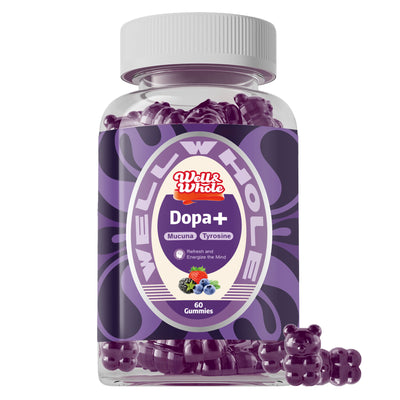
well&whole Dopamine Gummies and well&whole Mucuna Pruriens Liquid Drops both provide 500mg of Mucuna pruriens extract, standardized for consistent L-Dopa content. This standardization ensures that each dose delivers a reliable amount of the active compound.
The Blood-Brain Barrier: Why L-Dopa Is Special
The Brain's Security System
The blood-brain barrier (BBB) is a highly selective membrane that protects the brain from potentially harmful substances in the bloodstream. While this protection is essential for brain health, it also means that many molecules—including dopamine itself—cannot cross from the blood into the brain.
Dopamine is too polar and too large to cross the BBB efficiently. If you were to consume dopamine directly, it would have virtually no effect on brain dopamine levels.
L-Dopa's Passport
L-Dopa, however, can cross the blood-brain barrier. It uses a transport system designed for large neutral amino acids (LNAAs), which includes a transporter called LAT1 (Large Neutral Amino Acid Transporter 1). This transporter shuttles L-Dopa across the BBB and into the brain, where it can be converted to dopamine.
The Amino Acid Competition
There's a catch. The LAT1 transporter is shared by several amino acids, including phenylalanine, tyrosine, tryptophan, leucine, isoleucine, and valine. When you consume L-Dopa alongside a high-protein meal, these competing amino acids can reduce the amount of L-Dopa that crosses the BBB.
**Practical tip**: For optimal absorption, take Mucuna pruriens supplements between meals or with a lower-protein snack, rather than with a high-protein meal.
Peripheral Conversion: The Challenge
The AAAD Enzyme Everywhere
The enzyme that converts L-Dopa to dopamine (AAAD) exists throughout the body, not just in the brain. This means that a significant portion of orally consumed L-Dopa is converted to dopamine in the periphery—before it ever reaches the brain.
Research published in *Clinical Neuropharmacology* estimates that approximately 70–80% of oral L-Dopa is metabolized peripherally. This peripheral dopamine cannot cross the blood-brain barrier and may cause side effects such as nausea, low blood pressure, and cardiac arrhythmias.
How Medicine Solves This
In medical settings, L-Dopa for Parkinson's disease is always co-administered with a peripheral decarboxylase inhibitor (such as carbidopa or benserazide). These inhibitors block AAAD activity outside the brain, allowing more L-Dopa to reach the brain.
Natural Approaches
Mucuna pruriens supplements do not contain pharmaceutical decarboxylase inhibitors. However, the whole-plant extract may contain natural compounds that modestly influence peripheral conversion. Additionally, the lower doses used in supplementation (compared to medical L-Dopa therapy) generally result in fewer peripheral side effects.
Some practitioners recommend taking Mucuna with vitamin B6 (the AAAD co-factor) to support the conversion process, though this may also increase peripheral conversion. The optimal approach is still debated.
What Happens After Dopamine Is Produced
Dopamine Storage and Release
Once L-Dopa is converted to dopamine inside neurons, the dopamine is packaged into vesicles—small membrane-bound sacs—by a protein called VMAT2 (Vesicular Monoamine Transporter 2). This packaging protects dopamine from degradation and prepares it for release.
When a dopamine neuron fires (in response to a rewarding stimulus, a goal-directed behavior, or a motor command), the vesicles fuse with the cell membrane and release dopamine into the synapse—the gap between neurons.
Dopamine Receptors
Released dopamine binds to receptors on neighboring neurons. There are five types of dopamine receptors (D1–D5), grouped into two families:
- **D1-like receptors (D1, D5)**: Generally activate neurons and support motivation, reward, and motor function
- **D2-like receptors (D2, D3, D4)**: Generally inhibit neurons and regulate mood, impulse control, and cognitive function
Optimal dopamine signaling requires a balance between these receptor families.
Dopamine Clearance
After dopamine has done its job, it must be cleared from the synapse. This happens through two mechanisms:
1. **Reuptake**: The dopamine transporter (DAT) pumps dopamine back into the releasing neuron for reuse
2. **Degradation**: Enzymes like MAO (monoamine oxidase) and COMT (catechol-O-methyltransferase) break down dopamine into metabolites
This clearance system ensures that dopamine signals are precise and time-limited. Problems with clearance—either too fast or too slow—can affect how we feel and function.
Factors That Affect L-Dopa to Dopamine Conversion
1. Vitamin B6 Status
Vitamin B6 is the essential co-factor for the AAAD enzyme that converts L-Dopa to dopamine. Without adequate B6, this conversion is impaired. However, high-dose B6 supplementation may also increase peripheral conversion, potentially reducing the amount of L-Dopa that reaches the brain.
2. Gut Health
The gut contains significant amounts of AAAD enzyme. Gut bacteria can also metabolize L-Dopa. A study in *Science* found that specific gut bacteria can inactivate L-Dopa, potentially reducing its effectiveness. This highlights the importance of gut health for optimal supplement absorption.
3. Age
Dopamine naturally declines with age. Research in *Neurobiology of Aging* found that dopamine receptor density decreases by approximately 5–10% per decade after age 30. This age-related decline may make L-Dopa supplementation particularly relevant for older adults.
4. Stress
Chronic stress elevates cortisol, which can deplete dopamine stores and reduce dopamine receptor sensitivity. Managing stress supports the effectiveness of any dopamine-supporting strategy.
5. Diet and Protein Intake
As discussed, high-protein meals can compete with L-Dopa for absorption. Additionally, adequate intake of co-factors (B6, vitamin C, iron, folate) supports the dopamine pathway.
Potential Benefits of L-Dopa Supplementation
Mood and Emotional Balance
Dopamine is essential for experiencing pleasure and reward. Low dopamine is associated with anhedonia—the inability to feel pleasure—and flat mood. By supporting dopamine production, L-Dopa from Mucuna may help maintain emotional balance.
Motivation and Goal-Directed Behavior
Dopamine in the mesolimbic pathway (connecting the ventral tegmental area to the nucleus accumbens) is the neurochemical basis of motivation. Research in *Nature Neuroscience* demonstrated that dopamine levels directly predict willingness to exert effort for rewards.
Focus and Cognitive Clarity
Dopamine in the mesocortical pathway (connecting the ventral tegmental area to the prefrontal cortex) supports executive function, attention, and working memory. Optimal dopamine levels in this pathway are essential for sustained focus.
Motor Function
Dopamine in the nigrostriatal pathway (connecting the substantia nigra to the striatum) controls voluntary movement. This is the pathway most affected in Parkinson's disease.
Stress Resilience
By supporting dopamine levels during periods of stress, L-Dopa may help maintain motivation and cognitive function when demands are high.
Choosing Between Gummy and Liquid Formats
well&whole Dopamine Gummies (500mg):
- Pre-measured 500mg dose
- Convenient and portable
- Pleasant taste
- Good for daily consistent use

well&whole Mucuna Pruriens Liquid Drops (500mg):
- Same 500mg potency
- Potentially faster absorption (liquid bypasses tablet disintegration)
- Flexible dosing (can adjust drops)
- Easy to add to beverages
- Good for those who prefer liquids

Both products provide the same amount of Mucuna pruriens extract. The choice is primarily about format preference.
FAQ
Q: What is L-Dopa and how is it different from dopamine?
A: L-Dopa (levodopa) is the chemical precursor to dopamine. Dopamine cannot cross the blood-brain barrier, but L-Dopa can. Once in the brain, L-Dopa is converted to dopamine.
Q: How much L-Dopa is in 500mg of Mucuna pruriens extract?
A: This depends on the standardization of the extract. Mucuna pruriens seeds typically contain 3–7% L-Dopa. Check the product label for standardized L-Dopa content.
Q: Can I get L-Dopa from food?
A: Small amounts of L-Dopa are found in broad beans (fava beans) and some other legumes, but the concentrations are much lower than in Mucuna pruriens. Dietary L-Dopa alone is unlikely to significantly affect dopamine levels.
Q: Why should I take Mucuna between meals?
A: The transporter that carries L-Dopa across the blood-brain barrier is shared with other amino acids. High-protein meals can compete with L-Dopa for this transporter, reducing the amount that reaches the brain.
Q: Does Mucuna pruriens work immediately?
A: L-Dopa is converted to dopamine relatively quickly. Some users report feeling effects within 30–60 minutes. However, consistent daily use over several weeks provides the most reliable benefits.
Q: Can taking L-Dopa deplete my natural dopamine production?
A: Long-term use of exogenous L-Dopa may lead to downregulation of natural dopamine production. This is why many practitioners recommend cycling (taking breaks from supplementation).
Q: Is vitamin B6 necessary for L-Dopa to work?
A: Vitamin B6 is a co-factor for the enzyme that converts L-Dopa to dopamine. Most people get adequate B6 from diet. If you supplement with B6, be aware that high doses may increase peripheral L-Dopa conversion.
Q: Can I take Mucuna pruriens with other dopamine-supporting supplements?
A: Combining multiple dopamine-supporting supplements may increase effects. Consult your healthcare provider before combining supplements, especially if you take medications that affect dopamine.
Conclusion
The journey from Mucuna pruriens to dopamine is a remarkable example of biochemistry in action. L-Dopa from this ancient Ayurvedic herb crosses the blood-brain barrier, is converted to dopamine by a specific enzyme, and then supports the neurotransmitter systems that drive motivation, mood, focus, and movement.
Understanding this pathway helps explain why Mucuna pruriens has been valued for centuries and why modern science continues to study it. By providing the direct precursor to dopamine—bypassing the rate-limiting step in dopamine synthesis—L-Dopa from Mucuna offers a targeted approach to supporting brain dopamine levels.
Whether you choose well&whole Dopamine Gummies or Mucuna Pruriens Liquid Drops, you're giving your brain the raw material it needs to produce one of its most important neurotransmitters. Combine supplementation with a healthy lifestyle—adequate sleep, regular exercise, stress management, and a nutrient-rich diet—for the most comprehensive approach to dopamine support.
Related supplements
Should you decide to supplement, Dopamine Gummies – Mucuna Pruriens Supplements Gummies 500mg with Mood Support and Mucuna Pruriens Liquid, Mucuna Pruriens Supplements 500MG, Fuel for Focus & Attention are our formulation for this purpose. For a broader comparison, see the Mood Support and Brain Health collections.
These statements have not been evaluated by the Food and Drug Administration. This product is not intended to diagnose, treat, cure, or prevent any disease.