Is Liver Detox Real? Separating Science from Marketing
Is liver detox a real health concept or just marketing hype? Learn the science behind how your liver actually detoxifies—and what supplements can realistically support.

"Detox your liver." "Cleanse your liver in 7 days." "Flush out toxins and reset your health."
These claims appear everywhere—on supplement bottles, wellness blogs, social media posts, and juice cleanse advertisements. They sound appealing. Who wouldn't want to "reset" an organ that processes everything you consume? But beneath the marketing language, what does "liver detox" actually mean? Is there science behind it, or is it a wellness industry invention designed to sell products?
This article separates what is real from what is marketing, explains how your liver actually detoxifies, and shows what supplements can realistically support—not "detox"—your liver's natural function.
What "Liver Detox" Claims Typically Promise
Liver detox marketing generally claims one or more of the following:
- **"Flush" or "clean" the liver**: Implying that the liver accumulates toxins that need to be actively removed
- **"Reset" liver function**: Suggesting that a short-term protocol can restore optimal function
- **"Remove stored toxins"**: Claiming that environmental chemicals, heavy metals, or metabolic waste are stored in the liver and can be purged
- **"Rapid results"**: Promising noticeable effects within days
Let's examine each claim against what the science actually says.
How Your Liver Actually Detoxifies
Your Liver Does Not Store Toxins—It Processes Them
This is the fundamental misunderstanding that drives detox marketing. Your liver does not accumulate toxins like a storage tank waiting to be flushed. It is a processing plant. When toxins enter your body—through food, air, medications, or metabolic processes—your liver converts them into less harmful compounds that can be excreted through bile (into the intestines) or urine (via the kidneys).
The liver's detoxification process operates in two phases:
| Phase | Function | What Happens |
|-------|---------|-------------|
| Phase I (Functionalization) | Enzymes (CYP450 family) modify toxins to make them more reactive | Converts fat-soluble toxins into intermediate compounds |
| Phase II (Conjugation) | Intermediates from Phase I are conjugated (bound) to water-soluble molecules | Makes toxins water-soluble for excretion via bile or urine |
Phase I actually makes some toxins more reactive—and therefore more potentially harmful—before Phase II renders them safe for excretion. This means the detoxification process itself generates oxidative stress. If Phase II is sluggish (due to nutrient deficiency, liver stress, or genetic factors), Phase I intermediates accumulate and cause damage.
A 2017 review in the *Journal of Hepatology* explained this dual-phase system and noted that the primary determinant of detoxification efficiency is the liver's ongoing functional capacity—not a "flush" or "cleanse" protocol.
Glutathione: The Real "Detox" Molecule
Glutathione is the single most important molecule in liver detoxification. It is the primary conjugation substrate in Phase II—binding to toxins and rendering them water-soluble for safe excretion. It is also the liver's master antioxidant, neutralizing the free radicals generated by Phase I processing.
If you want to support your liver's detoxification capacity, the most evidence-backed approach is to support glutathione production—not "flush" anything.
Your Liver Detoxifies Continuously—Not on a Schedule
Your liver does not wait for a 7-day cleanse to start working. It processes every compound you consume, every moment of every day. The concept of "detoxing on a schedule" implies that the liver somehow stops working or falls behind, needing a periodic reset. This is not how the organ functions.
What can happen is that the liver's processing capacity becomes impaired—by NAFLD, alcohol, medication overload, chronic oxidative stress, or nutrient deficiency. When the liver is impaired, detoxification slows. But the solution is not a "flush"—it is addressing the underlying impairment and supporting the liver's functional capacity.
Where the Marketing Goes Wrong
Myth 1: "Your Liver Stores Toxins That Need to Be Flushed"
**Science says**: The liver processes toxins for excretion; it does not store them. Some fat-soluble environmental chemicals (like certain pesticides and PCBs) can accumulate in body fat, not the liver itself. The liver actively works to convert these compounds for excretion. You cannot "flush" what is not stored in the liver.
Myth 2: "A Short-Term Cleanse Can Reset Liver Function"
**Science says**: Liver function does not "reset" over a few days. Functional improvements—enzyme normalization, reduced fat accumulation, improved glutathione capacity—take weeks to months of consistent lifestyle changes and support. A 3-day juice cleanse does not meaningfully alter liver function.
A 2018 study in the *Journal of Hepatology* found that meaningful NAFLD improvement required sustained dietary changes over at least 6 months, not short-term detox protocols.
Myth 3: "Detox Products Remove Specific Toxins from Your Liver"
**Science says**: No supplement has been shown to selectively remove specific stored toxins from the liver. Supplements that support liver function (NAC, milk thistle, TUDCA) work by enhancing the liver's own detoxification pathways—not by directly pulling toxins out of storage.
Myth 4: "Everyone Needs Regular Liver Detoxing"
**Science says**: A healthy liver detoxifies efficiently without any supplemental assistance. The people who benefit most from liver support are those with identifiable liver stress—NAFLD, medication load, alcohol exposure, metabolic conditions—not healthy individuals who want a "preventive cleanse."
What Supplements Can Realistically Do
This is where science and marketing overlap—but with different framing. Supplements that contain NAC, milk thistle, TUDCA, dandelion, artichoke, and glutathione can support liver health. But they support the liver's own ongoing function—not "detox" it in the marketing sense.
| Ingredient | What It Actually Does | What Marketing Claims It Does |
|-----------|----------------------|------------------------------|
| NAC | Replenishes glutathione, the liver's primary detoxification and antioxidant molecule | "Flushes toxins," "deep cleanse" |
| Milk thistle | Provides antioxidant and anti-inflammatory support for hepatocytes | "Detoxifies the liver," "removes toxins" |
| TUDCA | Supports bile flow, reduces ER stress in liver cells | "Liver flush," "bile duct cleanse" |
| Dandelion | Supports bile production, mild diuretic effect | "Liver purifier," "blood cleanser" |
| Glutathione | Directly supplies the master antioxidant for Phase II detoxification | "Ultimate detox molecule" |
The ingredients themselves have evidence. The marketing framing ("detox," "cleanse," "flush") does not match what they actually do.
What Actually Supports Liver "Detoxification" (i.e., Function)
Based on the science, the most effective ways to support your liver's natural detoxification capacity are:
1. **Maintain adequate glutathione**: Through NAC supplementation, sufficient protein intake (for cysteine and methionine), or direct glutathione supplementation.
2. **Support bile flow**: TUDCA, dandelion, and artichoke promote healthy bile production and circulation—the pathway through which the liver excretes Phase II-conjugated toxins.
3. **Reduce oxidative stress**: Milk thistle, glutathione, and NAC provide antioxidant defense against the free radicals generated by Phase I detoxification.
4. **Reduce the incoming load**: Less alcohol, fewer unnecessary medications, fewer processed foods, and reduced environmental toxin exposure decrease the total demand on your liver's processing capacity.
5. **Maintain overall liver health**: Through diet, exercise, weight management, and consistent supplement support—not periodic "cleanses."
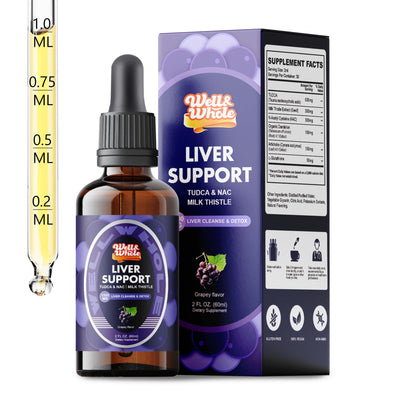
The well&whole Liver Support Liquid Drops combine NAC, TUDCA, milk thistle, dandelion, artichoke, and glutathione—not as a "detox cleanse," but as daily functional support for the liver's ongoing detoxification work.

FAQ
1. Is liver detox a real medical concept?
The liver's detoxification function (Phase I and Phase II metabolism) is real and well-established in biochemistry. The marketing concept of "liver detox" as a periodic cleansing protocol is not a recognized medical concept. Your liver detoxifies continuously; it does not need a scheduled "reset."
2. Do juice cleanses help the liver?
There is no clinical evidence that short-term juice cleanses improve liver function. Some juices provide antioxidants and hydration that support general health, but the "cleansing" claim is unsupported. A Mediterranean-style diet sustained over months is far more effective for liver health than any 3–7 day cleanse.
3. Does the liver actually store toxins?
The liver processes toxins for excretion—it does not store them long-term. Some fat-soluble environmental chemicals accumulate in body fat, not the liver. The liver actively works to process and excrete these compounds.
4. What is the best way to support liver detoxification?
Support glutathione production (via NAC or direct glutathione), maintain bile flow (via TUDCA, dandelion, artichoke), reduce incoming toxin load (less alcohol, fewer unnecessary medications), and maintain overall liver health through diet and exercise. These support the liver's own function—not a mythical "flush."
5. Can supplements "remove" toxins from the liver?
No supplement has been demonstrated to selectively remove stored toxins from the liver. Liver support supplements enhance the organ's own detoxification pathways—they do not act as toxin magnets or flushing agents.
6. Why do people feel better during "detox" protocols?
Short-term improvements during detox protocols typically come from: (1) eliminating alcohol and processed foods (which genuinely reduces liver load), (2) increasing hydration and vegetable intake (which supports general health), and (3) placebo effect. The benefits come from the dietary changes, not the "detox" mechanism.
7. Is glutathione the real key to liver detoxification?
Yes. Glutathione is the liver's primary Phase II conjugation substrate and master antioxidant. Adequate glutathione availability is the single most important factor in efficient liver detoxification. Supporting glutathione through NAC is more evidence-backed than any "detox cleanse."
8. How long does it take to improve liver function?
Measurable improvements in liver enzyme levels typically require 8–12 weeks of consistent lifestyle changes and supplement support. Significant structural improvements (reduced liver fat, fibrosis regression) may take 6–12 months. There is no 7-day shortcut.
9. Are there risks to aggressive "detox" protocols?
Yes. Extreme detox protocols—very low calorie intake, excessive supplementation, fasting—can paradoxically stress the liver by depriving it of the nutrients needed for detoxification pathways. Rapid weight loss can increase liver fat. Excessive supplement doses can cause liver injury.
10. What should I look for in a legitimate liver support product?
Look for products with specific, evidence-based ingredients (NAC, milk thistle, TUDCA, glutathione) at research-supported doses, transparent labeling, and no "detox cleanse" marketing language. The product should support ongoing liver function—not promise a quick flush. See our article "Can You Take Too Many Liver Supplements? Safety Guide" for more on choosing wisely.
Conclusion
Your liver detoxifies every day, every hour, continuously—it does not need you to "detox" it on a schedule. The marketing concept of liver detox is built on a misunderstanding of how the organ works. Your liver does not store toxins waiting to be flushed; it processes them for safe excretion, and its efficiency depends on functional capacity—not periodic cleansing.
What you can realistically do is support that functional capacity: maintain glutathione, support bile flow, reduce oxidative stress, and decrease the incoming load of substances your liver must process. These are evidence-based, physiologically sound approaches—not marketing myths.
well&whole Liver Support Liquid Drops combine NAC, TUDCA, milk thistle, dandelion, artichoke, and glutathione to support your liver's own detoxification function—every day, not just during a 7-day cleanse. Because liver support is a daily practice, not a periodic ritual.
Related supplements
If you're ready to put this into practice, our Liver Support Liquid Drops Supplement | TUDCA Drops Liver Cleanse & Detox with Milk Thistle, NAC, Dandelion, Artichoke & Glutathione for Detox and TUDCA 1000mg Gummies with Milk Thistle 500mg for Adults are formulated with this in mind. You can also compare the Liver Support and Milk Thistle ranges to find the format that suits you.
These statements have not been evaluated by the Food and Drug Administration. This product is not intended to diagnose, treat, cure, or prevent any disease.