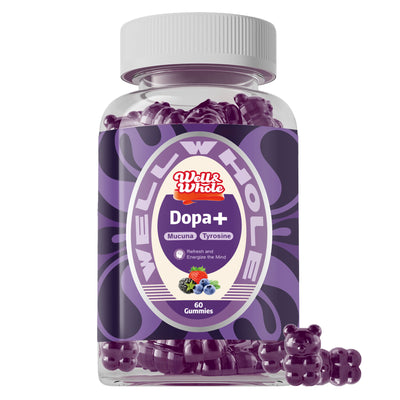
I Took Dopamine Gummies for 30 Days: Energy, Focus & What I Learned
A firsthand account of taking dopamine gummies for 30 days. Track day-by-day changes in motivation, focus, mood, and energy. Honest review with practical tips and what you should know before trying Mucuna pruriens.

I want to be upfront about something: I was skeptical. When the well&whole Dopamine Gummies – Mucuna Pruriens 500mg arrived at my desk, I gave them the same side-eye I give any supplement whose marketing involves the word "dopamine." The last five years have turned neurotransmitters into buzzwords, and "dopamine" has been stretched so thin across the wellness industry that it's practically meaningless. Dopamine fasting. Dopamine detox. Dopamine dressing. At a certain point, you start wondering if anyone actually understands what they're selling.

But here's what kept nagging at me: Mucuna pruriens isn't new-age hype. It's a tropical legume that's been used in Ayurvedic medicine for centuries, and its active compound — L-DOPA — is the same molecule prescribed as a pharmaceutical for Parkinson's disease. This isn't some proprietary blend of "brain-boosting botanicals." It's a plant with a known pharmacological mechanism. That distinction matters.
So I decided to run a 30-day experiment. One dose every morning. Track everything: energy, focus, motivation, mood, sleep quality, side effects. No other changes to my supplement routine. No new exercise programs or dietary overhauls. Just the gummies and a commitment to honest documentation.
This is what happened.
---
Week 0: Setting the Baseline
Before starting, I needed to know where I was beginning from. Here's what "normal" looked like for me:
Energy: I'd describe my baseline energy as "functional but flat." I wake up fine, get through my morning okay, but by 2-3 PM, there's a distinct fade. Not exhaustion — more like the mental equivalent of a phone battery dropping from 70% to 20% in an hour with no obvious cause.
Focus: I work in a creative profession that requires sustained concentration on writing, research, and editing. My natural focus pattern is inconsistent — some days I'm locked in for hours, other days I'm reading the same paragraph six times and still not absorbing it. Caffeine helps, but the line between "focused" and "jittery" is uncomfortably thin.
Motivation: This was my biggest friction point. The "activation energy" required to start difficult tasks — especially in the morning — felt disproportionately high. I'd stare at my to-do list, know exactly what needed doing, and feel a kind of internal resistance that had nothing to do with laziness. It felt chemical, if that makes sense.
Mood: Stable, but with a low ceiling. Not depressed, not anxious — just... muted. Hard to get genuinely excited about things. Hard to feel that "let's go" enthusiasm that I knew I was capable of.
Sleep: Generally decent. I fall asleep easily, stay asleep through the night, wake up without an alarm most days. No complaints here.
I committed to taking one serving of well&whole Dopamine Gummies – Mucuna Pruriens 500mg every morning within 30 minutes of waking up, with a light breakfast. No other new supplements. No significant lifestyle changes.

Week 1: The First 7 Days — Adjustment
Day 1
Took my first two gummies at 7:30 AM with scrambled eggs and toast. The gummies themselves taste good — slightly herbal but mostly berry-flavored, not medicinal at all. That matters when you're committing to 30 days of anything.
Within about 45 minutes, I noticed something. It wasn't dramatic — no "rush" or surge of energy — but there was a distinct shift in the quality of my attention. The best way I can describe it: normally, starting my workday feels like pushing a shopping cart with a sticky wheel. It moves, but there's resistance. This morning, the cart felt aligned. I opened my laptop, looked at my task list, and just... started. No internal negotiation. No five-minute scroll through Twitter first.
By 11 AM, I'd completed more focused work than I typically manage by lunch. The quality of the focus was notable too: less prone to tab-switching, less urge to check my phone. Not hyperfocus exactly — more like my brain was cooperating with my intentions instead of fighting them.
Days 2-3
The "smooth start" effect held. Days 2 and 3 were productive without feeling artificially stimulated. I wasn't buzzing or wired. I was just... present. The afternoon energy dip was noticeably shallower, though not eliminated. Around 3 PM I'd feel the familiar fade, but it was more like dipping to 40% instead of the usual 20%.
One unexpected observation: I felt more socially engaged. Conversations felt more rewarding. I found myself initiating discussions instead of just responding. Looking back, this makes sense — dopamine is heavily involved in social motivation and reward.
Days 4-7
By the end of Week 1, the effects had stabilized. The "novelty boost" of the first few days (which I suspect was partly placebo — new things always feel more powerful) leveled off, leaving behind a consistent, subtle enhancement. I described it in my notes as "feeling like myself on a good day, but more days feel like good days."
Side effects Week 1: None. No nausea, no headaches, no stomach issues. No sleep disruption — I was careful to take the gummies only in the morning.
---
Week 2: Settling In — What Was Actually Changing
The Task Initiation Effect
This was the most consistent benefit through Week 2. I started tracking my "task latency" — the time between deciding to do something and actually starting it. Pre-supplement, my average latency for medium-difficulty work tasks was around 8-12 minutes (enough time for "just one quick thing" that turns into 20). By Week 2, it had dropped to 2-4 minutes.
This isn't something I expected a supplement to affect. I'd always assumed my procrastination was behavioral — a habit problem, not a biology problem. But the consistency of the change (every day, not just "motivated days") suggested that dopamine availability was playing a role I'd underestimated.
The Afternoon Crash — Still There, But Different
Let me be honest: the Mucuna didn't eliminate my afternoon energy dip. What it did change was the quality of the dip. Previously, 2-4 PM felt like wading through mental mud. Thoughts were slow, motivation evaporated, and I'd inevitably reach for caffeine or sugar to compensate.
With the dopamine gummies, the afternoon felt more like a gentle slope than a cliff. I'd slow down, but I could still function. More importantly, I didn't feel the compulsion to "fix" the dip with another stimulant. I could acknowledge I was tired, take a short break, and come back without the frantic energy-seeking behavior.

Mood Observations
I started noticing something subtle around Day 10: I was laughing more. Finding things funnier. Actually looking forward to social plans instead of viewing them as obligations. My partner commented — unprompted — that I seemed "lighter" lately.
This was the most meaningful change of the experiment so far. Productivity gains are nice, but feeling more joy in daily life? That's the kind of benefit that changes your relationship with a supplement from "this helps me work" to "this helps me live better."
---
Week 3: The Plateau and the Adjustment
The Plateau
Around Day 16-17, I noticed the effects had plateaued. Not declined — I wasn't losing benefits — but they'd stopped improving. This is actually a good sign. A supplement that keeps escalating its effects is usually doing something unsustainable. A plateau suggests your system has found equilibrium with the new input.
The plateau state was solid: decent morning motivation, smoother task initiation, better emotional tone. But I also realized I needed to be strategic about what I was doing with the enhanced state. The gummies weren't going to make boring work interesting or hard work easy. They just reduced the internal friction that made those things harder than they needed to be.
An Important Error: I Took a Dose Too Late
On Day 19, I had a morning appointment and forgot to take my gummies until 11:30 AM. "It's only a few hours late," I thought. "How much could it matter?"
Answer: It mattered. I fell asleep fine that night, but the quality was different. My sleep tracker showed significantly less deep sleep than usual (43 minutes vs. my typical 65-85 minutes), and I woke up feeling like I'd slept four hours instead of seven. The lesson was clear: Mucuna pruriens is a morning-only supplement, period. Taking it after 10 AM risks disrupting sleep architecture.
Cycling Insight
By Day 21, I'd read enough about L-DOPA's potential to cause receptor downregulation with continuous use that I decided to introduce a cycling protocol. Starting Week 3, I took the gummies Monday through Friday and skipped Saturday and Sunday.
The first weekend off felt fine — no crash, no withdrawal, no "I need my dopamine" craving. Monday's return dose felt slightly more effective than the previous Friday's, suggesting the brief break was doing what cycling is supposed to do: maintaining receptor sensitivity.
---
Week 4: Final Observations and Lessons
What Definitely Improved
After 30 days, these changes felt reliable:
1. Morning activation energy: Starting work in the morning required less internal coercion. This alone made the experiment worthwhile.
2. Task follow-through: I was better at staying with a task through to completion instead of switching to something easier halfway through.
3. Baseline mood elevation: Not euphoria — just a consistent sense that life felt a little more rewarding, a little more worth engaging with.
4. Reduced caffeine dependency: I went from 2-3 cups of coffee per day to 1-2 without trying. The "must have coffee" feeling lost its urgency.
What Didn't Change
5. Sleep: Already good, stayed good. The gummies didn't make me sleepier or more alert at night.
6. Creativity: My creative output was about the same. The Mucuna helped me *execute* creative work, but didn't make me more *creative* per se. Focus ≠ imagination.
7. Afternoon energy (eliminated): Still got tired in the afternoon. Still needed breaks. The difference was in how I experienced and recovered from the fatigue, not in its elimination.
8. Exercise motivation: I was hoping for some crossover benefit to workout motivation, but I didn't notice any significant change. Getting to the gym still required discipline.
Side Effects Summary
| Side Effect | Frequency | Severity | Notes |
| Nausea | None | N/A | No stomach issues with food |
| Headache | None | N/A | — |
| Sleep disruption | Once | Moderate | Only when taken late (Day 19) |
| Jitters/anxiety | None | N/A | No overstimulation at recommended dose |
| Crash/withdrawal | None | N/A | Smooth on cycling days off |
| Digestive issues | None | N/A | — |
---
Pro Tips From My Experience
Pro Tip #1: Timing is everything.
I cannot emphasize this enough. Take your Dopamine Gummies within 30 minutes of waking up, and absolutely no later than 10 AM. The Day 19 mistake taught me this the hard way. Set a reminder on your phone until it becomes automatic.
Pro Tip #2: Pair with protein, not carbs.
I experimented with taking the gummies with different breakfasts. A protein-rich breakfast (eggs, Greek yogurt, protein shake) produced the smoothest, most sustained effect. Carb-heavy breakfasts (bagel, cereal) seemed to blunt the onset slightly. This makes biological sense — amino acids from protein support the same neurotransmitter pathways that Mucuna targets.
Pro Tip #3: Cycle 5 days on, 2 days off.
I started cycling in Week 3 and wish I'd done it from the beginning. The Monday dose after a weekend off felt subjectively stronger, suggesting the receptor rest was beneficial. My final protocol: Monday-Friday on, Saturday-Sunday off.
Pro Tip #4: Don't chase the feeling.
The first few days feel noticeably different — that smooth, frictionless start to the day. As your system adjusts, you won't "feel" the gummies in the same way. That's normal and actually desirable. If you keep increasing the dose trying to recapture those first few days, you're on a path to tolerance. The real test isn't "do I feel different?" but "am I getting more done? Am I in a better mood? Is starting tasks easier?" Track outcomes, not sensations.
Pro Tip #5: Combine with an evening wind-down supplement if you're prone to overwork.
The increased daytime motivation can lead to pushing too hard and not winding down properly. I added well&whole's [Magnesium Bisglycinate Gummies with Apigenin & B6](https://www.wellwholeshop.com/products/magnesium-bisglycinate-gummies-with-apigenin-b6-melatonin) ($21.99) to my evening routine around Week 2, and the combination — daytime dopamine support, nighttime magnesium sleep support — felt like a complete system rather than one isolated intervention. Consider this if you find yourself "too wired to sleep" despite good timing.
---
Common Mistakes to Avoid
Mistake #1: Expecting a Stimulant Effect
Mucuna pruriens is not a stimulant. It won't give you the jolt of energy that caffeine or amphetamine-class drugs produce. If you're expecting to feel "amped up," you'll be disappointed — and maybe think the supplement isn't working when it actually is. The effect is subtler: reduced resistance, smoother focus, better mood. It's a facilitator, not a driver.
Mistake #2: Skipping the Cycling Protocol
Continuous daily use of L-DOPA precursors without breaks can lead to dopamine receptor downregulation — your brain adapts to elevated dopamine by reducing receptor density, and over time, you need more to get the same effect, and eventually less (or none) works at all. The 5-on/2-off cycle prevents this. Don't skip it.
Mistake #3: Using It as a Substitute for Sleep
"You can't supplement your way out of sleep deprivation." I wrote this in my notes on Day 11 after a particularly bad night of sleep (unrelated to the supplement) and a day where the gummies barely helped. Dopamine support amplifies a functioning brain; it doesn't rescue a depleted one. If you're chronically under-slept, fix that before adding any supplement.
---
FAQ
Who should consider trying dopamine gummies?
People who struggle with morning motivation, task initiation (the "staring at my to-do list" problem), or a general sense of emotional flatness may be the best candidates. If your primary issue is physical fatigue or brain fog (as opposed to motivational friction), address sleep, nutrition, and exercise first. Mucuna pruriens helps your brain want to do things; it doesn't give you more raw energy.
How are the well&whole gummies different from other Mucuna supplements?
The gummy format eliminates the "pill fatigue" that makes supplement compliance hard, and the taste is genuinely good — this matters more than you'd think over 30 days. The 500mg dose is a reasonable middle ground (not underdosed, not excessive), and the formulation avoids the cheap fillers and artificial colors common in gummy supplements. Dopamine Gummies – Mucuna Pruriens 500mg are a solid entry point if you prefer gummies to capsules.
Can I take dopamine gummies with my morning coffee?
Yes, but pay attention to how you feel. The combination of caffeine (adenosine antagonist) and L-DOPA (dopamine precursor) can sometimes produce a jitterier feeling than either alone. I found that spacing them helped: Mucuna at 7:30 AM, first coffee around 9:00 AM. This also aligned with the natural cortisol awakening response (caffeine is most effective 90-120 minutes after waking, not immediately).
How quickly will I notice results?
The acute effects — smoother task initiation, reduced internal resistance — were noticeable on Day 1 for me. The mood benefits took about 7-10 days to become consistent. Don't judge the supplement by the first 2-3 days alone; the early novelty effect can be misleading in either direction.
What happens if I stop taking them?
When I cycled (weekends off), I experienced no withdrawal, no crash, and no noticeable drop in baseline mood below my pre-supplement normal. The Monday morning return — after two days off — was the smoothest day of each week. This suggests that proper cycling maintains both effectiveness and the baseline state.
Can I combine these with the liquid Mucuna drops?
Theoretically yes, but there's no reason to. The gummies and Mucuna Pruriens Liquid Drops 500mg both deliver Mucuna pruriens (L-DOPA). Choose one format based on preference: gummies for convenience and taste, liquid drops for faster absorption if you need quicker onset. Don't double up.
Is this safe for long-term use?
Short-term (weeks to months) use with cycling appears well-tolerated based on available evidence and traditional use history. Long-term (years) continuous use has not been studied outside of Parkinson's disease, where L-DOPA is used at much higher doses under medical supervision and is associated with motor complications after years of therapy. For healthy individuals, periodic cycling and periodic longer breaks (e.g., one month off after 2-3 months on) represent a prudent approach until more long-term data are available.
Will dopamine gummies help with ADHD?
Some individuals with ADHD report subjective benefits from Mucuna pruriens supplementation, as ADHD is associated with dysregulated dopamine signaling. However, L-DOPA from Mucuna is not a substitute for prescribed ADHD medication, and the two should not be combined without medical supervision. If you have diagnosed or suspected ADHD, discuss any supplement use with your healthcare provider, as dopaminergic supplements can interact with stimulant and non-stimulant ADHD medications.
---
Conclusion
After 30 days with well&whole's Dopamine Gummies – Mucuna Pruriens 500mg ($21.99), my verdict is this: they're not magic, and that's exactly why they're worth considering.
The supplement industry is full of products that promise transformation and deliver placebo. These gummies don't transform anything. What they do — and I believe the mechanism is the L-DOPA content supporting dopamine synthesis — is reduce the internal friction that makes daily life harder than it needs to be. Starting tasks becomes easier. Sustaining focus becomes more natural. Finding joy in ordinary moments happens more often.
The key is using them intelligently: morning only, 5 days on and 2 days off, with clear expectations about what dopamine support does and doesn't do. It doesn't replace sleep, discipline, or a functional life structure. It just makes all of those things a little more accessible.
Would I continue taking them? I already have. The morning routine — wake up, hydrate, Mucuna gummies, protein breakfast, start work — has become a reliable foundation. The combination with Magnesium Bisglycinate Gummies with Apigenin & B6 ($21.99) at night creates a complete daytime/nighttime system that I didn't know I needed until I had it.
If you're struggling with the same motivational friction I was — the sense that your brain is working against you instead of with you — these are worth a careful, well-timed trial. Just remember: morning dose, protein breakfast, cycle your weekends, and don't expect fireworks. Expect to feel a little more like yourself on a good day, a little more often.
Related supplements
Where to begin? Our Dopamine Gummies – Mucuna Pruriens Supplements Gummies 500mg with Mood Support and Mucuna Pruriens Liquid, Mucuna Pruriens Supplements 500MG, Fuel for Focus & Attention are a sensible place to start, and the Mood Support collection lays out the other formats side by side with Brain Health.
These statements have not been evaluated by the Food and Drug Administration. This product is not intended to diagnose, treat, cure, or prevent any disease.