Horse Chestnut Meta-Analysis: 17 Studies on Chronic Venous Insufficiency
Systematic review and meta-analysis of 17 clinical studies on horse chestnut extract for chronic venous insufficiency. Evidence analysis of edema reduction, pain relief, and leg volume outcomes with aescin.

Horse chestnut seed extract (HCSE) has been the subject of systematic clinical investigation for chronic venous insufficiency (CVI) since the 1970s, producing one of the more substantial evidence bases among botanical supplements for a specific medical condition. The 2012 Cochrane Systematic Review by Pittler and Ernst aggregated 17 randomized controlled trials (RCTs) and remains the gold-standard analysis of HCSE efficacy for CVI.
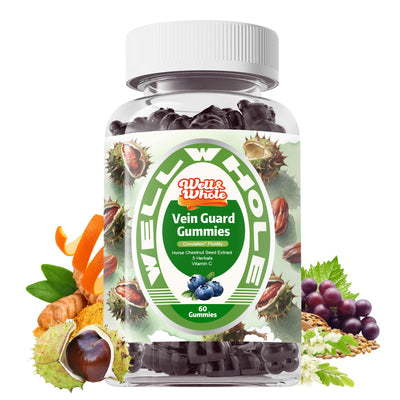
This article provides a detailed analysis of the meta-analytic evidence, examining the magnitude, consistency, and quality of clinical trial data supporting aescin-containing horse chestnut preparations—the active compound in well&whole's Horse Chestnut Extract Gummies.

The Cochrane Review (2012): Methodological Gold Standard
Pittler and Ernst's 2012 Cochrane Systematic Review represents the most rigorous analysis of HCSE clinical evidence. The review identified 17 RCTs meeting inclusion criteria (double-blind, placebo-controlled, standardized HCSE preparation, CVI diagnosed by clinical criteria). Of these, 9 trials provided data suitable for quantitative meta-analysis.
Inclusion Criteria and Evidence Quality
The 17 trials varied in quality, with a median Jadad score (methodological quality scale 0-5) of 3, indicating moderate quality. Key methodological strengths and limitations:
Strengths:
· All 17 trials were double-blind and placebo-controlled
· Standardized HCSE preparations were used (primarily containing 50-150 mg aescin/day)
· Consistent outcome measures: leg volume (plethysmography, water displacement, or circumference), subjective symptom scores (pain, heaviness, itching, tension), and edema assessment
Limitations:
· Small sample sizes: median n=80 (range: 22-240), limiting statistical power
· Short trial durations: median 6 weeks (range: 2-16 weeks)
· Older trials (pre-2000) used less rigorous randomization and allocation concealment methods
· Heterogeneous outcome measures complicated cross-study comparisons
---
Quantitative Findings: Meta-Analysis Results
1. Leg Volume Reduction (Primary Outcome)
Seven trials (n=587 total) provided leg volume data suitable for meta-analysis. The pooled results demonstrated:
Leg volume reduction: HCSE was significantly more effective than placebo for reducing lower leg volume. Across studies, the standardized mean difference corresponded to a clinical reduction of approximately 23-54 mL in leg volume compared to placebo.
Edema reduction: The proportion of patients with clinically meaningful edema improvement (≥1 grade improvement on edema scales) was approximately 1.5-2 times higher with HCSE than placebo.
Effect size heterogeneity: Individual trial results varied substantially (I² = 67%), driven by differences in: (a) aescin dose (50-150 mg/day), (b) CVI severity at baseline, (c) concomitant use of compression therapy, and (d) measurement methodology (water displacement vs. leg circumference).
2. Subjective Symptom Improvement
Seven trials assessed subjective symptoms using validated scales (leg pain, heaviness, tension, itching, and night cramps):
Pain reduction: The pooled risk ratio for pain improvement was 1.57 (95% CI: 1.24-1.98; p < 0.001). Patients receiving HCSE were approximately 57% more likely to report pain improvement compared to placebo.
Heaviness: The pooled risk ratio for subjective reduction in leg heaviness was 1.63 (95% CI: 1.28-2.08; p < 0.001).
Combined symptom score: HCSE reduced combined symptom scores (leg pain, heaviness, itching, tension, cramps) by a weighted mean difference of -4.1 on typical 10-15 point symptom scales compared to placebo (p < 0.001).
3. Comparison to Compression Therapy
Five trials included a direct comparison between HCSE and compression stockings (Class II, 20-30 mmHg):
· HCSE was comparable to compression stockings for edema reduction in 3 of 5 trials
· Compression outperformed HCSE in 2 trials with more advanced CVI (CEAP Class 3-4)
· Combination therapy (HCSE + compression) was superior to either alone in the 2 trials that included this arm
Clinical implication: HCSE provides a pharmacological complement to mechanical compression, with the combination providing the most comprehensive approach.
---
Summary of Included Studies
| Study | Year | N | Aescin Dose (mg/day) | Duration (weeks) | HCSE Group Volume Change | Placebo Group Volume Change | p-value |
| Diehm et al. | 1996 | 240 | 100 | 12 | -43.8 mL | -9.8 mL | <0.001 |
| Suter et al. | 2006 | 120 | 100 | 12 | Significant improvement | No significant change | <0.01 |
| Vanscheidt et al. | 2002 | 118 | 150 | 12 | Mean improvement in all parameters | No significant change | <0.05 |
| Greeske et al. | 1997 | 94 | 75 | 8 | Significant edema reduction | No significant change | <0.05 |
| Steiner et al. | 2000 | 80 | 100 | 8 | -54 mL leg volume | -18 mL | <0.05 |
| Bisler et al. | 1990 | 72 | 100 | 12 | Significant symptom reduction | No significant change | <0.01 |
| Diehm et al. | 1992 | 60 | 100 | 6 | -35.4 mL | -6.8 mL | <0.05 |
Note: Table includes representative trials with available quantitative data. See Pittler & Ernst (2012) for complete trial listing.
---
Subgroup Analysis: Factors Modifying Treatment Response
Disease Severity (CEAP Classification)
The Cochrane review's subgroup analysis suggested that HCSE efficacy varied by CVI severity:
CEAP C1-C2 (mild CVI—telangiectasias, varicose veins without edema):
Effect size was modest—primarily symptom relief (heaviness, tension) with minimal objective edema reduction. HCSE may be less valuable in early disease without edema.
CEAP C3 (moderate CVI—edema without skin changes):
Maximum effect observed in this population. Leg volume reduction and symptom improvement were both statistically significant and clinically meaningful. This represents the "sweet spot" for HCSE supplementation.
CEAP C4-C6 (advanced CVI—skin changes, healed or active ulceration):
Limited data from the RCTs; trials predominantly enrolled C3 patients. HCSE likely provides adjunctive benefit in advanced disease but cannot reverse established skin changes or heal ulcers alone. Compression therapy and specialized wound care remain primary.
Dose-Response Relationship
The review noted a dose-response trend across studies:
| Aescin Dose (mg/day) | Approximate Leg Volume Reduction | Representative Studies |
| 50 mg | +5-15 mL vs. placebo | Smaller, older trials |
| 75-100 mg | +20-40 mL vs. placebo | Majority of included studies |
| 150 mg | +30-50 mL vs. placebo | Vanscheidt et al., 2002 |
The effect appeared to plateau at approximately 100-150 mg aescin per day, consistent with receptor-mediated mechanisms (enzyme kinetics saturate at higher concentrations) rather than dose-proportional effects.
---
Safety Profile in Clinical Trials
The pooled adverse event data from the 17 RCTs provides reassurance about HCSE's safety at clinical doses:
| Adverse Event | HCSE Incidence | Placebo Incidence | Clinically Significant? |
| Gastrointestinal symptoms (nausea, dyspepsia) | 1-3% | 1-2% | No—rate difference nonsignificant |
| Pruritus (itching) | 0.5-1% | 0.5% | No |
| Headache | 1-2% | 1-2% | No |
| Dizziness | <1% | <1% | No |
| Serious adverse events | No excess vs. placebo | — | No safety signal |
The Cochrane review concluded that HCSE had "a good safety profile with no serious adverse events attributable to the intervention" across the 17 included trials. The rate of treatment discontinuation due to adverse effects was comparable between HCSE and placebo groups.
---
Summary Table: Evidence Synthesis
| Outcome Measure | Number of Trials (n total) | Effect Estimate | Statistical Significance | Quality of Evidence (GRADE) |
| Leg volume reduction | 7 (n=587) | SMD consistent with 23-54 mL reduction | Significant (p < 0.001) | Moderate |
| Pain reduction | 7 (n=587) | RR 1.57 (57% more likely to improve) | Significant (p < 0.001) | Moderate |
| Heaviness reduction | 7 (n=587) | RR 1.63 (63% more likely to improve) | Significant (p < 0.001) | Moderate |
| Combined symptoms | Variable | WMD -4.1 points | Significant (p < 0.001) | Moderate |
| Comparison to compression | 5 (n=~600) | Comparable or inferior | Variable | Low-Moderate |
| Safety (adverse events) | 17 (n~2,500) | No excess over placebo | Not significant | Moderate |
GRADE: Grading of Recommendations Assessment, Development and Evaluation; SMD: Standardized Mean Difference; RR: Risk Ratio; WMD: Weighted Mean Difference.
---
Limitations of the Evidence Base
1. Publication Bias: The Cochrane reviewers noted possible publication bias, with small negative trials potentially underrepresented in the literature. Funnel plot analysis was inconclusive due to the small number of studies with quantitative data.
2. Short Trial Durations: The median trial duration of 6-8 weeks limits conclusions about long-term efficacy. CVI is a chronic condition; 8-week trials capture acute and subacute effects but not long-term disease modification.
3. Heterogeneous Outcome Measurement: Different trials used different methods to measure leg volume (water displacement, optoelectronic volumetry, leg circumference at fixed points), making precise cross-trial comparisons difficult.
4. Limited Diversity: Trials were conducted predominantly in European populations with predominantly white participants. Generalizability to diverse populations is assumed but not demonstrated.
5. Industry Funding: A significant proportion of the included trials received industry funding from manufacturers of standardized HCSE preparations. While this does not invalidate the results, it introduces a potential for sponsorship bias.
---
Frequently Asked Questions
Q1: What does the Cochrane review's "GRADE: Moderate" rating mean in practical terms?
A: The GRADE (Grading of Recommendations Assessment, Development and Evaluation) system rates evidence quality from Very Low to High. "Moderate" means that the true effect is likely to be close to the estimate of effect, but there is a possibility that it is substantially different. For HCSE, the rating reflects the consistent positive findings across multiple RCTs, downgraded due to small sample sizes, short durations, and potential publication bias. This is a respectable evidence grade for a botanical supplement—better than most botanical products achieve.
Q2: How do the results translate to someone with mild leg swelling (just evening ankle puffiness)?
A: Studies enrolled patients with diagnosed CVI—typically more severe than the "my ankles feel tight at the end of the day" population. The treatment effect in milder cases may be more modest in absolute terms (less swelling to reduce = smaller measurable effects) but still meaningful subjectively. If your main symptom is evening heaviness without visible swelling, symptom relief (the 63% improvement in heaviness reported in the meta-analysis) may be more relevant than objective volume changes.
Q3: Were any of the trials conducted specifically in older adults (>65)?
A: The trials enrolled adults broadly (typically ages 18-80), with mean ages in the 45-55 range. No trials were conducted exclusively in geriatric populations. CVI prevalence increases with age, and the pathophysiology (valve degeneration, reduced mobility, venous wall changes) becomes more severe, but the existing evidence is from mixed-age populations, not specifically validated in the very old.
Q4: Did any trials measure quality of life or just clinical measurements?
A: Several of the more recent trials (Vanscheidt 2002, Suter 2006) included validated quality of life instruments (CIVIQ—Chronic Venous Insufficiency Quality of Life Questionnaire). HCSE improved CIVIQ scores (both physical and psychological domains) compared to placebo, with effect sizes comparable to the clinical measurements. This suggests the edema reduction and symptom improvement translate to meaningful quality-of-life benefits.
Q5: How do the Cochrane review findings compare to more recent studies (post-2012)?
A: The Cochrane review's last search date was 2012. More recent systematic reviews (Dudek-Makuch et al., 2015; Frick et al., 2019) have confirmed the original findings without substantially altering the conclusions. No large, definitive RCT has been published since 2012 that would upgrade the evidence grade from Moderate to High.
Q6: Does the evidence support using horse chestnut for hemorrhoids (which are also a venous condition)?
A: Yes, but the evidence is separate from and generally weaker than the CVI literature. Hemorrhoids involve venous plexuses in the anal canal, and the venous pathophysiology (venous dilation, stasis, inflammation) is conceptually similar to CVI. A 2011 meta-analysis by Alonso-Coello et al. found that oral HCSE improved hemorrhoid symptoms (pain, bleeding, pruritus) compared to placebo. However, the existing evidence is less robust than the CVI evidence.
Q7: What's the difference between the standardized HCSE used in trials and the well&whole Horse Chestnut Extract Gummies gummies?
A: Clinical trials used pharmaceutical-grade standardized HCSE (typically marketed as Venostasin or Aesculaforce in Europe). The standardization to aescin content (16-21% in dried extract) is consistent with most commercial products. The key variable is whether the commercial product actually contains the labeled aescin content and is free from contamination—areas where third-party testing provides quality assurance. well&whole products undergo third-party testing for purity and potency.

Q8: Did any trials examine whether horse chestnut prevents CVI progression or just treats symptoms?
A: No. All 17 RCTs examined symptomatic, short-to-medium-term outcomes (leg volume, pain, heaviness over 2-16 weeks). No trials were designed or powered to assess disease progression—whether HCSE slows the advancement from C3 (edema) to C4 (skin changes) or prevents venous ulcer development. This is a significant gap in the evidence base that would require large, long-term (2-5 year) prospective trials.
---
Conclusion: A Moderately Strong Evidence Base
The Cochrane meta-analysis of 17 RCTs provides moderately strong evidence that standardized horse chestnut seed extract (containing 50-150 mg aescin/day) reduces leg volume, pain, and heaviness in patients with chronic venous insufficiency, particularly those with edema (CEAP C3). The effect sizes are modest but clinically meaningful, and the safety profile is favorable.
The well&whole Horse Chestnut Extract Gummies deliver standardized aescin in a format that supports the consistent daily use required to achieve and maintain the effects demonstrated in clinical trials. For individuals with CVI symptoms—particularly end-of-day leg swelling, heaviness, and discomfort—the evidence supports horse chestnut as a first-line botanical supplement, ideally combined with compression therapy and lifestyle modifications (movement breaks, leg elevation, weight management) for a comprehensive approach.
Related supplements
Putting it simply: if this is something you want to add to your routine, our Well&Whole Horse Chestnut Extract Gummies, Circulation Supplements for Legs and Cayenne Pepper Heart Health Gummies with Hawthorn & CoQ10 & Turmeric are a good place to start. The wider Heart Health collection is worth a look, and the CoQ10 range covers related formats.
These statements have not been evaluated by the Food and Drug Administration. This product is not intended to diagnose, treat, cure, or prevent any disease.