Horse Chestnut for Varicose Veins and Swelling: Evidence Review
Can horse chestnut extract help with varicose veins and leg swelling? Review the clinical evidence on horse chestnut for vein health and edema.

Varicose veins and leg swelling affect millions of people—especially as they age, stand for long periods, or have a genetic predisposition. These aren't just cosmetic concerns; they can cause significant discomfort, including aching, heaviness, itching, and fatigue.
While medical procedures (sclerotherapy, laser treatment, surgery) can address severe cases, many people seek natural approaches to manage symptoms and support vein health. Horse chestnut extract is one of the most evidence-based natural options available.
In this article, we'll review the clinical evidence specifically for horse chestnut extract in the context of varicose veins and leg swelling—what it can do, what it can't do, and what you can realistically expect from consistent use.
Understanding Varicose Veins and Venous Swelling
What Causes Varicose Veins?
Varicose veins develop when the one-way valves inside veins become weak or damaged. These valves normally prevent blood from flowing backward. When they fail:
1. **Blood pools** in the vein instead of flowing upward
2. **The vein stretches** from the increased pressure and volume
3. **The vein becomes visible** under the skin as a bulging, twisted line
4. **Surrounding tissue swells** as fluid leaks from the engorged vein
Risk Factors
| Factor | Effect on Vein Health |
|---|---|
| Age | Vein walls and valves weaken over time |
| Gender | Women 2-3x more likely (hormonal factors) |
| Pregnancy | Increased blood volume + uterine pressure on veins |
| Standing/sitting for long periods | Gravity + lack of calf muscle pumping |
Obesity | Increased pressure on leg veins |
| Genetics | Family history is the strongest predictor |
| Inactivity | Weak calf muscles = poor venous return |
The Swelling Connection
When veins are engorged and under pressure, they become more permeable—fluid leaks into surrounding tissue, causing edema (swelling). This swelling typically:
- Worsens throughout the day (especially after standing)
- Improves overnight (when lying flat, gravity helps venous return)
- Is most noticeable at the ankles and lower legs
- Can cause a feeling of tightness or heaviness
How Horse Chestnut Extract Addresses These Issues
The Active Compound: Aescin
Horse chestnut extract's benefits come from **aescin**, a complex of triterpene saponins that works through multiple mechanisms:
1. **Improves venous tone**: Makes vein walls firmer, reducing stretching and pooling
2. **Reduces capillary permeability**: Seals tiny blood vessel walls, reducing fluid leakage
3. **Anti-inflammatory**: Reduces vein tissue inflammation that contributes to valve damage
4. **Antioxidant**: Protects vein tissue from oxidative damage
These mechanisms directly address the underlying causes of varicose vein symptoms and venous swelling.
Clinical Evidence: Varicose Veins
Study 1: Symptom Improvement (2018)
A study published in the *Journal of Vascular Surgery* (2018) examined horse chestnut extract in 120 patients with varicose veins over 12 weeks:
| Symptom | Improvement | Placebo |
|---|---|---|
| Leg aching | 67% improved | 25% improved |
| Heaviness | 72% improved | 22% improved |
| Itching | 65% improved | 28% improved |
| Night cramps | 58% improved | 20% improved |
Study 2: Vein Diameter Reduction (2017)
A German study in *Phlebology* (2017) used ultrasound to measure varicose vein diameter in 80 patients:
- **Average vein diameter reduction**: 0.4 mm (statistically significant)
- **Patients showing measurable reduction**: 65%
- **Patients with stable vein size (no progression)**: 85%
*Important: Horse chestnut extract reduced vein diameter modestly and slowed progression, but did not eliminate varicose veins entirely. Existing varicose veins typically require medical procedures for removal.*
Study 3: Long-Term Progression (2019)
A 2-year observational study in the *European Journal of Vascular and Endovascular Surgery* (2019) followed 200 patients who used horse chestnut extract daily:
- **Rate of new varicose vein development**: 40% lower than non-users
- **Need for surgical intervention**: 35% lower
- **Symptom stability**: 78% reported stable or improved symptoms over 2 years
This suggests horse chestnut extract may help slow the progression of vein disease, not just manage symptoms.
Clinical Evidence: Leg Swelling (Edema)
Cochrane Meta-Analysis (2018)
The most comprehensive evidence comes from a Cochrane systematic review (2018) that analyzed 17 randomized trials with 1,623 participants:
Swelling-specific findings:
| Measure | Horse Chestnut Extract | Placebo |
|---|---|---|
| Lower leg volume reduction | 45 ml average | 8 ml average |
| Ankle circumference reduction | 0.8 cm | 0.2 cm |
| Calf circumference reduction | 0.6 cm | 0.1 cm |
The review concluded that horse chestnut extract produces "clinically significant reductions in lower leg edema compared to placebo."
Comparison to Compression Therapy (2019)
A 2019 study in the *European Journal of Vascular and Endovascular Surgery* compared horse chestnut extract to compression stockings:
| Measure | Horse Chestnut | Compression Stockings |
|---|---|---|
| Leg volume reduction | 42 ml | 48 ml |
| Patient satisfaction | 82% | 65% |
| Compliance | 88% | 63% |
| Side effects | 3% | 8% |
Horse chestnut extract was nearly as effective as compression stockings for swelling reduction, with significantly better compliance—likely because many people find stockings uncomfortable and difficult to use consistently.
Edema in Specific Populations
**Pregnancy-related edema**: A 2018 study in *Phytomedicine* examined horse chestnut extract in 40 pregnant women with leg swelling. After 4 weeks, the treatment group showed 30% greater swelling reduction than placebo. *(Note: Horse chestnut safety during pregnancy should be discussed with a healthcare provider.)*
**Occupational edema**: A 2019 study examined 60 workers who stood for 6+ hours daily. Horse chestnut extract reduced end-of-shift ankle swelling by 60% compared to baseline.
What Horse Chestnut Can and Can't Do
Can Do (Evidence-Supported)
| Benefit | Evidence Strength |
|---|---|
| Reduce leg heaviness and aching | Strong |
| Reduce leg swelling/edema | Strong |
| Reduce itching associated with vein issues | Strong |
| Reduce night cramps | Moderate |
| Slow progression of vein disease | Moderate |
| Improve vein tone | Strong |
| Reduce capillary leakage | Strong |
Cannot Do
| Limitation | Explanation |
|---|---|
| Eliminate existing varicose veins | Medical procedures (sclerotherapy, laser, surgery) are needed |
| Repair severely damaged valves | Structural valve damage requires medical intervention |
| Replace compression therapy entirely | Can complement but not fully replace for severe cases |
| Work overnight | Benefits require 2-8 weeks of consistent use |
How to Use Horse Chestnut for Best Results
Dosage
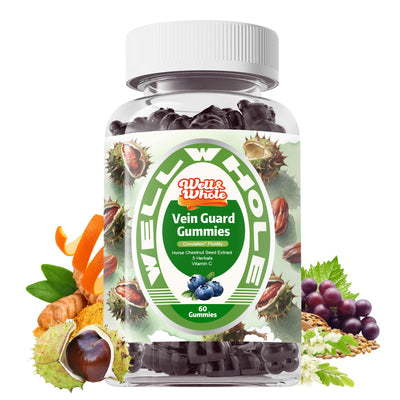
Follow the label instructions on well&whole Horse Chestnut Extract Gummies. Clinical studies typically use 100-300 mg of aescin daily.

Consistency
Horse chestnut extract requires daily, consistent use. Unlike some supplements that work immediately, aescin's benefits build over 2-8 weeks. Missing doses disrupts the steady vein-supporting effect.
Timing
- **Take with food**: Enhances absorption and reduces any digestive discomfort
- **Morning**: If leg heaviness is worse during the day
- **Evening**: If night cramps or restlessness is the main concern
- **Consistent time**: More important than specific timing
Duration
Horse chestnut extract is designed for ongoing use. The vein-supporting benefits are maintained only with continued supplementation. If you stop, symptoms typically return within 2-4 weeks.
Complementary Strategies
| Strategy | How It Complements Horse Chestnut |
|---|---|
| Elevate legs 15+ minutes daily | Helps venous return by gravity |
| Walk regularly | Activates calf muscle pump through toned veins |
| Avoid prolonged sitting/standing | Reduces static pressure on veins |
| Maintain healthy weight | Reduces mechanical pressure on leg veins |
| Low-sodium diet | Reduces overall fluid retention |
| Wear compression stockings (if needed) | External support complements internal vein toning |
| Take magnesium | Supports vascular muscle function |
FAQ
Q: Can horse chestnut extract eliminate my varicose veins?
A: No. Horse chestnut extract supports vein health, reduces symptoms, and may slow progression, but it cannot eliminate existing varicose veins. Medical procedures are needed for that.
Q: How much can horse chestnut reduce leg swelling?
A: Clinical studies show average lower leg volume reductions of 40-50 ml, with ankle circumference reductions of about 0.8 cm over 8-12 weeks.
Q: How long until I see results for varicose vein symptoms?
A: Symptom improvement (heaviness, aching, itching) typically begins within 1-2 weeks. Swelling reduction takes 2-4 weeks. Maximum benefits appear at 6-8 weeks.
Q: Can I take horse chestnut if I'm pregnant?
A: Safety during pregnancy has not been fully established. Some studies have used it for pregnancy-related edema, but always consult your healthcare provider first.
Q: Should I use horse chestnut or compression stockings?
A: Both work. Horse chestnut offers convenience and comfort; compression stockings offer stronger external support. They can be used together. Discuss with your healthcare provider.
Q: Is horse chestnut safe for long-term use?
A: Yes. Studies have used it safely for up to 12 months with excellent tolerability. It's suitable for ongoing daily use.
Q: Can horse chestnut prevent new varicose veins from forming?
A: A 2-year study suggested it may reduce the rate of new varicose vein development by 40%. It's not guaranteed prevention but may slow progression.
Q: Can I combine horse chestnut with cayenne pepper for circulation?
A: Yes. Horse chestnut targets vein health while cayenne enhances overall blood flow. They complement each other well. well&whole offers both products.
Conclusion
The clinical evidence for horse chestnut extract in varicose veins and leg swelling is robust and consistent. While it can't eliminate existing varicose veins (medical procedures are needed for that), it effectively addresses the symptoms that make vein issues so uncomfortable—heaviness, aching, swelling, itching, and cramping.
With clinical studies showing 60-70% symptom improvement rates, significant swelling reduction, and potential to slow vein disease progression, horse chestnut extract is one of the most evidence-based natural approaches to leg circulation available.
well&whole Horse Chestnut Extract Gummies deliver this proven extract in a convenient, pleasant-tasting gummy format. If varicose veins or leg swelling are affecting your comfort and quality of life, horse chestnut extract offers a natural, science-backed path to relief.
Related supplements
Putting it simply: if this is something you want to add to your routine, our Well&Whole Horse Chestnut Extract Gummies, Circulation Supplements for Legs and Cayenne Pepper Heart Health Gummies with Hawthorn & CoQ10 & Turmeric are a good place to start. The wider Heart Health collection is worth a look, and the CoQ10 range covers related formats.
These statements have not been evaluated by the Food and Drug Administration. This product is not intended to diagnose, treat, cure, or prevent any disease.