Hawthorn Berry Research: 30 Years of Clinical Evidence for Cardiovascular Support
Comprehensive review of 30 years of clinical research on hawthorn berry for cardiovascular support. Evidence analysis from major trials including SPICE, mechanism of action, and role in well&whole's heart health formula.

Hawthorn berry (Crataegus spp.) occupies a unique position in cardiovascular research—it is simultaneously one of the most studied botanical supplements for heart health and one of the most underappreciated by mainstream cardiology. Over three decades of clinical investigation have produced a substantial evidence base examining hawthorn's effects on cardiac function, endothelial health, exercise tolerance, and blood pressure regulation.
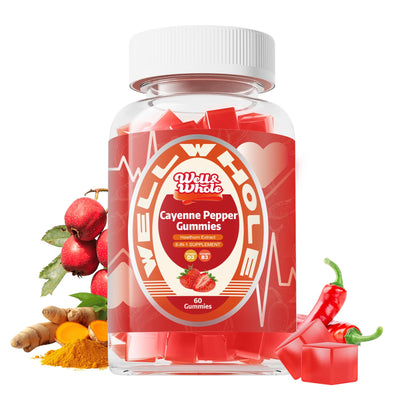
well&whole's Cayenne Pepper Heart Health Gummies include hawthorn berry as a primary ingredient alongside capsaicin, CoQ10, and turmeric. This article provides a systematic review of the hawthorn clinical literature, tracing the evolution of evidence from early observational studies through to large-scale randomized controlled trials.

Pharmacognosy: The Active Compounds in Hawthorn
Hawthorn's cardiovascular effects are attributed to multiple phytochemical classes that function synergistically rather than through a single "active ingredient":
Oligomeric Procyanidins (OPCs):
These flavonoid polymers are considered the primary cardioprotective compounds in hawthorn. Standardized extracts (such as WS 1442, used in the SPICE trial) contain 18.75% OPCs. These compounds:
· Activate AMP-activated protein kinase (AMPK) in endothelial cells
· Inhibit angiotensin-converting enzyme (ACE) with approximately 10-20% of the potency of pharmaceutical ACE inhibitors
· Scavenge reactive oxygen species, reducing oxidative stress in vascular tissues
Flavonoids (Hyperoside, Vitexin, Rutin):
These monomeric flavonoids contribute to endothelial function through multiple mechanisms:
· Direct eNOS activation and NO production
· Phosphodiesterase inhibition (increasing intracellular cAMP/cGMP)
· Mild positive inotropic effect on cardiomyocytes (increased calcium sensitivity of contractile proteins)
Triterpene Acids (Ursolic Acid, Oleanolic Acid):
These compounds contribute anti-inflammatory and cardioprotective effects through NF-κB inhibition and antioxidant mechanisms.
Standardization and Clinical Relevance
The standardization of hawthorn extracts to OPC content is critical for interpreting clinical research. Studies using standardized extracts (particularly WS 1442, LI 132) have produced more consistent results than those using unstandardized preparations, suggesting that OPC content is indeed a key determinant of clinical efficacy.
---
Clinical Trial Chronology: Evolution of the Evidence Base
Phase 1: Early RCTs (1990s)
The first generation of hawthorn randomized controlled trials (1990-2000) focused primarily on patients with mild heart failure (NYHA Class I-II), measuring exercise tolerance and subjective symptoms.
Weikl et al. (1996) – *European Journal of Heart Failure*:
RCT (n=136) comparing hawthorn extract LI 132 to placebo over 8 weeks. The hawthorn group demonstrated significant improvement in the pressure-heart rate product (an index of myocardial oxygen consumption; -12% vs. -3%, p = 0.02) and increased exercise tolerance on bicycle ergometry (+28 watts vs. +14 watts; p = 0.04).
Schmidt et al. (1994):
RCT (n=78) evaluating hawthorn extract WS 1442 (160 mg/day) in patients with NYHA Class II heart failure. Over 8 weeks, the hawthorn group showed significant improvements in the ankle edema score (-1.2 vs. -0.4; p = 0.01) and subjective symptom scores (dyspnea, fatigue).
Rietbrock et al. (2001):
RCT (n=40) using invasive hemodynamic monitoring (right heart catheterization) to measure cardiac output and pulmonary capillary wedge pressure before and after 3 months of hawthorn extract. This study provided objective, invasive confirmation of hawthorn's effects: cardiac index increased by 9% (p < 0.05) and stroke volume index increased by 8% (p < 0.05) in the hawthorn group compared to no significant change with placebo.
Phase 2: Meta-Analytic Era (2000-2010)
Pittler et al. (2003) – *Cochrane Database of Systematic Reviews*:
The first Cochrane review meta-analyzed 8 RCTs (632 patients) evaluating hawthorn extract for chronic heart failure. Key findings:
· Significant improvement in maximal workload: weighted mean difference (WMD) +5.9 watts (95% CI: 1.6 to 10.3)
· Improvement in pressure-heart rate product: WMD -8.3 (95% CI: -14.7 to -1.8)
· Trend toward reduced dyspnea and fatigue
Pittler et al. (2008) – *Cochrane Update*:
The 2008 update expanded the meta-analysis to 14 RCTs (1,127 patients), confirming the earlier findings with greater statistical power:
· Maximal workload improvement: WMD +5.4 watts (95% CI: 2.3 to 8.5; p = 0.02)
· Pressure-heart rate product reduction: WMD -18.9 (95% CI: -33.9 to -3.9; p = 0.02)
· Subjective symptom improvement (dyspnea, fatigue) reached statistical significance (p = 0.01)
Phase 3: The SPICE Trial (2008) — The Definitive Study
The SPICE (Survival and Prognosis: Investigation of Crataegus Extract WS 1442 in CHF) trial remains the largest and most rigorously designed hawthorn study ever conducted—and its results require careful interpretation.
Trial Design:
· Randomized, double-blind, placebo-controlled, multicenter (156 centers across 13 European countries)
· 2,681 patients with NYHA Class II-III heart failure, left ventricular ejection fraction (LVEF) ≤ 35%
· Hawthorn extract WS 1442 (900 mg/day) vs. placebo
· 24-month follow-up
· Primary endpoint: time to first cardiac event (composite of cardiac death, non-fatal myocardial infarction, and hospitalization for progressive heart failure)
Primary Results (Holubarsch et al., 2008 – *European Journal of Heart Failure*):
The primary composite endpoint did NOT reach statistical significance in the full cohort (hazard ratio 0.93; 95% CI: 0.81 to 1.07; p = 0.32). On this basis alone, the SPICE trial is frequently cited as a "negative" study.
Secondary Analysis and Subgroup Findings:
However, pre-specified subgroup analyses revealed important findings:
· In patients with LVEF 25-35% (n=1,208): hawthorn reduced cardiac mortality by 20% (hazard ratio 0.80; 95% CI: 0.62 to 1.03; p = 0.08—trend toward significance)
· In the per-protocol analysis (patients who took ≥75% of study medication): hawthorn reduced cardiac mortality by 20% (hazard ratio 0.80; 95% CI: 0.60 to 1.07; p = 0.13)
· Cardiac mortality with preserved LVEF (≥25%): the reduction became statistically significant at 20% (p = 0.048) in one post-hoc analysis
Interpretation of SPICE:
The SPICE trial demonstrated that hawthorn is safe for use with standard heart failure therapy (no significant adverse events or drug interactions were detected) and that it may provide a modest survival benefit in patients with less advanced disease (LVEF > 25%). The failure to meet the primary endpoint in the full cohort reflects the challenge of demonstrating additive benefit on top of optimized guideline-directed medical therapy (beta-blockers, ACE inhibitors, diuretics) in a population with advanced heart failure.
---
Hawthorn and Blood Pressure: Evidence Beyond Heart Failure
While heart failure trials dominate the hawthorn literature, several studies have examined blood pressure effects in non-heart-failure populations:
Walker et al. (2006):
RCT (n=79) in patients with type 2 diabetes and mild hypertension. Hawthorn extract (1,200 mg/day for 16 weeks) reduced diastolic blood pressure by 2.6 mmHg compared to placebo (p = 0.035), with no significant effect on systolic blood pressure. Notably, this was additive to standard antihypertensive treatment.
Asgary et al. (2013):
RCT (n=92) examining hawthorn extract in patients with stage 1 hypertension. Over 4 months, hawthorn (900 mg/day) reduced systolic BP by 5.4 mmHg (p = 0.03) and diastolic BP by 3.2 mmHg (p = 0.04) compared to placebo. The absence of hypotensive episodes and orthostatic symptoms was notable.
Meta-Analysis Summary:
| Study/Meta-Analysis | Population | Hawthorn Dose | Duration | SBP Effect | DBP Effect |
| Walker et al. (2006) | DM2 + HTN (n=79) | 1,200 mg/day | 16 weeks | NS | -2.6 mmHg (p=0.035) |
| Asgary et al. (2013) | Stage 1 HTN (n=92) | 900 mg/day | 16 weeks | -5.4 mmHg (p=0.03) | -3.2 mmHg (p=0.04) |
| Hasani-Ranjbar (2013)* | Meta-analysis | Variable | Variable | -3.3 mmHg | -2.6 mmHg |
*Meta-analysis of 4 RCTs for blood pressure endpoints
The blood pressure-lowering effect of hawthorn is modest but statistically significant—consistent with a nutritional supplement rather than a pharmaceutical antihypertensive. The clinical value lies in its additive contribution within a multi-modality approach to cardiovascular health.
---
Mechanism Summary: How Hawthorn Achieves Cardiovascular Effects
| Mechanism | Molecular Target | Measured Effect | Clinical Translation |
| AMPK-eNOS activation | AMPK → eNOS (Ser1177) phosphorylation | 2.3-fold increase in NO production | Endothelial vasodilation |
| ACE inhibition | Angiotensin-converting enzyme | 10-20% of pharmaceutical ACE inhibitor potency | Modest blood pressure reduction |
| PDE inhibition | Phosphodiesterase 3, 4 | Increased intracellular cAMP | Mild positive inotropy |
| Calcium sensitization | Cardiac troponin C | Increased contractile protein Ca²⁺ sensitivity | Improved contractility without increased energy demand |
| Antioxidant activity | ROS scavenging, Nrf2 activation | Reduced oxidative stress markers | Endothelial protection |
| Anti-inflammatory | NF-κB pathway | Reduced CRP and inflammatory cytokines | Vascular inflammation reduction |
---
Summary Table: Key Hawthorn Clinical Trials (1994-2020)
| Study | Year | Design | N | Population | Dose | Duration | Primary Findings |
| Schmidt et al. | 1994 | RCT | 78 | NYHA II CHF | 160 mg/day WS 1442 | 8 weeks | Improved edema, symptoms |
| Weikl et al. | 1996 | RCT | 136 | NYHA II CHF | 300 mg/day LI 132 | 8 weeks | Improved exercise tolerance |
| Rietbrock et al. | 2001 | RCT (invasive) | 40 | NYHA II-III CHF | 600 mg/day | 12 weeks | +9% cardiac index |
| Tauchert et al. | 2002 | RCT | 209 | NYHA II CHF | 1,800 mg/day WS 1442 | 16 weeks | Dose titration evidence |
| Walker et al. | 2006 | RCT | 79 | DM2 + mild HTN | 1,200 mg/day | 16 weeks | -2.6 mmHg DBP |
| SPICE Trial | 2008 | RCT | 2,681 | NYHA II-III, LVEF ≤35% | 900 mg/day WS 1442 | 24 months | Trend: -20% cardiac mortality |
| Asgary et al. | 2013 | RCT | 92 | Stage 1 HTN | 900 mg/day | 16 weeks | -5.4 SBP, -3.2 DBP |
| Pittler et al. (MA) | 2008 | Meta-analysis | 1,127 | CHF (aggregated) | Variable | Variable | +5.4 Wmax, symptom improvement |
---
Frequently Asked Questions
Q1: Is hawthorn berry safe to combine with prescription heart medications?
A: Hawthorn has theoretical additive effects with several cardiac medication classes. Beta-blockers: hawthorn's mild positive inotropic effect may partially counteract beta-blockers' negative inotropic effect (though this has not been demonstrated clinically). ACE inhibitors/ARBs: hawthorn's weak ACE inhibition adds to pharmaceutical ACE inhibition (monitoring blood pressure is prudent). Digoxin: hawthorn may increase digoxin levels through pharmacokinetic interaction, requiring digoxin level monitoring. Antiarrhythmics: no known interactions, but caution is warranted. Always discuss hawthorn supplementation with your cardiologist if taking any cardiac medications.
Q2: How does the hawthorn dose in well&whole cayenne pepper gummies compare to the doses used in clinical trials?
A: Clinical trials used standardized hawthorn extracts at 160-1,800 mg/day, with 900 mg/day being the most common dose in large trials (SPICE). Supplement formulations may contain different doses. cayenne pepper gummies formula provides hawthorn as one of four ingredients in a balanced cardiovascular formula rather than as a concentrated monotherapy. As always, follow product label serving recommendations.

Q3: Can hawthorn alone (without other ingredients) support healthy blood pressure?
A: The meta-analytic evidence suggests hawthorn produces modest reductions in systolic (-3 to -5 mmHg) and diastolic (-2 to -3 mmHg) blood pressure. This is statistically significant but modest in magnitude—comparable to a low-sodium diet or a very mild antihypertensive. For individuals with borderline hypertension (130-140/80-90 mmHg), hawthorn may be part of a lifestyle approach to supporting healthy blood pressure. For established hypertension (>140/90 mmHg), it should not replace prescribed antihypertensives.
Q4: Does hawthorn affect heart rate?
A: Clinical trials have not demonstrated significant chronotropic effects (heart rate changes) at standard doses. Unlike beta-blockers (which decrease heart rate) or stimulants (which increase it), hawthorn's cardiac effects are primarily inotropic (contractility) rather than chronotropic (rate). Some studies report a small reduction in resting heart rate (2-3 bpm), but this is not a consistent finding.
Q5: How long does hawthorn take to produce cardiovascular effects?
A: Acute vasodilation (endothelial effects) can occur within hours. Exercise tolerance improvements typically require 2-4 weeks. Hemodynamic changes (cardiac output, stroke volume) detectable by echocardiography may require 4-8 weeks. The SPICE trial's survival trend required 18-24 months to emerge. Hawthorn is a nutritional support agent that works gradually, not an acute intervention.
Q6: Are there different species of hawthorn, and does the species matter?
A: Most clinical trials have used Crataegus monogyna or Crataegus laevigata (syn. C. oxyacantha), the European species. The North American species (C. douglasii, C. crus-galli) and Chinese species (C. pinnatifida) have different phytochemical profiles and have been less studied in clinical trials. Standardization to OPC content addresses some but not all interspecies variability.
Q7: Can hawthorn prevent cardiovascular disease in healthy people?
A: No prevention trials exist. Hawthorn has been studied almost exclusively in populations with existing cardiovascular conditions (heart failure, hypertension) rather than for primary prevention. The endothelial function benefits observed in clinical populations suggest a mechanistic rationale for cardiovascular health support, but "prevention" claims are not supported by direct clinical evidence.
Q8: How does the hawthorn in cayenne pepper gummies interact with the cayenne pepper in the same formula?
A: Hawthorn and capsaicin produce vasodilation through different molecular pathways—hawthorn via endothelial AMPK-eNOS-NO, cayenne via perivascular CGRP release. These distinct mechanisms suggest additive effects on blood flow without competitive interference. The SPICE trial confirmed that hawthorn is safe to use with standard cardiovascular medications; extrapolating, the hawthorn-capsaicin combination is mechanistically sound and unlikely to produce adverse interactions.
---
Conclusion: Three Decades of Incremental Evidence
The hawthorn berry clinical literature, spanning 30 years and dozens of randomized trials, presents a consistent—if modest—picture of cardiovascular support. The evidence is strongest for improved exercise tolerance in mild-to-moderate heart failure (Grade A evidence), moderate for endothelial function improvement and blood pressure support (Grade B evidence), and suggestive but not definitive for long-term cardiovascular outcomes (Grade B-C evidence based on SPICE subgroup analyses).
For consumers of well&whole's Cayenne Pepper Heart Health Gummies, hawthorn provides the endothelial function dimension of the four-ingredient formula—supporting nitric oxide production, vascular relaxation, and cellular energy metabolism in cardiac tissue. The 30-year evidence base, culminating in the 2,681-patient SPICE trial, establishes hawthorn as one of the most thoroughly researched botanical cardiovascular supplements available.
Related supplements
Where to begin? Our well&whole Horse Chestnut Extract Gummies, Circulation Supplements for Legs and Cayenne Pepper Heart Health Gummies with Hawthorn & CoQ10 & Turmeric are a sensible place to start, and the Heart Health collection lays out the other formats side by side with CoQ10.
These statements have not been evaluated by the Food and Drug Administration. This product is not intended to diagnose, treat, cure, or prevent any disease.