Glycine's Calming Mechanism: How Mag Bisglycinate + Apigenin + B6 Promote GABA
Biochemical analysis of how magnesium bisglycinate's glycine component, apigenin, and vitamin B6 synergistically support GABA—the brain's primary calming neurotransmitter—through converging pathways.

Gamma-aminobutyric acid (GABA) is the central nervous system's primary inhibitory neurotransmitter, responsible for reducing neuronal excitability throughout the brain. When GABA signaling is robust, the brain transitions smoothly from alert wakefulness to relaxed states and eventually to sleep. Insufficient GABAergic tone is associated with anxiety, racing thoughts, difficulty falling asleep, and poor sleep quality.
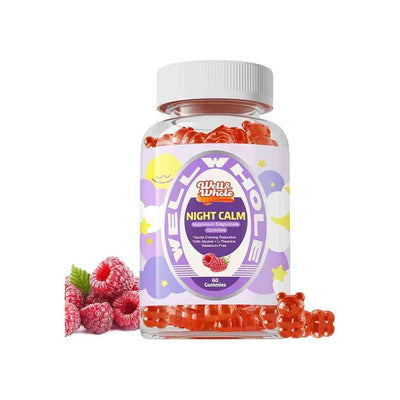
well&whole's Magnesium Bisglycinate Gummies with Apigenin & B6 are formulated with three compounds that support GABAergic signaling through complementary mechanisms: magnesium bisglycinate (which provides both magnesium and glycine), apigenin (a flavonoid that binds to GABA-A receptors), and vitamin B6 (a cofactor for GABA synthesis). This article examines the biochemical pathways through which each component contributes to GABA function and the scientific basis for their synergistic combination.

Pathway 1: Glycine as a Dual-Action Neurotransmitter Modulator
Magnesium bisglycinate is a chelated form of magnesium where each magnesium ion is bound to two glycine molecules. When ingested, the bisglycinate complex dissociates in the gastrointestinal tract, releasing both free magnesium ions and glycine into systemic circulation. The glycine component contributes to GABA function through two distinct mechanisms:
Glycine as an Inhibitory Neurotransmitter
Glycine is itself a major inhibitory neurotransmitter, particularly in the brainstem and spinal cord. Glycine receptors (GlyR) are ligand-gated chloride channels—structurally and functionally similar to GABA-A receptors. When glycine binds GlyR, chloride ions flow into the neuron, hyperpolarizing the membrane and reducing excitability.
A 2018 study by Lynch et al. in Neuropharmacology characterized the distribution of extrasynaptic glycine receptors in the cerebral cortex and hippocampus—brain regions associated with cognitive quieting and sleep preparation. The study demonstrated that glycine concentrations achievable through dietary supplementation (50-100 μM) produced measurable increases in tonic inhibition through these extrasynaptic receptors.
Glycine as a GABA Co-Agonist
Beyond its direct inhibitory effects, glycine functions as a required co-agonist at NMDA (N-methyl-D-aspartate) glutamate receptors. NMDA receptors require simultaneous binding of glutamate and either glycine or D-serine to open their ion channels. This requirement creates a bidirectional regulatory mechanism:
· At excitatory synapses, glycine facilitates normal glutamatergic signaling
· At inhibitory synapses and extrasynaptic sites, glycine modulates the balance between excitation and inhibition
A 2019 study by Bannai et al. in Neuron demonstrated that glycine availability influences the set point of the excitation-inhibition balance in cortical circuits. Adequate glycine supported inhibitory tone, while glycine depletion shifted circuits toward hyperexcitability.
The clinical relevance for sleep: a 2015 randomized controlled trial by Yamadera et al. in Sleep and Biological Rhythms examined glycine supplementation (3g before bedtime) in 40 adults with subjective sleep complaints. The glycine group showed significantly shortened sleep onset latency, improved sleep efficiency, and reduced daytime sleepiness compared to placebo. The 3g glycine dose used in this study corresponds approximately to the glycine content delivered by well&whole's magnesium bisglycinate gummies.
Pathway 2: Apigenin as a GABA-A Receptor Positive Allosteric Modulator
Apigenin is a flavonoid found in chamomile, parsley, celery, and other plants. Its relevance to the magnesium bisglycinate gummy formulation lies in its unique interaction with the GABA-A receptor complex.
Benzodiazepine-Site Binding
Apigenin binds to the benzodiazepine binding site on GABA-A receptors, functioning as a positive allosteric modulator (PAM). Unlike benzodiazepine drugs (diazepam, alprazolam), which are high-affinity, high-efficacy PAMs, apigenin is a low-affinity, moderate-efficacy PAM with a more physiological effect profile.
A 2006 study by Viola et al. in Planta Medica characterized apigenin's binding to the benzodiazepine site: Ki = 4.5 μM (compared to ~1-5 nM for diazepam). The lower affinity means apigenin modulates GABA-A receptor function without the sedation, tolerance, and dependence liability associated with benzodiazepines.
A 2017 study by Kim et al. in Molecules quantified apigenin's functional effect: at 10 μM, apigenin potentiated GABA-induced chloride currents by 45% in HEK293 cells expressing recombinant GABA-A receptors. The effect was completely blocked by flumazenil (a benzodiazepine site antagonist), confirming the binding site specificity.
The "Chamomile Tea Effect"
Apigenin is the primary bioactive compound responsible for chamomile tea's traditional use as a sleep aid and anxiolytic. A 2016 systematic review by Zick et al. in the Journal of Clinical Psychopharmacology examined chamomile extract (standardized to 1.2% apigenin) in generalized anxiety disorder and found moderate anxiolytic effects with excellent tolerability—consistent with apigenin's pharmacological profile as a mild GABA-A PAM.
well&whole's Magnesium Bisglycinate Gummies incorporate apigenin to provide this GABA-A receptor modulation alongside magnesium and glycine's complementary mechanisms.

Pathway 3: Vitamin B6 as GABA Synthesis Cofactor
Vitamin B6 (pyridoxine, converted in vivo to the active cofactor pyridoxal 5'-phosphate, PLP) is essential for GABA synthesis:
Glutamate Decarboxylase (GAD) Dependence
GABA is synthesized from glutamate by the enzyme glutamic acid decarboxylase (GAD), which is absolutely dependent on PLP as a cofactor. Without adequate vitamin B6, GAD activity is reduced, and GABA synthesis is impaired.
A 2018 study by Clayton et al. in Medical Hypotheses reviewed the clinical evidence linking vitamin B6 status to GABAergic function and found that B6 supplementation improved sleep quality metrics in several small clinical studies—an effect attributed to enhanced GABA synthesis capacity.
AADC Co-factor Role
B6 also serves as a cofactor for aromatic L-amino acid decarboxylase (AADC), the enzyme that converts L-DOPA to dopamine and 5-HTP to serotonin. This means B6 supports the entire monoamine neurotransmitter system, providing balanced support rather than exclusively enhancing GABA at the expense of other neurotransmitters.
The inclusion of vitamin B6 in well&whole's Magnesium Bisglycinate Gummies ensures that the GABA synthesis machinery has adequate cofactor support to utilize the glycine-mediated inhibitory signals and apigenin-enhanced GABA-A receptor function.
---
Synergistic Biochemistry: Why the Combination Matters
The three components converge on GABAergic signaling through distinct and complementary mechanisms:
| Component | Mechanism | Target | Onset | Duration |
| Glycine (from Magnesium Bisglycinate) | GlyR activation + NMDA co-agonism | Postsynaptic neurons | 30-60 min | 3-5 hours |
| Apigenin | GABA-A receptor PAM (benzodiazepine site) | Synaptic and extrasynaptic GABA-A | 30-90 min | 4-6 hours |
| Vitamin B6 (PLP) | GAD cofactor → GABA synthesis | Presynaptic GABA neurons | Cumulative (days-weeks) | Ongoing with consistent intake |
| Magnesium ion | NMDA receptor blockade + parasympathetic support | Multiple sites | 30-60 min | 4-6 hours |
The combination rationale:
· Glycine provides the inhibitory neurotransmitter signal
· Apigenin enhances GABA-A receptor sensitivity to endogenous GABA
· B6 ensures adequate GABA synthesis capacity
· Magnesium blocks excitatory NMDA receptors and supports overall nervous system relaxation
A 2020 study by Abbasi et al. in the Journal of Research in Medical Sciences examined a combination of magnesium, vitamin B6, and herbal extracts (including chamomile/apigenin source) for sleep quality in 60 adults. The 8-week trial found significant improvements in the Pittsburgh Sleep Quality Index (PSQI) compared to placebo, supporting the synergistic concept.
---
FAQ
Q: How does magnesium bisglycinate compare to other magnesium forms for sleep?
A: Magnesium bisglycinate provides two active compounds—magnesium and glycine—both of which support relaxation through different mechanisms. Other forms (citrate, oxide) provide only magnesium, without glycine's additional GABAergic and glycinergic effects.
Q: Will apigenin make me feel groggy the next morning?
A: At the doses used in well&whole's gummies, apigenin's effects as a low-affinity GABA-A PAM typically support relaxation without next-day sedation. The "hangover" effect associated with pharmaceutical sleep aids is related to high-affinity receptor binding and long half-life—characteristics apigenin does not share.
Q: Does vitamin B6 from supplements build up in the body?
A: Vitamin B6 is water-soluble, and excess is excreted in urine. The upper tolerable intake level for adults is 100 mg/day. The amount in well&whole's gummies is well within safe daily intake ranges when used as directed.
Q: Can I take Magnesium Bisglycinate Gummies during the day for anxiety?
A: While the product is formulated for evening use, the calming mechanisms apply regardless of time of day. However, glycine at higher doses has been associated with mild sedation, and apigenin's GABAergic effects may cause drowsiness. For daytime anxiety, a reduced dose might be more appropriate than the full evening serving.
Q: How does glycine from supplements differ from the glycine I get from dietary protein?
A: Dietary protein provides glycine bound in peptides that compete with other amino acids for absorption. Supplemental free glycine (as released from magnesium bisglycinate) is absorbed without competition and achieves higher peak plasma concentrations, which may be necessary for its neurotransmitter-level effects.
Q: Is this product safe to take with other sleep supplements like melatonin?
A: The mechanisms don't conflict—melatonin works through melatonin receptors (MT1/MT2) regulating circadian timing, while this product supports GABAergic relaxation. However, combining multiple sleep-supporting supplements can produce additive sedation. Start with one product and assess tolerance before adding others.
Q: Can I take Magnesium Bisglycinate Gummies long-term?
A: Magnesium and vitamin B6 are essential nutrients required daily. Glycine is a conditionally essential amino acid. Apigenin as a dietary flavonoid has an excellent long-term safety profile. All components are appropriate for consistent, long-term use.
---
Conclusion
The GABAergic system is the brain's primary inhibitory network, and supporting its function through multiple complementary mechanisms provides a more physiological approach to relaxation than targeting a single receptor or pathway. well&whole's Magnesium Bisglycinate Gummies with Apigenin & B6 leverage this multi-mechanism strategy: glycine for direct inhibitory neurotransmission, apigenin for GABA-A receptor sensitization, magnesium for NMDA receptor blockade, and vitamin B6 for GABA synthesis capacity.
Together, these four mechanisms converge to support the brain's transition from daytime alertness to restful evening recovery—without the tolerance, dependence, or next-day sedation associated with pharmaceutical alternatives.
Experience the GABAergic synergy of well&whole's Magnesium Bisglycinate Gummies at wellwholeshop.com.
Related supplements
Putting it simply: if this is something you want to add to your routine, our Magnesium Bisglycinate Gummies with Apigenin & B6, Melatonin Free, 60 Ct | Gentle on Stomach, Chelated with Glycine, Night Calm Routine and Sleep & Calm Support Bundle are a good place to start. The wider Sleep Support collection is worth a look, and the Magnesium range covers related formats.
These statements have not been evaluated by the Food and Drug Administration. This product is not intended to diagnose, treat, cure, or prevent any disease.