Glycine: What This Calming Amino Acid Does

Glycine is the simplest amino acid your body uses, and its best-evidenced role is a quiet one: taken as roughly 3 grams before bedtime, it has improved subjective sleep quality and next-morning alertness in small trials. It is not a sedative. Think of it as a metabolic multitool that happens to help some people wind down at night.
Key takeaways
- Glycine is a conditionally essential amino acid used to build protein, creatine, glutathione, and collagen.
- About 3 g roughly an hour before bed is the dose most human sleep trials have used.
- Glycine is one half of magnesium glycinate — but the magnesium salt and the free amino acid are not interchangeable.
- Bone broth, gelatin, and skin-on cuts of poultry are the richest food sources; your body also makes 3 g or more daily.
- Trials report few side effects at typical doses, but high-dose use alongside schizophrenia medication needs medical guidance.
What glycine actually does in the body
Glycine is the smallest of the twenty amino acids, and small does not mean minor. It is a structural building block of every protein you make, and it is the dominant amino acid in collagen — by some counts a third of collagen's amino acid content. Beyond structure, glycine is the raw material for creatine, contributes to glutathione, the body's master antioxidant, and participates in methylation cycles that process homocysteine. In the central nervous system it also acts as an inhibitory neurotransmitter, which is where the calming reputation begins.
Your body manufactures several grams of glycine every day, which is why it is called non-essential. The open research question, raised in reviews by essential-amino-acid researchers, is whether modern diets that favor muscle meats over collagen-rich cuts leave a metabolic gap — synthesis may cover baseline needs but not the full theoretical demand.
The 3-gram bedtime research
The human trials that made glycine a sleep supplement are small but consistent in shape. In a 2007 Japanese crossover study, participants took 3 g of glycine before bedtime and reported better sleep quality and less daytime sleepiness the next day. A follow-up study using overnight polysomnography found that glycine shortened the time it took to fall asleep and improved objective sleep measures when participants were mildly sleep-restricted. Another trial measured next-day performance and found better scores on memory and attention tasks after glycine at bedtime.
The proposed mechanism is a cooling one: glycine appears to lower core body temperature slightly by increasing blood flow to the extremities, and a falling core temperature is part of the body's natural descent into deep sleep. That fits the observation that glycine does not knock people out the way a hypnotic does — it nudges the physiology of night-time onset in the direction it already wants to go. People with persistent insomnia should still treat any amino acid as a supporting player, not a treatment.
Glycine versus magnesium glycinate
This mix-up is constant, and it matters. Magnesium glycinate is magnesium bound to glycine — a chelated mineral salt. You take it primarily for the magnesium, which supports muscle relaxation and sleep quality in its own right, with the glycine coming along as a small passenger. Free-form glycine supplements deliver grams of the amino acid itself with only trace mineral content. The table makes the difference concrete.
| Free glycine | Magnesium glycinate | |
|---|---|---|
| What you are dosing | The amino acid, ~3 g | Magnesium, ~100–200 mg |
| Best-studied use | Bedtime sleep quality | Sleep and relaxation via magnesium |
| Mineral contribution | None | Fulfills magnesium requirement |
| Typical timing | About an hour before bed | With or before bed |
Because the two do different jobs, they are also stackable — some evening routines use both, which is why many sleep-focused formulas pair them deliberately rather than treating one as a substitute for the other.
Food sources worth knowing
The richest food sources are the ones built on connective tissue: bone broth simmered from joints and skin, gelatin desserts, skin-on chicken, pork skin, tough cuts like oxtail and shank, and crustacean tails. Muscle meats, by contrast, are glycine-poor relative to their volume. If your protein comes mostly from chicken breast and ground beef, your glycine intake is likely modest — one more argument, on purely nutritional grounds, for cooking with the whole animal now and then.
Safety notes
Trials at 3–6 g per day report good tolerance, with occasional mild stomach upset. Two cautions matter. Very high doses — an order of magnitude above dietary levels — have been studied in schizophrenia in combination with antipsychotics such as clozapine, where interactions are a real concern and self-experimentation is a bad idea. And anyone who has had a stroke should discuss glycine with their doctor first, because animal data suggest possible effects on brain tissue after injury. Anyone taking medications that affect sleep should introduce any new nighttime supplement one at a time.

Frequently asked questions
How long does glycine take to work for sleep?
In trials the effect was measured on the nights it was taken, so it is not a cumulative supplement in the way some are. Most people who respond notice it within the first week of use.
Can I take glycine with magnesium?
Yes — glycine and magnesium are commonly paired, and magnesium glycinate is itself a combination of the two. Just account for the total magnesium dose from all products.
Will glycine make me groggy in the morning?
Trials measured the opposite: participants reported less morning grogginess and better daytime alertness. Individual responses vary, so a single evening test dose tells you more than any average.
Is glycine safe to take every night?
Trials ran daily dosing for several weeks without notable adverse effects. Long-term safety data at high doses are limited, so periodic breaks and staying near the studied 3 g dose are reasonable habits.
Related supplements
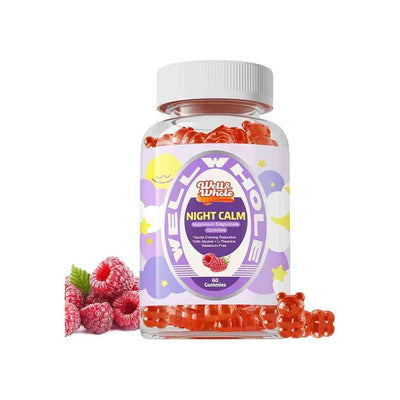
Should you decide to supplement, Magnesium Bisglycinate Gummies with Apigenin & B6, Melatonin Free, 60 Ct | Gentle on Stomach, Chelated with Glycine, Night Calm Routine is our formulation for this purpose. For a broader comparison, see the Sleep Support and Magnesium collections.
These statements have not been evaluated by the Food and Drug Administration. This product is not intended to diagnose, treat, cure, or prevent any disease. Talk to a healthcare professional before starting any new supplement, especially if you are pregnant, nursing, taking medication, or managing a health condition.
These statements have not been evaluated by the Food and Drug Administration. This product is not intended to diagnose, treat, cure, or prevent any disease.