Glutathione in Liver Support Drops: The Master Antioxidant Explained
Discover why glutathione is called the master antioxidant for liver health. Learn how it supports detoxification, fights oxidative stress, and protects cells.

Glutathione isn't just another antioxidant—it's the one your liver relies on above all others. Present in higher concentrations in hepatocytes (liver cells) than in any other cell type, glutathione is the foundation of Phase II detoxification, the primary defender against oxidative stress, and the molecule that keeps your liver's biochemical machinery running.
Yet most people have never heard of it. And among those who have, confusion persists: Can you absorb oral glutathione? Is it better to take glutathione directly or use NAC to make more? Does it really matter for everyday liver health?
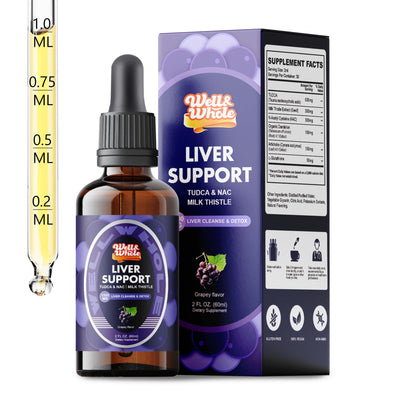
This article explains glutathione's role in liver function, the science behind oral supplementation, why it's paired with NAC in well&whole's Liver Support Liquid Drops, and what the research actually shows.
What Is Glutathione?
Glutathione (GSH) is a tripeptide composed of three amino acids: **glutamate, cysteine, and glycine**. It exists in two forms in the body:
- **Reduced glutathione (GSH)**: The active, antioxidant form
- **Oxidized glutathione (GSSG)**: The form after glutathione has neutralized a free radical and sacrificed itself
The ratio of GSH to GSSG—called the "GSH/GSSG ratio" or "redox ratio"—is one of the most important biomarkers of cellular health. A high ratio (lots of reduced, active glutathione) indicates good antioxidant capacity. A low ratio (more oxidized glutathione) signals oxidative stress and cellular vulnerability.
Key Facts About Glutathione
| **Property** | **Detail** |
|---|---|
| Chemical structure | Tripeptide: glutamate-cysteine-glycine |
| Primary location | Liver (highest concentrations of any organ) |
| Active form | Reduced glutathione (GSH) |
| Key function | Phase II detoxification, antioxidant defense |
| Production | Synthesized intracellularly from amino acid precursors |
| Rate-limiting precursor | Cysteine (supplied by NAC) |
| Typical daily turnover | ~8-12 grams produced and recycled daily |
Why Glutathione Is Called the "Master Antioxidant"
Several properties distinguish glutathione from other antioxidants:
1. It's Endogenous—Made by Your Body
Unlike vitamin C, vitamin E, or silymarin (which you must ingest), glutathione is produced *inside your cells*. Your body manufactures roughly 8-12 grams daily, recycling and reusing it continuously. This self-production means glutathione is always available when your liver needs it—as long as the raw materials (especially cysteine) are in supply.
2. It's Present in Every Cell—but Concentrated in the Liver
While glutathione exists in virtually every cell, liver cells contain 5-10 times more glutathione than most other tissues. This concentration reflects the liver's unique role as the body's primary detoxification organ—it needs more antioxidant capacity than any other system.
3. It Regenerates Other Antioxidants
Glutathione doesn't just fight free radicals directly—it also *recharges* other antioxidants. When vitamin C or vitamin E neutralize a free radical, they become oxidized (inactive). Glathione reduces them back to their active forms, creating an antioxidant recycling network.
This "recycling" function is why glutathione is called the *master* antioxidant—it orchestrates the entire antioxidant defense system, not just its own direct action.
4. It's Essential for Phase II Detoxification
The liver's detoxification process occurs in two phases:
- **Phase I**: Enzymes (primarily CYP450) modify toxins, often creating *more* reactive intermediates
- **Phase II**: These reactive intermediates are conjugated (bound) to other molecules for safe elimination
Glutathione is the primary conjugating agent in Phase II. It binds to toxins, heavy metals, pharmaceutical metabolites, and environmental chemicals—transforming them from dangerous reactive compounds into water-soluble forms that can be excreted through bile or urine.
Without adequate glutathione, Phase I keeps producing toxic intermediates, but Phase II can't process them. The result: reactive compounds accumulate inside liver cells, causing oxidative damage.
Glutathione Depletion: When the Master Antioxidant Runs Low
Glutathione levels decline under multiple circumstances:
Age-Related Decline
Research by Sekhar et al. (2011) in *American Journal of Clinical Nutrition* documented that glutathione levels decrease significantly with aging, particularly after age 40. This decline correlates with increased oxidative stress markers and reduced detoxification capacity.
| **Age Group** | **Average GSH Level** | **Oxidative Stress Markers** |
|---|---|---|
| 20-30 | High | Low |
| 40-50 | Moderately reduced | Moderately elevated |
| 60+ | Significantly reduced | Significantly elevated |
Alcohol Consumption
Alcohol metabolism directly depletes glutathione. The liver metabolizes alcohol through multiple pathways, all generating reactive oxygen species. Glutathione is consumed at an accelerated rate to neutralize these ROS, leading to rapid depletion—particularly in mitochondrial glutathione stores.
Medication and Drug Exposure
Many common medications increase glutathione demand:
- **Acetaminophen (Tylenol)**: The classic example—overdose depletes glutathione so rapidly that the toxic metabolite NAPQI kills liver cells
- **NSAIDs**: Nonsteroidal anti-inflammatory drugs increase oxidative stress
- **Statins**: Cholesterol-lowering drugs can affect liver enzyme metabolism
- **Antibiotics**: Some increase hepatic oxidative burden
Environmental Toxins
Pollution, pesticides, heavy metals, and industrial chemicals all increase glutathione consumption as the liver attempts to conjugate and eliminate them.
Chronic Disease States
Conditions like NAFLD, diabetes, and metabolic syndrome are associated with reduced glutathione levels and increased oxidative stress (Liu et al., 2016, *Oxidative Medicine and Cellular Longevity*).
Oral Glutathione Supplementation: Does It Absorb?
This has been one of the most debated questions in supplement science. The arguments:
The Skeptic Position
Early research suggested oral glutathione was poorly absorbed because:
- Glutathione is a peptide that might be broken down by digestive enzymes
- Blood levels after oral dosing showed modest increases
- Some researchers argued only precursor supplementation (NAC) was effective
The Emerging Evidence
More recent studies have challenged the skeptic position:
- A 2018 study by Richie et al. in *Nutrients* found that oral glutathione supplementation (500-1000mg/day) for 4 weeks was associated with significant increases in blood glutathione levels and reduced oxidative stress biomarkers in human subjects
- A 2015 study by Allen et al. in *European Journal of Nutrition* documented that oral glutathione at 1000mg/day increased erythrocyte (red blood cell) glutathione levels
- Witschi (1970) in *Toxicology and Applied Pharmacology* demonstrated that a portion of oral glutathione is absorbed intact, reaching the liver within hours
The current consensus: **oral glutathione does absorb, though not with 100% efficiency. The increases are real, measurable, and clinically relevant—especially when combined with NAC, which ensures ongoing production.**
Why Liquid Delivery May Help
Liquid glutathione delivery, as in well&whole's drops, offers potential absorption advantages:
- **No capsule dissolution delay**: The compound is already in solution
- **Sublingual possibility**: Drops can be placed under the tongue for direct absorption into the bloodstream, bypassing GI degradation
- **Faster gastric transit**: Liquid passes through the stomach more rapidly, reducing time exposed to digestive enzymes
Glutathione + NAC: Why Both Are Better Than Either Alone
well&whole's Liver Support Liquid Drops include *both* glutathione and NAC. This isn't redundancy—it's a two-pronged strategy:
| **Strategy** | **Mechanism** | **Advantage** | **Gap** |
|---|---|---|---|
| NAC alone | Builds glutathione from cysteine supply | Sustained production, cost-efficient | Slow ramp-up; limited by enzyme kinetics |
| Glutathione alone | Direct delivery of the antioxidant | Immediate antioxidant capacity | Short-lived; doesn't address ongoing production |
| NAC + Glutathione | Production + direct delivery | Immediate reserves + sustained manufacturing | Requires both ingredients |
The analogy: NAC is the factory that makes cars (glutathione). Direct glutathione is a car delivered to your driveway today. Under normal conditions, the factory keeps up. Under stress (alcohol, toxins, illness), demand exceeds production—having a car in the driveway while the factory ramps up is the smartest approach.
Glutathione's Role in Specific Liver Conditions
NAFLD (Fatty Liver)
Glutathione depletion is a documented feature of NAFLD. A 2016 review in *Oxidative Medicine and Cellular Longevity* (Liu et al.) established that:
- NAFLD patients show significantly reduced hepatic glutathione levels
- Glutathione depletion correlates with disease severity
- Restoring glutathione levels may help reduce oxidative stress driving NAFLD progression
Alcohol-Related Liver Stress
Mitochondrial glutathione—the glutathione inside liver cell mitochondria—is particularly vulnerable to alcohol-induced depletion. Vendemiale et al. (1999) in *Hepatology* demonstrated that mitochondrial glutathione depletion was a critical early step in alcohol-related liver damage, and that replenishing it (via NAC) helped restore mitochondrial function.
Medication-Related Liver Stress
Any medication that increases hepatic oxidative demand consumes glutathione. Supplemental glutathione + NAC provides both immediate reserves and ongoing production to meet this increased demand.
The Glutathione System in well&whole's Liver Support Drops
Within the six-ingredient formula ($19.99), glutathione serves a specific, irreplaceable role:
| **Ingredient** | **Antioxidant Mechanism** |
|---|---|
| Glutathione | Direct master antioxidant; Phase II conjugation |
| NAC | Glutathione production engine |
| Milk thistle | Separate antioxidant (silymarin); membrane protection |
| Dandelion | Additional phenolic antioxidant compounds |
| Artichoke | Luteolin/apigenin flavonoid antioxidants |
| TUDCA | Cellular stress reduction (indirect antioxidant benefit) |
Five of six ingredients contribute to antioxidant defense—but glutathione is the centerpiece that ties them all together.
FAQ
Q1: What exactly is glutathione?
Glutathione is a tripeptide (glutamate + cysteine + glycine) that serves as your body's primary intracellular antioxidant and detoxification molecule. It's present in highest concentrations in the liver.
Q2: Can I absorb oral glutathione, or does it just break down in the gut?
Emerging research confirms oral glutathione is absorbed. Richie et al. (2018) in *Nutrients* found that daily supplementation (500-1000mg) significantly increased blood glutathione levels and reduced oxidative stress markers in human subjects.
Q3: Why is glutathione called the "master antioxidant"?
Glutathione doesn't just neutralize free radicals directly—it also regenerates other antioxidants (vitamin C, vitamin E) after they become oxidized, orchestrating the entire antioxidant defense system. It's also the primary conjugating agent in Phase II liver detoxification.
Q4: Should I take glutathione directly or use NAC to make more?
Both. NAC provides the cysteine needed for ongoing glutathione production (the "factory"), while direct glutathione provides immediate antioxidant reserves (the "inventory"). Under stress, production alone can't keep up—having both ensures coverage.
Q5: Does aging reduce glutathione levels?
Yes. Research by Sekhar et al. (2011) documented significant glutathione decline after age 40, correlating with increased oxidative stress markers. This makes glutathione supplementation particularly relevant for adults over 40.
Q6: How does glutathione help with liver detoxification?
Glutathione is the primary conjugating agent in Phase II detoxification. It binds to toxins, heavy metals, and drug metabolites—transforming them from dangerous reactive compounds into water-soluble forms that can be eliminated through bile or urine.
Q7: Does alcohol deplete glutathione?
Yes. Alcohol metabolism generates large amounts of reactive oxygen species, consuming glutathione at an accelerated rate. Mitochondrial glutathione—the form inside liver cell energy centers—is particularly vulnerable.
Q8: What is the GSH/GSSG ratio?
It's the ratio of reduced (active) glutathione (GSH) to oxidized glutathione (GSSG). A high ratio indicates good cellular antioxidant capacity; a low ratio signals oxidative stress and vulnerability. This ratio is a key biomarker of liver health.
Q9: Why include glutathione in a multi-ingredient formula instead of selling it alone?
Glutathione works best as part of an antioxidant network. NAC keeps production running; milk thistle provides separate antioxidant silymarin; TUDCA reduces cellular stress that creates free radicals. A multi-ingredient formula creates layered defense that glutathione alone can't provide.
Q10: How long does it take for glutathione supplementation to show effects?
Research suggests measurable increases in glutathione levels within days of starting supplementation. Meaningful reductions in oxidative stress markers typically require 4-8 weeks of consistent daily use.
Conclusion
Glutathione is the cornerstone of liver antioxidant defense—the molecule your liver depends on most for detoxification, free radical neutralization, and antioxidant network coordination. Without adequate glutathione, your liver's Phase II detoxification slows, oxidative damage accumulates, and cellular vulnerability increases.
In well&whole's Liver Support Liquid Drops, glutathione works alongside NAC (its production engine), milk thistle, TUDCA, dandelion, and artichoke to create six-pathway liver support. The glutathione-NAC combination delivers both immediate reserves and sustained production—the two-pronged approach that neither ingredient alone can match.

Your liver runs on glutathione. Make sure it has enough.
Related supplements
Putting it simply: if this is something you want to add to your routine, our Liver Support Liquid Drops Supplement | TUDCA Drops Liver Cleanse & Detox with Milk Thistle, NAC, Dandelion, Artichoke & Glutathione for Detox and TUDCA 1000mg Gummies with Milk Thistle 500mg for Adults are a good place to start. The wider Liver Support collection is worth a look, and the Milk Thistle range covers related formats.
These statements have not been evaluated by the Food and Drug Administration. This product is not intended to diagnose, treat, cure, or prevent any disease.