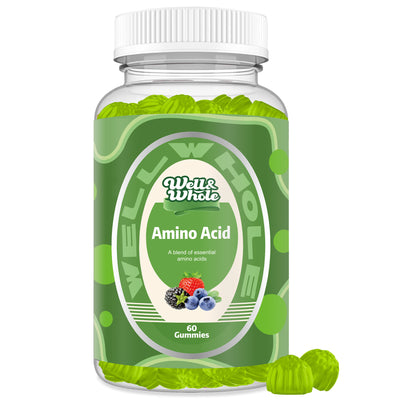
free form amino acids vs essential amino acids

free form amino acids vs essential amino acids
When people start looking into amino acid supplements, two terms come up frequently: free form amino acids and essential amino acids. They sound similar, but the difference matters—especially if you're serious about recovery, muscle building, or overall health. At well&whole, we often get asked which type is better, and the answer isn't one-size-fits-all. Let's break down what each actually is, how your body handles them, and which one might fit your goals.
What Are Essential Amino Acids?
Essential amino acids (EAAs) are the nine amino acids your body cannot produce on its own. You must get them from food or supplements. These include leucine, isoleucine, valine, lysine, methionine, phenylalanine, threonine, tryptophan, and histidine. Without enough EAAs, your body cannot build muscle proteins, repair tissues, or produce key neurotransmitters. For anyone who trains hard or is recovering from illness, EAAs are non-negotiable.
Why they matter: Studies show that consuming a complete profile of EAAs—especially with a higher proportion of leucine—stimulates muscle protein synthesis more effectively than incomplete sources (Phillips, 2014). Many quality essential amino acid supplements contain these nine in precise ratios to maximize anabolic response. well&whole’s EAA formula, for example, is designed to deliver that leucine spike while supporting steady blood levels of all other EAAs.
Essential amino acids are the building blocks your body cannot make. They are crucial for muscle repair, immune function, and metabolism. Without them, recovery stalls and muscle loss accelerates.
What Are Free Form Amino Acids?
Free form amino acids are individual amino acids that are not bound to other amino acids in a peptide chain. In whole food proteins (like chicken or eggs), amino acids are linked together. During digestion, your body has to break those bonds to release single amino acids. Free form aminos, on the other hand, are already in their "free" state—meaning they skip that breakdown step and can be absorbed directly into the bloodstream.
This makes free form amino acids absorption much faster than protein-bound forms. For instance, a free form amino acid powder can start entering your blood within 15–20 minutes of ingestion, whereas whole protein may take 1–2 hours to be fully digested (Boirie et al., 1997). That speed is particularly useful for pre-workout, intra-workout, or anytime you need rapid delivery.
Important note: Not all free form aminos are essential. You can find free form versions of non-essential amino acids (like glutamine or glycine) as well. The "free form" tag refers only to the chemical structure, not the nutritional category.
Free form amino acids are pre-digested, so they absorb quickly. This makes them ideal for fast recovery, energy support, or anyone with digestive issues. But they still need to include the nine EAAs to be effective for muscle protein synthesis.
Absorption and Efficiency: Which Works Better for the Body?
The real debate comes down to absorption kinetics and efficiency. Essential amino acids in a protein meal require digestion. That's not bad—it leads to a sustained release of amino acids over hours. But for rapid intervention (say, immediately after a workout or during a long endurance session), free form aminos win.
A 2018 study in the Journal of the International Society of Sports Nutrition found that free form EAAs increased peak blood amino acid levels by 40% more than an equivalent amount of intact protein (Phillips & Van Loon, 2018). That spike triggers higher muscle protein synthesis in the first 60 minutes post-exercise.
However, for everyday maintenance and between meals, whole food protein or a standard EAA blend (non-free form) may be sufficient. The choice depends on timing. well&whole’s best amino acid powder for muscle recovery actually combines both concepts: it contains free form EAAs and added free form glutamine for cell hydration, giving you rapid absorption with broad coverage.Free form EAAs absorb faster and create a stronger acute muscle-building signal. Whole protein or standard EAAs provide a more gradual supply. The best option depends on when you take it and what your body needs at that moment.
How to Choose Between Them for Your Goals
If you're trying to maximize post-workout recovery, go with a free form essential amino acid supplement that has a high leucine content (around 2–3g per serving). That gives you the speed and the signal. well&whole’s intra-workout formula is specifically designed this way—free form EAAs plus electrolytes for hydration.
If your goal is general health or meal replacement, a standard EAA product (not necessarily free form) works fine. The digestion process is normal and you'll still get the benefits. Many people also prefer free form aminos if they have a sensitive stomach, since there's less work for the gut.
Long-tail keyword integration: When searching for free form amino acid powder for post-workout, look for products that list all nine EAAs in free form—and ideally third-party tested for purity. Similarly, best amino acid powder for recovery often ranks those with added BCAAs (which are a subset of EAAs) but remember that BCAAs alone lack the full EAA profile needed for optimal results.
小结: For speed and targeted recovery, free form EAAs are superior. For daily maintenance or budget-conscious use, standard EAAs are perfectly effective. Always check the label for completeness.
well&whole’s Approach: Combining Science with Practicality
At well&whole, we source both free form and standard EAA ingredients, but we formulate our products based on the intended use. For example, our flagship Recovery Amino contains 8g of free form EAAs (including 3g leucine) plus a small amount of glutamine. This is designed for athletes who train hard and need that fast absorption window.
We also provide a daily EAA supplement that uses bound (peptide) EAAs for slower release—better for people who want to sip throughout the day. The key is matching the delivery method to the lifestyle. Essential amino acid supplements don't have to be confusing if you understand your own training schedule and digestion.
小结: well&whole tailors the amino acid form to the timing and goal. Whether you need free form for speed or bound form for steadiness, we’ve got a clean, transparent option.
Frequently Asked Questions
1. Can I take free form amino acids on an empty stomach?
Yes. In fact, that’s one of their biggest advantages. Because they require no digestion, they won’t cause bloating or discomfort, and they can be used pre-workout or even during a fast without breaking ketosis in most people.
2. Do I still need essential amino acids if I eat a high-protein diet?
Possibly. Even with adequate protein intake, the timing and ratio of EAAs matter. For example, if you only eat two large meals, you may have gaps in blood amino acid levels. EAA supplements—especially free form ones—can fill those gaps and sustain muscle protein synthesis throughout the day.
3. Are free form amino acids safe for long-term use?
Current research indicates they are safe when taken as directed. The body treats free form aminos the same way it treats food-derived aminos after absorption. The only caveat is to avoid excessive single-amino-acid supplements (like mega-doses of leucine alone), as that could disrupt balance. well&whole’s formulas contain balanced ratios to avoid that issue.
References:
- Phillips, S. M. (2014). A brief review of critical processes in exercise-induced muscular hypertrophy. Sports Medicine, 44(Suppl 1), S71–S77.
- Boirie, Y., et al. (1997). Slow and fast dietary proteins differently modulate postprandial protein accretion. Proceedings of the National Academy of Sciences, 94(26), 14930–14935.
- Phillips, S. M., & Van Loon, L. J. (2018). Dietary protein for athletes: From requirements to optimum adaptation. Journal of the International Society of Sports Nutrition, 15(1), 5.
These statements have not been evaluated by the Food and Drug Administration. This product is not intended to diagnose, treat, cure, or prevent any disease.