EAA vs Whey Protein: Do You Need Both?

Essential amino acids (EAAs) are the nine amino acids your body cannot make and must get from food; whey is a complete dairy protein that already contains all nine of them. So no — you do not strictly need both. Whey delivers everything an EAA product does, plus the rest of the amino acid spectrum. EAA products earn their place when you want a full protein-level stimulus in a small, fast, low-volume form: fasted training, appetite-suppressed cutting phases, or a gummy you will actually take when a shake is not practical.
Key takeaways
- EAA are the nine indispensable amino acids; whey contains all nine plus eleven more — it is the parent, EAA is the extract.
- What drives muscle recovery is the leucine-trigger: about 2.5–3 g leucine per serving initiates muscle protein synthesis.
- Total daily protein (roughly 1.6 g/kg for active people) matters far more than any single product choice.
- Whey wins on cost per gram of protein and satiety; EAA wins on speed, volume, and convenience.
- Using both is redundancy, not synergy — pick by situation, not by stacking.
The difference, side by side
Think of whey as a whole food extract and EAA as its functional core. Whey protein concentrate or isolate is roughly 20–25% essential amino acids by weight — one 25 g scoop supplies about 5–6 g EAA, including the 2.5–3 g of leucine needed to switch on muscle protein synthesis. A dedicated EAA product flips that ratio: a 10 g EAA dose delivers the full nine, including the leucine trigger, with almost nothing else. Gram for gram, EAA is the more "efficient" stimulus; whey is the more complete and economical food.
What actually drives recovery: the leucine threshold
Muscle protein synthesis is switched on per-meal, not per-day. Research since the early 2000s converges on a practical target: about 2.5–3 g of leucine in a single serving, which is what traditionally defines an "anabolic" dose of protein. For most people that means 20–40 g of a complete protein like whey, or an EAA product dosed to match. Hit that threshold three to five times across the day, keep total protein near 1.6 g/kg body weight (more during a cut), and you have captured nearly all of what supplementation can do for muscle recovery — whichever product you use to get there.
When EAA alone makes sense
Three situations favor EAA. First, fasted or low-appetite training: 5–10 g of EAA in liquid sits easily in the stomach where 30 g of whey would slosh. Second, cutting phases: when calories are tight, spending them on pure amino stimulus preserves protein synthesis without adding much energy. Third, format and adherence: a gummy or liquid drops format travels in a gym bag and requires no shaker, no milk, no refrigeration — and the best supplement is the one you actually take on the days that matter.
When whey is the better pick
Whey is dramatically cheaper per gram of protein, it is more satiating — useful when hunger is the enemy — and it brings calcium and bioactive compounds along. For most gym-goers, one or two whey servings plus protein-anchored meals covers the day completely. If you tolerate dairy fine, there is no nutritional hole that EAA needs to fill.
The practical answer
Pick one primary product based on your bottleneck: budget and appetite → whey; speed, gut comfort and training schedule → EAA. If you already hit your daily protein target with food, neither is necessary. And skip the outdated "BCAA vs EAA" debate entirely — BCAA-only products are superseded, since leucine cannot do its job without the other eight essentials present.
How to dose either option
Whichever product you choose, the same rules apply. Anchor the dose to the leucine threshold rather than the label's serving suggestion, take it near training or spread across protein-anchored meals, and count it toward — not on top of — your daily protein total. Consistency across weeks of training is what compounds into muscle recovery and strength gains; no post-workout timing window is precise enough to rescue an under-fueled day.
A quick decision summary: training fasted or squeezed between meetings → EAA; rebuilding overall protein intake on a budget → whey; cutting with tight calories → EAA around workouts plus protein-anchored meals; everything else → whichever format you will actually use consistently.

Frequently asked questions
Can I replace whey with EAA completely?
Technically you can meet the leucine threshold with EAA alone, but it is expensive and leaves you without the satiety and additional nutrients of complete protein. EAA is best treated as a situational tool, not a whey replacement.
Do EAA gummies work as well as powder?
What matters is the dose of essential amino acids, especially leucine, reaching your muscles. A gummy delivering several grams of EAA works on the same principle as a drink; check the label for the actual EAA and leucine content per serving rather than the serving size.
Should I take EAA or whey after a workout?
Either supports recovery — total daily protein is the bigger lever. Whey is the economical default; EAA is convenient for fasted sessions or when a heavy shake right after training sits poorly.
Are BCAAs still worth taking?
Current evidence says no, not as a standalone. Without all nine essentials, BCAAs cannot sustain muscle protein synthesis. Products labeled EAA have effectively replaced BCAA formulas for good reason.
Related supplements
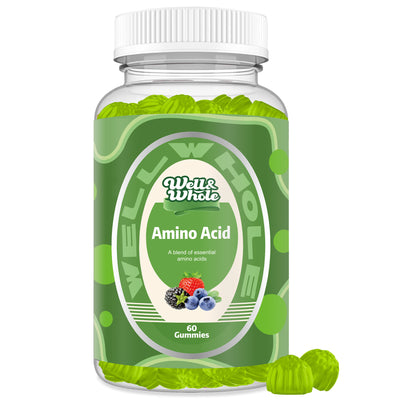
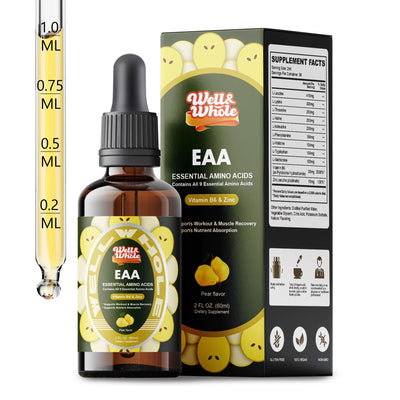
Where to begin? Our EAA Gummie 60 counts Essential Amino Acids Supplement Gummies for Men and Women and Essential Amino Acid (EAA) Liquid Drops & Liver Support Liquid Supplement are a sensible place to start, and the Amino Acids collection lays out the other formats side by side with Muscle Support.
These statements have not been evaluated by the Food and Drug Administration. This product is not intended to diagnose, treat, cure, or prevent any disease. Talk to a healthcare professional before starting any new supplement, especially if you are pregnant, nursing, taking medication, or managing a health condition.