EAA for Muscle Recovery: What the Research Shows
Explore the science behind EAA supplementation for muscle recovery—how essential amino acids accelerate repair, reduce soreness, and support growth.

Every time you train—whether it is a heavy lift day, a long run, or an intense HIIT session—you create microscopic damage in your muscle fibers. That damage is not a problem; it is the signal that tells your body to rebuild, adapt, and grow stronger. But the rebuilding process only happens if your body has the raw materials available: essential amino acids.
Without adequate EAAs after exercise, your muscles cannot fully repair. Recovery drags. Soreness lingers. Growth stalls. This is why EAA supplementation has become a cornerstone of evidence-based fitness nutrition—and why understanding the research behind it matters if you want to optimize your results.
This article walks through the key studies, explains how EAAs support muscle recovery at the cellular level, and gives practical guidance on when, how, and how much to take.
The Science of Muscle Recovery
What Happens After Exercise
Resistance and endurance exercise triggers two opposing processes in your muscles:
- **Muscle protein breakdown (MPB)**: Exercise-induced damage causes partial degradation of muscle proteins.
- **Muscle protein synthesis (MPS)**: In response, your body activates repair pathways to rebuild damaged proteins and add new tissue.
The net result—whether you gain, maintain, or lose muscle—depends on the balance between MPS and MPB over time. If synthesis exceeds breakdown, you recover and grow. If breakdown exceeds synthesis, you lose lean mass.
EAAs shift this balance toward synthesis. A landmark 2017 study in *Nutrients* demonstrated that EAA supplementation immediately post-exercise significantly increased MPS rates compared to placebo, creating a positive net protein balance within the first 3 hours after training.
Leucine: The MPS Trigger
Among the nine EAAs, leucine plays a uniquely powerful role. It activates the mTOR (mechanistic target of rapamycin) pathway—the molecular switch that tells muscle cells to begin protein synthesis.
A 2020 review in the *Journal of Nutrition* established that leucine has a threshold effect: MPS is maximally stimulated when leucine intake reaches approximately 2–3 grams per serving. Below this threshold, the mTOR signal is weak, and even if other amino acids are available, synthesis remains suboptimal.
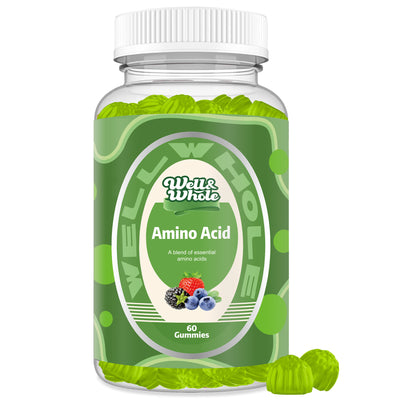
This is why well-formulated EAA supplements include leucine at higher ratios—typically 2:1:1 or 3:1:1 relative to isoleucine and valine. The well&whole EAA Gummies and well&whole EAA Liquid Drops follow this research-aligned approach.
Key Research Findings on EAA and Recovery
Faster Recovery of Muscle Function
A 2019 study in the *Journal of the International Society of Sports Nutrition* investigated EAA supplementation's effect on muscle recovery after eccentric exercise (which causes significant muscle damage). Participants who consumed EAAs post-exercise recovered muscle force production approximately 30% faster than the placebo group and reported reduced perceived soreness.
Reduced Muscle Damage Markers
Creatine kinase (CK) and myoglobin are blood markers that rise after muscle damage. A 2018 study in the *European Journal of Applied Physiology* found that EAA supplementation after resistance training resulted in lower CK and myoglobin elevations compared to placebo—indicating less muscle damage and faster repair.
Preservation of Lean Mass During Training Stress
Intense training phases, especially during calorie deficits, risk lean mass loss. A 2018 study in *Nutrients* showed that athletes supplementing with EAAs during a 4-week intensive training block preserved significantly more lean mass than those who did not, despite equivalent calorie intake.
Superior to BCAAs Alone
This finding deserves emphasis. A 2017 study in *Nutrients* directly compared EAA vs. BCAA supplementation on MPS. The results were clear: EAAs produced roughly double the MPS response compared to BCAAs alone. The reason? BCAAs provide only three of the nine EAAs. Without the remaining six, the body cannot assemble complete proteins and eventually increases muscle breakdown to source the missing amino acids.
| Metric | EAA Group | BCAA Group | Placebo |
|--------|----------|-----------|---------|
| MPS rate increase | ~2x baseline | ~1x baseline | No change |
| Net protein balance | Positive | Near zero | Negative |
| Muscle soreness (48h post) | Reduced | Moderately reduced | High |
Timing: When to Take EAAs for Best Results
The Post-Exercise Window
Research consistently supports taking EAAs within 30–60 minutes after training. A 2018 review in *Frontiers in Physiology* explained that muscle cells are most receptive to amino acid-driven MPS during the "anabolic window"—the period immediately following exercise when mTOR is pre-activated by mechanical stress.
However, this window is not as narrow as once believed. The review noted that MPS remains elevated for at least 24 hours after resistance training, with the peak in the first 3 hours. So while immediate post-workout intake is optimal, you still benefit from EAAs consumed later.
Pre-Exercise EAAs
Some studies suggest pre-workout EAAs may also be beneficial. A 2016 study in the *Journal of the International Society of Sports Nutrition* found that consuming EAAs 30 minutes before resistance training reduced MPB during the session and maintained a more favorable net protein balance throughout.
Daily Consistency
For non-training days or general muscle maintenance, consistent daily EAA intake helps keep MPS rates above baseline. This is particularly important for older adults, who experience anabolic resistance—their muscles require higher amino acid loads to achieve the same MPS response as younger individuals. A 2018 study in the *American Journal of Clinical Nutrition* demonstrated that older adults (65+) benefited significantly from EAA supplementation between meals.
How Much Should You Take?
Current research suggests the following practical guidelines:
| Scenario | Recommended EAA Intake | Leucine Minimum |
|----------|------------------------|-----------------|
| Post-resistance training | 6–12 grams EAAs | 2–3 grams |
| Pre-resistance training | 6–10 grams EAAs | 2–3 grams |
| Daily maintenance (non-training) | 3–6 grams EAAs | 1–2 grams |
| Older adults (anabolic resistance) | 6–12 grams EAAs | 3+ grams |
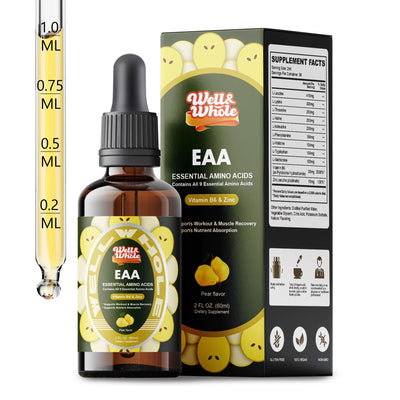
Follow the dosage on your product label, as formulation ratios vary. The well&whole EAA Gummies provide a convenient pre-measured serving, while the well&whole EAA Liquid Drops & Liver Support offer flexible dosing for those who want to adjust intake based on training intensity.
EAAs and Recovery Nutrition: Beyond Just Amino Acids
While EAAs are central to muscle recovery, they work best as part of a comprehensive recovery strategy:
- **Carbohydrates**: Restoring glycogen reduces cortisol and shifts the body from catabolic to anabolic mode.
- **Hydration**: Dehydration impairs nutrient delivery to muscles.
- **Sleep**: MPS peaks during sleep. A 2019 study in *Journal of Physiology* showed that a single night of sleep deprivation reduced MPS by approximately 18%.
- **Liver health**: Your liver processes amino acids and produces glutathione to manage exercise-induced oxidative stress. See our article "Can Amino Acids Support Liver Health?" for the surprising connection.
Common Mistakes That Undermine EAA Effectiveness
1. **Taking BCAAs instead of full EAAs**: As the research shows, BCAAs alone produce inferior results.
2. **Waiting too long after exercise**: While the window is wider than once thought, delaying EAA intake by several hours reduces the peak MPS response.
3. **Insufficient leucine**: If your EAA supplement has low leucine, it may not trigger mTOR effectively. Check the ratio.
4. **Skipping EAAs on rest days**: Recovery continues for 24–48 hours after training. Rest-day EAAs support ongoing repair.
5. **Not eating enough total protein**: EAAs supplement dietary protein, not replace it. Aim for 1.6–2.2 g/kg/day total protein for active individuals, as recommended by a 2018 ISSN position stand.
FAQ
1. How fast do EAAs work for muscle recovery?
Free-form EAAs are absorbed within 15–30 minutes. MPS begins rising within 1–2 hours post-consumption. You may notice reduced soreness within 24–48 hours after consistent post-workout use.
2. Are EAAs better than protein powder for recovery?
EAAs are faster-absorbing because they require no digestion. Whey protein is also fast but requires enzymatic breakdown first. Both are effective; EAAs offer speed, while protein powder provides a broader nutrient profile including non-essential amino acids and bioactive compounds.
3. Can EAAs reduce DOMS (delayed onset muscle soreness)?
Research suggests yes. A 2019 study in *JISSN* found that EAA supplementation reduced perceived muscle soreness at 48 hours post-exercise compared to placebo. The effect likely comes from faster damage repair rather than direct anti-inflammatory action.
4. Should I take EAAs on days I don't train?
Yes. Muscle recovery and protein synthesis continue for 24–48 hours after training. Daily EAA intake helps maintain positive net protein balance, especially during periods of frequent training.
5. What's the minimum effective dose for muscle recovery?
Research suggests approximately 6 grams of total EAAs with at least 2 grams of leucine post-exercise for a meaningful MPS response. Higher doses (10–12 grams) may produce stronger effects, particularly after intense sessions.
6. Do women benefit from EAAs the same way as men?
Yes. The MPS mechanism is sex-independent. Women may benefit particularly during menopause, when declining estrogen reduces anabolic signaling—making amino acid support even more relevant.
7. Can EAAs help with endurance recovery?
Endurance exercise causes muscle damage and increases protein turnover, though less than resistance training. EAAs support repair in both contexts. They may also help preserve lean mass during heavy endurance training blocks.
8. Is there a best time—pre or post workout?
Post-workout has the strongest evidence base. Pre-workout EAAs may reduce muscle breakdown during the session. For maximal benefit, some athletes use both, splitting their daily dose.
9. How do EAAs compare to HMB for recovery?
HMB (beta-hydroxy beta-methylbutyrate) is a leucine metabolite that has shown recovery benefits. However, EAAs provide the full amino acid spectrum, while HMB addresses only one leucine-derived pathway. They can be complementary but are not interchangeable.
10. Can I stack EAAs with creatine?
Yes. EAAs and creatine work through different mechanisms—EAAs drive protein synthesis, creatine enhances energy availability and cell hydration. They are commonly stacked with no known adverse interactions.
Conclusion
The research on EAA supplementation for muscle recovery is clear and growing. Essential amino acids—particularly when delivered in a complete profile with adequate leucine—accelerate muscle protein synthesis, reduce damage markers, shorten functional recovery time, and preserve lean mass during training stress. They outperform BCAAs alone and work synergistically with proper nutrition, hydration, and sleep.
For athletes and active individuals, EAA supplementation is not optional optimization—it is foundational recovery nutrition. Choose a complete EAA formula, take it consistently around your training, and support the process with adequate total protein and rest.
well&whole EAA Gummies deliver all nine essential amino acids in a convenient, research-aligned format perfect for your gym bag. For those who want muscle recovery plus liver support in one formula, well&whole EAA Liquid Drops & Liver Support combines EAAs with hepatoprotective ingredients—because your liver processes those amino acids, and keeping it healthy helps your whole recovery chain run efficiently.
Related supplements
Putting it simply: if this is something you want to add to your routine, our EAA Gummie 60 counts Essential Amino Acids Supplement Gummies for Men and Women and Essential Amino Acid (EAA) Liquid Drops & Liver Support Liquid Supplement are a good place to start. The wider Amino Acids collection is worth a look, and the Muscle Support range covers related formats.
These statements have not been evaluated by the Food and Drug Administration. This product is not intended to diagnose, treat, cure, or prevent any disease.