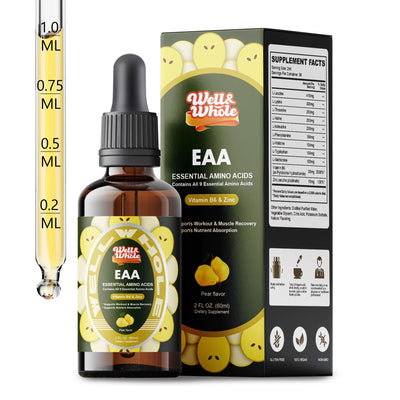
EAA Drops: Boost Muscle Recovery & Wellness with Essential Amino Acids

What Are EAA Drops and Why They Matter for Your Wellness
EAA drops are a convenient liquid supplement packed with essential amino acids (EAAs) that your body cannot produce on its own. Unlike the synthesis of non-essential amino acids that your body manages internally, EAAs must be obtained through diet or supplementation to support muscle recovery, energy production, and overall wellness.
Key Benefits of Using EAA Drops
- Supports Muscle Recovery: EAAs help repair muscle tissue after workouts.
- Boosts Energy Levels: Essential amino acids contribute to sustained energy throughout the day.
- Promotes Protein Synthesis: EAAs enhance your body’s ability to build and maintain lean muscle.
- Convenient & Fast-Absorbing: Liquid form allows quicker uptake compared to capsules or powders.
Who Should Use EAA Drops?
EAA drops are ideal for:
- Athletes and fitness enthusiasts looking for efficient muscle support.
- Busy professionals needing a quick amino acid boost.
- Anyone aiming to improve recovery and maintain lean muscle mass.
- Individuals with dietary restrictions who may lack sufficient EAAs from food.
How to Incorporate EAA Drops into Your Daily Routine
To maximize benefits, add the recommended serving of EAA drops to water or your favorite beverage once or twice daily. Use before or after workouts to support muscle repair and energy replenishment. The liquid form makes it easy to carry and consume anytime.
Comparison: EAA Drops vs. BCAA Supplements
| Feature | EAA Drops | BCAA Supplements |
|---|---|---|
| Amino Acid Coverage | All 9 essential amino acids | Only 3 branched-chain amino acids (leucine, isoleucine, valine) |
| Muscle Recovery Support | Comprehensive support for protein synthesis | Partial support, mainly focused on muscle synthesis |
| Form | Liquid drops (fast absorption) | Powders or capsules |
People Also Ask
What are the essential amino acids in EAA drops?
EAA drops contain all nine essential amino acids including histidine, isoleucine, leucine, lysine, methionine, phenylalanine, threonine, tryptophan, and valine.
Can EAA drops improve muscle growth?
Yes, by providing all essential amino acids, EAA drops support protein synthesis which is key for muscle growth and recovery.
How do EAA drops differ from non-essential amino acids?
Non-essential amino acids are produced naturally by the body through synthesis of non essential amino acids, while EAAs must be consumed as they cannot be made internally.
When is the best time to take EAA drops?
The best times are before, during, or after workouts to optimize muscle recovery and energy levels.
Frequently Asked Questions (FAQ)
Are EAA drops safe for everyone?
Generally, EAA drops are safe for most adults. However, consult your healthcare provider if you have any medical conditions or are pregnant.
How many drops should I take daily?
Follow the product label instructions. Typically, 15-30 drops mixed with water once or twice a day is recommended.
Can I use EAA drops if I’m vegetarian or vegan?
Yes, many EAA drops are plant-based and suitable for vegetarian and vegan diets. Check the product label to confirm.
Do EAA drops have any flavor?
Most EAA drops come in natural or lightly flavored options for easy consumption.
Ready to Boost Your Wellness with EAA Drops?
Experience faster recovery and sustained energy by adding our premium EAA drops to your daily routine. Shop now and take the next step towards better muscle support and overall wellness.
Related supplements
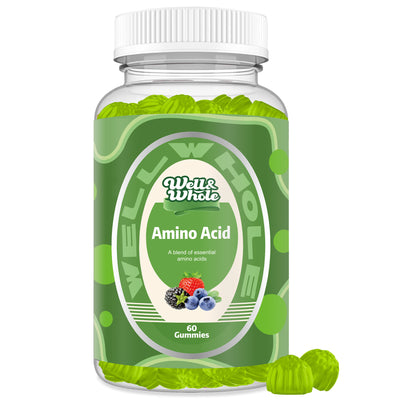
Where to begin? Our EAA Gummie 60 counts Essential Amino Acids Supplement Gummies for Men and Women and Essential Amino Acid (EAA) Liquid Drops & Liver Support Liquid Supplement are a sensible place to start, and the Amino Acids collection lays out the other formats side by side with Muscle Support.
Essential versus non-essential, and why it matters here
Nine of the twenty amino acids your body uses to build protein are "essential" — meaning you lack the metabolic pathway to make them, so they have to arrive from food. The nine are histidine, isoleucine, leucine, lysine, methionine, phenylalanine, threonine, tryptophan and valine.
The practical consequence: protein synthesis cannot proceed past the point where one essential amino acid runs short. If even one is limiting, the whole process is capped regardless of how much of everything else is available. That is why EAA supplementation is a different proposition from adding more protein generally — it targets the limiting factor directly.
It is also why the leucine content gets attention: leucine is a trigger for the mTOR pathway that initiates muscle protein synthesis, and it is the amino acid most associated with the anabolic signal.
EAA versus BCAA
This is the comparison most buyers are actually making, and it is worth being direct. BCAAs are three amino acids — leucine, isoleucine, valine. EAAs are all nine essentials. Since synthesis needs all nine, supplementing only three means the other six have to come from diet, and if any of those six is limiting, the BCAAs cannot do their job.
That is the honest argument for EAAs over BCAAs. BCAAs are not useless — they still deliver the leucine signal — but the "complete" claim belongs to EAAs, and the price difference usually reflects that.
Who actually benefits
The strongest case is for people whose dietary protein is genuinely inadequate or poorly distributed, older adults (who need a larger per-meal leucine dose to trigger the same response — the "anabolic resistance" effect), and people training fasted or in a calorie deficit. If you already eat 1.6 g of protein per kilogram of body weight spread across three or four meals, an EAA supplement is largely redundant, and saying so is more useful than selling it.
Dosing and safety
Common supplemental doses land around 6–15 g of EAAs, often taken around training or between meals. Free-form amino acids absorb quickly and do not need digestion, which is the argument for a liquid format. They are also quite bitter, which is the argument against it — flavouring matters more here than for capsules.
Safety is good at these doses for healthy adults, with gastrointestinal complaints the main issue at the top of the range. The real caution is renal: anyone with kidney disease should not supplement amino acids in gram quantities without medical guidance. There is also a theoretical competition issue with levodopa, since large neutral amino acids share transport.
Where it fits
Our EAA liquid drops suit peri-workout use and dose adjustment; EAA gummies are the more convenient everyday format. Compare both against the wider amino acid collection.
These statements have not been evaluated by the Food and Drug Administration. This product is not intended to diagnose, treat, cure, or prevent any disease.