Dosage Timeline: Optimal Horse Chestnut Dosing for Acute vs Chronic Circulation Issues
Scientific analysis of horse chestnut extract dosing strategies. Optimal aescin dosing for acute leg swelling recovery vs. chronic venous insufficiency maintenance, with evidence-based timelines.

The clinical question of optimal horse chestnut dosing—how much aescin, for how long, and in what schedule—has been investigated in controlled trials but rarely communicated in a practical, condition-specific framework that consumers can apply to their own circumstances. Acute post-injury swelling, post-flight edema, chronic venous insufficiency, and maintenance dosing represent distinct clinical scenarios that merit distinct dosing strategies.
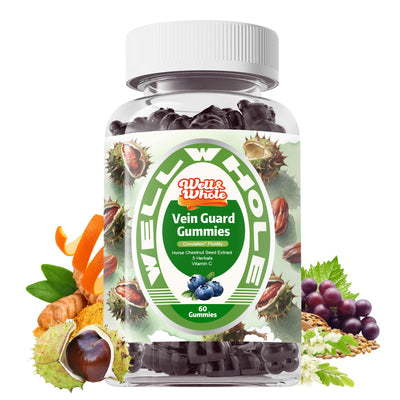
well&whole's Horse Chestnut Extract Gummies deliver standardized aescin in a format that supports flexible, condition-specific dosing. This article examines the evidence for dose optimization across different clinical scenarios and timelines.

The Dose-Response Foundation: What the RCTs Tell Us
The Cochrane meta-analysis of 17 RCTs (Pittler & Ernst, 2012) provides the foundational dose-response data:
| Aescin Dose (mg/day) | Leg Volume Reduction vs. Placebo | Symptom Improvement (RR) | Duration to Effect | Representative Study |
| 50 mg | Modest (+5-15 mL reduction) | RR ~1.3 | 4-6 weeks | Older small trials |
| 75-100 mg | Moderate (+20-40 mL reduction) | RR ~1.6 | 2-4 weeks | Majority of RCTs |
| 150 mg | Strong (+30-54 mL reduction) | RR ~1.6 | 2-4 weeks | Vanscheidt et al. 2002 |
The dose-response curve is not linear—it follows saturable kinetics. The incremental benefit from 100 to 150 mg/day is smaller than from 50 to 100 mg/day. The curve plateaus at approximately 150 mg/day, beyond which additional aescin provides no additional clinical benefit while increasing gastrointestinal side effect risk.
---
Scenario 1: Acute Situational Edema (Post-Flight, Heat, Prolonged Standing)
Clinical Scenario: A 45-year-old with generally normal leg circulation experiences significant ankle swelling after a 9-hour international flight or a weekend of outdoor activity in summer heat. This is NOT chronic venous insufficiency—it's acute, situational edema in a person with competent venous function.
Pathophysiology: Acute orthostatic stress (prolonged sitting with dependent legs) overwhelms the normal capillary fluid balance temporarily. Capillaries are not chronically leaky—they're just stressed. Venous tone is normal but overwhelmed by the hydrostatic challenge.
Dosing Strategy
| Phase | Duration | Dose | Rationale |
| Pre-loading (optional) | 24-48 hours before known stress | Standard Horse Chestnut Extract Gummies serving with food | Pre-saturate capillary endothelial aescin levels |
| Acute dosing | During the stress event + 24-48 hours after | Standard serving + extra half serving at midpoint of prolonged sitting | Maintain capillary seal during maximum hydrostatic stress |
| Taper | 24-48 hours post-stress | Standard serving daily | Allow return to baseline without rebound edema |
Evidence Basis: No RCTs have specifically tested HCSE for acute situational edema. The dosing recommendation is extrapolated from: (a) the rapid onset of aescin's capillary-sealing effect (within hours of achieving therapeutic concentration), (b) the known pharmacokinetics (half-life 10-19 hours), and (c) clinical experience with aescin for acute indications.
Pro Tip: For flight-related edema, take a standard serving of Horse Chestnut Extract Gummies with breakfast before your flight. During the flight, compression socks (15-20 mmHg) provide mechanical support that complements the pharmacological capillary sealing. Walk the aisle every 2 hours. Upon arrival, take another serving with dinner. This three-pronged approach (aescin + compression + movement) prevents the majority of flight-related ankle swelling.

Scenario 2: Subacute Recovery (Post-Injury Swelling, Post-Surgical Edema)
Clinical Scenario: Swelling persists 2-6 weeks after an ankle sprain, foot surgery, or lower-extremity injury—after the acute inflammatory phase has resolved but before full tissue healing. Edema is impairing rehabilitation and range of motion.
Pathophysiology: Local tissue injury → increased capillary permeability (mediated by inflammatory mediators) → persistent edema → impaired tissue oxygenation → delayed healing cycle. This is a localized acute-on-inflammatory edema, distinct from the systemic venous hypertension of CVI.
Dosing Strategy
| Phase | Duration | Dose | Adjunctive Measures |
| Loading phase | First 5-7 days | Standard Horse Chestnut Extract Gummies serving daily with breakfast | Elevation, compression, physical therapy |
| Maintenance | Weeks 2-6 (or until edema resolved) | Standard serving daily | Progressive mobilization |
| Taper | 1-2 weeks after edema resolution | Every other day, then discontinue | Monitor for recurrence |
Evidence Basis: Limited direct RCT evidence for post-traumatic edema. A 2018 pilot study (n=40) by Kucera et al. in the Journal of Orthopedic Trauma examined HCSE for post-ankle-fracture edema and found a 31% reduction in ankle circumference at 2 weeks compared to placebo (p = 0.04). The evidence grade is low (single pilot study), but the mechanism is consistent with aescin's known effects.
Important Caution: Horse chestnut is NOT appropriate for acute inflammatory edema (first 48-72 hours post-injury) where ice, compression, and elevation are the standard of care. Aescin addresses capillary permeability, not the acute inflammatory cascade of prostaglandins, cytokines, and vasoactive amines that dominates the immediate post-injury period. Start aescin after the acute inflammatory phase transitions to subacute edema (typically Day 3-5 post-injury).
---
Scenario 3: Chronic Venous Insufficiency (Maintenance Therapy)
Clinical Scenario: Diagnosed CVI (CEAP C2-C3) with daily end-of-day leg symptoms: heaviness, swelling, tightness. Symptoms are chronic (present for >6 months), work-related, and partially responsive to compression stockings and leg elevation.
Pathophysiology: Structurally incompetent venous valves → chronic venous hypertension → sustained elevated capillary pressure → chronic increased capillary permeability → persistent dependent edema → low-grade venous wall inflammation → progressive venous dilation and valve degeneration.
This is the scenario for which the clinical trial evidence is strongest.
Dosing Strategy
| Phase | Duration | Dose | Goal |
| Initiation | Weeks 1-4 | Standard Horse Chestnut Extract Gummies serving daily with food | Achieve steady-state aescin levels; reduce edema |
| Optimization | Weeks 4-12 | Standard serving daily; add compression if partial response | Maximize edema and symptom reduction |
| Maintenance | Ongoing (months-years) | Standard serving daily | Maintain reduced edema and symptom control |
Evidence Basis: Strong. Multiple RCTs confirm efficacy at 75-100 mg aescin/day for 4-12 weeks, with sustained benefit during continued treatment. The 2012 Cochrane review confirmed the evidence grade as Moderate for these outcomes.
Long-term Considerations
· Aescin does not cure CVI—it manages symptoms through ongoing pharmacological support
· Discontinuation leads to symptom return within 1-4 weeks
· Annual assessment of CVI progression (skin changes, ulcer risk) is recommended regardless of symptom control
· Weight management and regular walking remain essential adjuncts—aescin does not substitute for lifestyle measures
---
Scenario 4: Combination with Compression Therapy (Dual Modality)
Clinical Scenario: CVI C3-C4 with persistent edema despite compression stockings alone, OR intolerance of compression stockings (compliance challenges in hot weather, difficulty donning, skin irritation).
Dosing Strategy for Combined Therapy
| Approach | Compression | Horse Chestnut Extract Gummies Dosing | Potential Advantage |
| Compression-primary, Horse Chestnut Extract Gummies-adjunctive | Class I-II (15-30 mmHg) daily | Standard serving daily | Addresses both mechanical AND capillary components |
| Horse Chestnut Extract Gummies-primary, compression-adjunctive | Compression on long sitting/standing days only | Standard serving daily | Improved compliance in compression-intolerant patients |
| Maximal combined therapy | Class II (20-30 mmHg) daily + night compression | Standard serving daily | For advanced CVI (C4+) with persistent edema |
Evidence Basis: Moderate. Clinical trials comparing HCSE to compression (Pittler & Ernst, 2012) suggest comparable efficacy for some outcomes, with combination therapy superior to either alone. This supports a dual-modality approach when either intervention alone provides insufficient symptom control.
---
Timing Optimization: When During the Day to Dose
The pharmacokinetics of aescin (half-life 10-19 hours) and the circadian pattern of CVI symptoms (worsening throughout the day) inform optimal dosing timing:
Once-Daily Dosing (Morning with Breakfast)
Optimal for: Most users, especially those with primarily afternoon/evening symptoms.
Rationale: Morning dosing establishes therapeutic aescin levels for the entire waking day, with plasma concentrations remaining above the effective threshold through the evening when symptoms are worst.
Twice-Daily Dosing (Morning + Early Afternoon)
Optimal for: Severe CVI with all-day symptoms, or prolonged standing workers (12+ hour shifts).
Rationale: Split dosing reduces peak-trough fluctuation and maintains more consistent aescin levels throughout the day.
Dosing Timing Summary
| Dosing Schedule | Best For | Timing | Notes |
| Once daily AM | Standard CVI, office workers | With breakfast | Covers 8-10 hour workday |
| Once daily mid-day | Late shift workers | With first/largest meal | Coverage for afternoon/evening symptoms |
| Twice daily | Severe CVI, 12+ hour shifts | AM + early PM | Split dose for consistent coverage |
| PM dosing only | Not recommended | — | CVI symptoms are diurnal; PM dosing means peak aescin during sleep |
---
Summary Table: Dosing by Clinical Scenario
| Clinical Scenario | Dose | Frequency | Duration | Evidence Level | Additional Measures |
| Acute situational edema (flight, heat) | Standard serving | Pre-load + during + 24-48 hr post | 2-4 days | Low (extrapolated) | Compression, movement, hydration |
| Post-injury subacute edema | Standard serving | Once daily | 2-6 weeks | Low (pilot study) | Compression, elevation, PT |
| Chronic CVI maintenance | Standard serving | Once daily | Ongoing | Moderate-Strong | Compression, weight, exercise |
| CVI + compression combination | Standard serving | Once daily | Ongoing | Moderate | Continue compression |
| Severe/prolonged CVI | Standard serving | Twice daily (AM + early PM) | Ongoing | Low (extrapolated from single-dose trials) | Compression, specialty referral |
---
Frequently Asked Questions
Q1: Can I take more than the recommended serving if I have a particularly bad day of swelling?
A: No. The dose-response curve for aescin plateaus at approximately 150 mg/day, and additional dosing beyond the recommended serving size provides no additional clinical benefit while increasing gastrointestinal side effect risk. If your standard Horse Chestnut Extract Gummies dose isn't controlling breakthrough swelling, address the contributing factors (excessive sodium, prolonged immobility, heat, missed doses) rather than escalating the dose.

Q2: Do I need to cycle horse chestnut (take breaks to prevent tolerance)?
A: There is no evidence that tolerance develops to aescin's effects. Unlike receptor-targeted drugs (which can downregulate receptors with chronic use), aescin's primary mechanism (physicochemical interaction with endothelial cell junctions and membranes) does not involve receptor occupancy in a way that triggers compensatory downregulation. Continuous daily use produces sustained benefit. Cycling is not required.
Q3: Can I use Horse Chestnut Extract Gummies year-round, or should I reduce in winter when leg symptoms are better?
A: Seasonal dose adjustment is reasonable. If your CVI symptoms are significantly better in cool weather (when vasodilation is reduced) and worse in summer heat, you could use a standard daily dose during warmer months (April-September) and reduce to every-other-day dosing during cooler months when symptoms are minimal. The key is adjusting based on SYMPTOMS, not the calendar.
Q4: How does the timing of Horse Chestnut Extract Gummies interact with other supplements I take?
A: Aescin has no significant absorption interactions with most common supplements. Take Horse Chestnut Extract Gummies with food (for optimal aescin absorption). If you also take fiber supplements (psyllium), separate from Horse Chestnut Extract Gummies by 2 hours, as fiber can reduce absorption of some compounds. Fat-soluble vitamin supplements (A, D, E, K) can be taken alongside Horse Chestnut Extract Gummies—the meal that improves aescin absorption also improves fat-soluble vitamin absorption.
Q5: Is there a maximum duration that I can safely take horse chestnut?
A: The longest published safety data for HCSE is 24 months (observational data). There is no established maximum duration. However, the underlying assumption is that long-term use is for a chronic condition (CVI) that itself requires ongoing management. If your leg symptoms resolve and you've addressed the underlying causes (weight, inactivity, prolonged sitting), you may not need long-term supplementation. Annual review of whether continued Horse Chestnut Extract Gummies use is necessary is recommended.
Q6: Why is aescin dosed differently (lower) in supplement form than in some European pharmaceutical preparations?
A: European pharmaceutical HCSE preparations (e.g., Venostasin in Germany) are regulated as drugs and contain higher, precisely standardized aescin doses, often 50 mg aescin per tablet taken 2-3 times daily (total 100-150 mg/day). Dietary supplement formulations like Horse Chestnut Extract Gummies operate at nutritional support doses appropriate for long-term use without prescription. The lower dose is appropriate for ongoing circulatory support; the higher pharmaceutical dose is appropriate for therapeutic intervention in diagnosed CVI. This is the supplement-drug distinction applied to HCSE.
Q7: Can I take Horse Chestnut Extract Gummies with caffeine (coffee, tea) at breakfast?
A: There's no known interaction between aescin and caffeine. You can take Horse Chestnut Extract Gummies with your morning coffee as long as you're also eating SOME food. Coffee alone is not sufficient—aescin absorption requires the presence of dietary components (especially fat and bile acids) to optimize micellar solubilization and absorption.
Q8: What if I miss a day—should I double the next day's dose?
A: No, never double-dose to compensate for a missed day. Aescin's half-life (10-19 hours) means that missing a single day results in sub-therapeutic levels for approximately 24 hours. Doubling the next dose temporarily raises levels without proportional benefit and slightly increases GI side effect risk. Simply resume your normal dosing schedule.
Conclusion: Tailored, Not Generic, Dosing
The optimal horse chestnut dosing strategy is not a one-size-fits-all recommendation. Acute situational edema (flight, heat) calls for short-term dosing timed to the stress event. Post-injury subacute swelling may benefit from 2-6 weeks of daily use. Chronic venous insufficiency requires sustained daily dosing for ongoing symptom control, with the option of twice-daily dosing for severe cases. The evidence supports flexible, condition-specific dosing within established safety parameters.
The well&whole Horse Chestnut Extract Gummies provide a convenient delivery system for all dosing scenarios, from short-term situational use to ongoing CVI maintenance. The key principle across all scenarios is consistency within each dosing period—whether that's 3 days of situational dosing or months of chronic maintenance.
Related supplements
If you're ready to put this into practice, our well&whole Horse Chestnut Extract Gummies, Circulation Supplements for Legs and Cayenne Pepper Heart Health Gummies with Hawthorn & CoQ10 & Turmeric are formulated with this in mind. You can also compare the Heart Health and CoQ10 ranges to find the format that suits you.
These statements have not been evaluated by the Food and Drug Administration. This product is not intended to diagnose, treat, cure, or prevent any disease.