Dopamine Supplements: Can They Really Boost Focus and Drive?
Can dopamine supplements really improve focus and motivation? Learn what science says about Mucuna pruriens, L-Dopa, and cognitive performance.

"Boost your dopamine." "Hack your focus." "Unlock your drive." The supplement industry is full of promises about dopamine enhancement. But behind the marketing claims, there's real neuroscience—and it tells a more nuanced story.
Dopamine is genuinely one of the brain's most important neurotransmitters for focus, motivation, and cognitive performance. And supplements that support dopamine production—like Mucuna pruriens with its natural L-Dopa content—may indeed help. But understanding how they work, what they can realistically do, and what they can't do is essential for making informed decisions.
This article examines the science behind dopamine supplements for focus and drive, what research actually shows, and how to use them effectively.
The Neuroscience of Focus and Drive
How Dopamine Drives Focus
Focus and concentration depend heavily on dopamine, particularly in the prefrontal cortex—the brain region responsible for executive function. Research published in *Nature Reviews Neuroscience* identified several ways dopamine supports focus:
1. **Signal-to-noise ratio**: Dopamine helps neurons in the prefrontal cortex maintain relevant information while filtering out distractions. It essentially turns up the "signal" and turns down the "noise."
2. **Working memory**: Dopamine is essential for working memory—the ability to hold and manipulate information in your mind. Both too little and too much dopamine impair working memory, following the "inverted U" principle.
3. **Sustained attention**: Dopamine helps maintain attention over time. When dopamine signaling is optimal, you can stay focused on a task without your mind wandering.
4. **Task switching**: Dopamine supports cognitive flexibility—the ability to switch between tasks efficiently.
How Dopamine Drives Motivation
Motivation is dopamine's signature function. The mesolimbic pathway—connecting the ventral tegmental area to the nucleus accumbens—is the brain's primary reward and motivation circuit.
A study in *Science* revealed that dopamine doesn't just signal pleasure—it signals "wanting." This wanting system is what we experience as drive, ambition, and the urge to pursue goals. When dopamine is high, we're willing to exert more effort. When it's low, even simple tasks feel overwhelming.
Why Dopamine May Need Support
Modern Challenges to Dopamine
Several factors in modern life can affect dopamine function:
1. **Chronic stress**: Prolonged stress elevates cortisol, which can deplete dopamine stores and reduce receptor sensitivity. Research in *Psychoneuroendocrinology* showed that chronic stress impaired dopamine signaling in the prefrontal cortex.
2. **Age-related decline**: Dopamine receptor density decreases by approximately 5–10% per decade after age 30, as documented in *Neurobiology of Aging*.
3. **Overstimulation**: Excessive social media, video games, and processed foods can overstimulate dopamine circuits, potentially leading to receptor downregulation.
4. **Poor sleep**: Sleep deprivation reduces dopamine receptor availability, as shown in a study in *The Journal of Neuroscience*.
5. **Nutritional gaps**: Deficiencies in dopamine co-factors (tyrosine, B6, iron, folate) can limit dopamine production.
When Dopamine Support Makes Sense
Dopamine-supporting supplements may be particularly relevant for:
- Busy professionals facing demanding cognitive workloads
- Students during exam periods
- Athletes seeking improved motivation and performance
- Adults over 40 experiencing age-related cognitive changes
- Anyone going through a stressful period with reduced motivation
- People transitioning away from dopamine-dysregulating habits
How Dopamine Supplements Work
The L-Dopa Approach
The most direct way to support dopamine production through supplementation is by providing L-Dopa—the immediate precursor to dopamine. Mucuna pruriens is nature's richest source of L-Dopa.
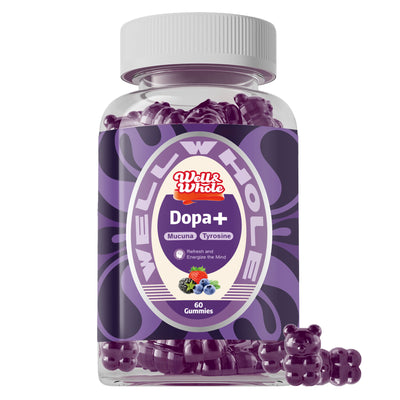
well&whole Dopamine Gummies and Mucuna Pruriens Liquid Drops both provide 500mg of Mucuna pruriens extract, delivering naturally occurring L-Dopa that the brain can convert to dopamine.

The Mechanism
1. You consume Mucuna pruriens extract containing L-Dopa
2. L-Dopa is absorbed through the digestive tract
3. L-Dopa crosses the blood-brain barrier via amino acid transporters
4. Inside the brain, the enzyme AAAD converts L-Dopa to dopamine
5. The newly produced dopamine supports signaling in focus and motivation circuits
Why Not Just Take Tyrosine?
Tyrosine is the amino acid that the brain uses to make L-Dopa (which is then converted to dopamine). So why not just take tyrosine?
The answer lies in the rate-limiting step. The conversion of tyrosine to L-Dopa (by the enzyme tyrosine hydroxylase) is the bottleneck in dopamine production. The brain tightly regulates this step, meaning that taking more tyrosine doesn't necessarily produce more L-Dopa or dopamine.
L-Dopa from Mucuna bypasses this bottleneck entirely, providing the product of the rate-limiting step directly to the brain.
What Research Shows About Dopamine and Cognitive Performance
Focus and Attention Studies
Research on dopamine's role in focus is extensive:
- A study in *Cerebral Cortex* found that optimal dopamine levels in the prefrontal cortex improved working memory performance and reduced distractibility.
- Research in *Psychopharmacology* showed that dopamine support improved sustained attention in fatigued individuals.
- A study in *Neuropsychopharmacology* demonstrated that dopamine support enhanced task engagement and reduced procrastination-like behavior.
Motivation Studies
- Research in *Behavioral Neuroscience* showed that dopamine levels predicted willingness to exert effort for rewards.
- A study in *Neuron* demonstrated that dopamine neurons encoded the "cost" of effort—when dopamine was high, effort felt less costly.
- Research in *Trends in Cognitive Sciences* proposed that dopamine specifically supports "motivational vigor"—the intensity with which we pursue goals.
Mucuna Pruriens Specific Research
- A study in the *Journal of Neurology* found that Mucuna pruriens preparation provided bioavailable L-Dopa in human subjects, demonstrating that the L-Dopa in Mucuna is effectively absorbed and utilized.
- Research in *Phytotherapy Research* showed that Mucuna pruriens extract supported antioxidant defenses in neural tissue, potentially protecting dopamine-producing neurons.
Realistic Expectations: What Dopamine Supplements Can and Can't Do
What They May Help With
- Supporting mental clarity and alertness during cognitively demanding tasks
- Maintaining motivation during long projects or stressful periods
- Supporting focus and concentration
- Complementing healthy lifestyle habits for optimal cognitive function
- Supporting age-related dopamine maintenance
What They Can't Do
- Replace quality sleep, exercise, and nutrition
- Compensate for burnout or chronic overwork
- Treat ADHD, depression, or other clinical conditions
- Provide unlimited motivation without effort
- Work as a "quick fix" without consistent use
The Inverted U Principle
It's crucial to understand that more dopamine is not always better. The relationship between dopamine and cognitive performance follows an inverted U curve:
- **Too little dopamine**: Poor focus, low motivation, apathy
- **Optimal dopamine**: Sharp focus, strong motivation, clear thinking
- **Too much dopamine**: Anxiety, impulsivity, impaired focus
This means the goal is not to maximize dopamine but to optimize it. Standard supplement doses (like 500mg of Mucuna pruriens) are designed to support healthy dopamine levels—not overwhelm the system.
How to Use Dopamine Supplements Effectively
Dosage
Follow the product label instructions. Both well&whole Dopamine Gummies and Mucuna Pruriens Liquid Drops provide 500mg of Mucuna pruriens extract per serving.
Timing
- **Morning**: Best for supporting daytime focus and motivation
- **Pre-workout**: May support exercise motivation and intensity
- **Before cognitively demanding work**: 30–60 minutes before a focus session
- **Avoid evening use**: Dopamine supports alertness and may interfere with sleep
Cycling
To prevent tolerance and maintain effectiveness, consider cycling:
- 5 days on, 2 days off (weekly cycle)
- 3 weeks on, 1 week off (monthly cycle)
Combining with Other Strategies
For maximum effectiveness, pair Mucuna pruriens with:
1. **Caffeine** (in moderation): Caffeine and L-Dopa work through different mechanisms and may complement each other for focus support
2. **L-theanine**: May smooth out the effects of caffeine and support calm focus
3. **Omega-3 fatty acids**: Support overall brain health
4. **B-complex vitamins**: Provide co-factors for dopamine synthesis
FAQ
Q: Can dopamine supplements replace ADHD medication?
A: No. If you have been diagnosed with ADHD, continue working with your healthcare provider. Mucuna pruriens is not a treatment for ADHD and should not replace prescribed medications.
Q: How quickly will I feel the effects of a dopamine supplement?
A: Some users report feeling more alert and focused within 30–60 minutes. For sustained benefits, consistent daily use over 2–4 weeks is recommended.
Q: Can I take dopamine supplements every day?
A: Many people take Mucuna daily, but cycling is recommended to prevent tolerance. A common protocol is 5 days on, 2 days off. Consult your healthcare provider for personalized guidance.
Q: Will dopamine supplements make me anxious?
A: At standard doses, Mucuna pruriens is unlikely to cause anxiety. However, because dopamine supports alertness, excessive doses or combining with high caffeine may cause jitteriness. Start with the standard dose and assess your response.
Q: Can I take Mucuna pruriens before a workout?
A: Yes. Many athletes take Mucuna 30–45 minutes before exercise to support motivation and drive. Dopamine plays a role in exercise motivation and motor control.
Q: Do I need to take Mucuna with food?
A: Taking Mucuna with a small amount of food may reduce the chance of stomach upset. However, avoid high-protein meals, as protein can compete with L-Dopa for absorption.
Q: Can I take Mucuna pruriens with coffee?
A: Many people combine Mucuna with caffeine for enhanced focus. Start with lower doses of both to assess tolerance, and avoid this combination in the evening.
Q: What happens if I stop taking dopamine supplements?
A: If you've been cycling as recommended, stopping should not cause significant issues. If you've taken Mucuna daily for an extended period without cycling, you may notice a temporary reduction in motivation as your natural dopamine production normalizes.
Conclusion
Can dopamine supplements really boost focus and drive? The science says yes—with important caveats. Dopamine is genuinely essential for focus, motivation, and cognitive performance. And supplements that provide L-Dopa—like Mucuna pruriens—can support the brain's dopamine production in a meaningful way.
But dopamine supplements are not magic. They work best when combined with the lifestyle foundations that support healthy brain function: regular exercise, quality sleep, stress management, and proper nutrition. They provide the raw material; your lifestyle provides the context.
well&whole Dopamine Gummies and Mucuna Pruriens Liquid Drops both provide 500mg of Mucuna pruriens extract—nature's richest source of L-Dopa. Choose the format that fits your life, commit to consistent (cycled) use, and pair it with a brain-healthy lifestyle.
Focus and motivation are not fixed traits—they're neurochemical processes that you can support. With the right tools and habits, you can give your brain what it needs to perform at its best.
Related supplements
Where to begin? Our Dopamine Gummies – Mucuna Pruriens Supplements Gummies 500mg with Mood Support and Mucuna Pruriens Liquid, Mucuna Pruriens Supplements 500MG, Fuel for Focus & Attention are a sensible place to start, and the Mood Support collection lays out the other formats side by side with Brain Health.
These statements have not been evaluated by the Food and Drug Administration. This product is not intended to diagnose, treat, cure, or prevent any disease.