Dandelion Root for Liver Detox: Folk Remedy or Science-Backed?
Is dandelion root for liver detox just a folk remedy? Discover the science behind dandelion's choleretic, antioxidant, and hepatoprotective effects.

Dandelion root has been used as a liver tonic for centuries—by Native American healers, traditional European herbalists, and Chinese medicine practitioners alike. The common dandelion (Taraxacum officinale), often dismissed as a garden weed, contains a surprising array of compounds that modern science is beginning to validate.
But is dandelion root's reputation for liver support based on real science, or is it merely folk medicine dressed up for the modern supplement market?
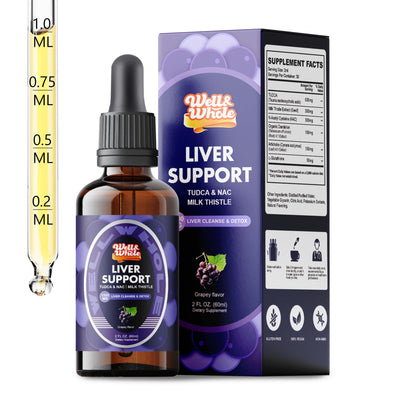
This article examines the traditional uses, emerging research, mechanisms of action, and practical role of dandelion root in liver support—particularly as part of well&whole's Liver Support Liquid Drops.
The Traditional History
A Global Folk Remedy
Dandelion's medicinal use spans multiple cultures and centuries:
- **European tradition**: Used since the 10th century for liver and digestive complaints. The French name "pissenlit" (pee-in-bed) reflects its well-known diuretic properties
- **Native American medicine**: Various tribes used dandelion root for digestive and liver ailments
- **Chinese medicine**: Known as "pu gong ying," dandelion was classified as a heat-clearing herb, used for liver and gallbladder imbalances
- **Ayurvedic practice**: Employed for digestive support and detoxification
This cross-cultural convergence is noteworthy—when multiple independent traditions identify the same plant for the same purpose, it suggests genuine biological activity rather than coincidence.
What Dandelion Root Contains
Dandelion root is rich in bioactive compounds:
| **Compound Class** | **Key Constituents** | **Primary Action** |
|---|---|---|
| Sesquiterpene lactones | Taraxacin, taraxacoside | Anti-inflammatory |
| Phenolic acids | Chicoric acid, caffeic acid | Antioxidant |
| Flavonoids | Luteolin, apigenin | Antioxidant, anti-inflammatory |
| Terpenoids | Taraxasterol | Anti-inflammatory, hepatoprotective |
| Inulin | Prebiotic fiber | Gut health support |
| Vitamins & minerals | Vitamin A, C, K; iron, potassium | Nutrient support |
The hepatoprotective (liver-protecting) potential comes primarily from the phenolic acids, flavonoids, and terpenoids—which collectively deliver antioxidant, anti-inflammatory, and bile-stimulating effects.
The Science: What Research Shows
Choleretic and Cholagogue Effects
The most well-documented liver action of dandelion root is its ability to stimulate bile production and release:
- **Choleretic**: Increases bile *production* by the liver
- **Cholagogue**: Promotes bile *release* from the gallbladder into the digestive tract
A foundational study by Mahajna et al. (2015) in *Advances in Biological Chemistry* reviewed dandelion's traditional and pharmacological properties, confirming its choleretic activity. The mechanism involves taraxasterol and other terpenoids stimulating hepatocytes to increase bile secretion.
Enhanced bile flow supports:
- Better fat digestion and absorption
- More efficient toxin elimination (many toxins are excreted via bile)
- Reduced gallbladder stagnation
- Improved cholesterol metabolism (cholesterol is eliminated through bile)
Antioxidant and Hepatoprotective Properties
Multiple animal studies have demonstrated dandelion root's ability to protect liver cells from damage:
- A 2010 study in *Journal of Ethnopharmacology* found that dandelion root extract significantly reduced oxidative liver damage in animal models, attributed to its flavonoid and phenolic acid content
- A 2015 study in *International Journal of Molecular Sciences* reported that dandelion root extract exhibited protective effects against alcohol-induced liver damage, reducing inflammatory markers and oxidative stress
- Schutz et al. (2005) in *Journal of Ethnopharmacology* documented dandelion root's hepatoprotective activity in carbon tetrachloride-induced liver injury models
While animal studies don't directly translate to human outcomes, they demonstrate genuine biological activity rather than mere tradition.
Anti-Inflammatory Effects
Dandelion root's anti-inflammatory compounds (taraxacin, taraxasterol, luteolin) modulate inflammatory signaling:
- **NF-κB pathway inhibition**: Similar to silymarin in milk thistle, dandelion compounds help suppress this master inflammatory switch
- **COX-2 reduction**: Limits production of inflammatory prostaglandins
- **Cytokine modulation**: Reduces levels of pro-inflammatory cytokines like TNF-α
In liver health, controlling inflammation is critical—chronic inflammation transforms benign fat accumulation into progressive cell damage.
Diuretic and Kidney Support
Dandelion root's well-documented diuretic effect supports the liver indirectly:
- The kidneys and liver work together in detoxification—while the liver processes toxins, the kidneys eliminate water-soluble waste products
- Enhanced urine flow helps clear metabolic waste, reducing the detoxification burden on the liver
- Unlike pharmaceutical diuretics, dandelion is a "potassium-sparing" diuretic—it increases urine output without depleting this essential mineral
Limitations of the Evidence
It's important to acknowledge where dandelion research falls short:
- **Limited human clinical trials**: Most evidence comes from animal and in vitro studies. Large-scale human trials are still needed
- **Standardization challenges**: Different extracts use varying concentrations, making comparisons difficult
- **Mechanistic depth**: While choleretic and antioxidant effects are documented, the precise molecular pathways need further elucidation
Compared to ingredients like TUDCA or NAC—which have robust clinical data—dandelion's evidence base is more preliminary. This doesn't mean it's ineffective; it means the science is still catching up to the tradition.
Dandelion Root in well&whole's Liver Support Liquid Drops
Dandelion root is included in well&whole's Liver Support Liquid Drops as one of six synergistic ingredients. Its role is specific and complementary:

| **Ingredient** | **Primary Pathway** | **Dandelion's Relationship** |
|---|---|---|
| TUDCA | Bile flow maintenance (thinning) | Dandelion stimulates bile *production*—TUDCA maintains its *flow*. Together: more bile, better flow |
| NAC | Glutathione production | Dandelion's antioxidants *spare* glutathione by scavenging some free radicals directly |
| Milk thistle | Direct antioxidant, membrane protection | Dandelion adds *bile stimulation* that milk thistle doesn't provide |
| Artichoke | Bile secretion, cholesterol metabolism | Both stimulate bile—but through different compounds (cynarin vs. taraxasterol) |
| Glutathione | Immediate antioxidant defense | Dandelion's phenolic acids provide *additional* antioxidant coverage |
Dandelion fills a unique niche: **bile production stimulation + gentle diuretic support**—functions not covered by other formula ingredients.
Practical Considerations
Form Matters
Dandelion root is most effective when extracted properly. The liquid delivery format in well&whole's drops offers:
- **Better extraction**: Liquid extracts can capture both water-soluble and alcohol-soluble compounds from the root
- **Faster absorption**: No capsule dissolution delay
- **Flexible dosing**: Dropper allows dose adjustment
Quality Considerations
Look for dandelion root supplements that specify:
- **Taraxacum officinale** as the species (not unspecified "dandelion")
- Root extract rather than leaf (the root is more relevant for liver support; the leaf is more diuretic)
- Standardized extraction methods
Folk Remedy or Science-Backed? The Honest Answer
Dandelion root sits between pure folk medicine and fully validated clinical science. The evidence is:
- **Strong for**: Traditional cross-cultural use, choleretic/cholagogue activity, antioxidant properties (animal data), anti-inflammatory mechanisms
- **Emerging for**: Human clinical liver outcomes, standardized dosing recommendations
- **Not yet established for**: Direct comparison with pharmaceutical liver treatments, large-scale human trials
The most honest characterization: dandelion root is a **traditionally validated, pre-clinically supported** liver herb with genuine biological activity, awaiting larger human trials to confirm its traditional reputation with modern clinical rigor.
For supplemental use—as part of a multi-ingredient formula—dandelion root adds bile stimulation and additional antioxidant coverage without requiring pharmaceutical-level evidence. It fills a functional gap that other ingredients don't address.
FAQ
Q1: Does dandelion root really help the liver?
Research supports dandelion root's choleretic (bile-stimulating) and hepatoprotective properties, primarily from animal studies. Human clinical data is more limited. Its inclusion in multi-ingredient formulas is justified by its complementary bile-stimulating role.
Q2: Is dandelion root a detox herb?
Dandelion root supports liver detoxification indirectly by stimulating bile production and flow—bile is one of the liver's primary elimination pathways. It also provides antioxidant compounds that protect liver cells during detoxification processes.
Q3: What's the difference between dandelion root and dandelion leaf?
The root is more relevant for liver and gallbladder support (choleretic, hepatoprotective). The leaf is more diuretic-focused. well&whole's formula uses root extract for its liver-specific properties.
Q4: Can dandelion root replace milk thistle?
No—they serve different functions. Milk thistle provides direct antioxidant defense (silymarin) and membrane stabilization. Dandelion provides bile stimulation and complementary antioxidants. Both are valuable; they work best together.
Q5: Is dandelion root safe?
Dandelion root has a long safety record in traditional use and modern supplementation. The most common concern is potential allergic reactions in people sensitive to Asteraceae family plants (ragweed, chrysanthemums, marigolds).
Q6: Can I take dandelion root if I have gallstones?
Caution is warranted. Dandelion's cholagogue effect stimulates bile release, which could potentially aggravate gallstone issues. Consult your healthcare provider before using dandelion root if you have known gallbladder conditions.
Q7: How does dandelion root work in a multi-ingredient formula?
Dandelion adds bile production stimulation—a function not covered by TUDCA (which maintains flow), NAC (which boosts glutathione), or milk thistle (which provides antioxidant defense). It fills a specific functional niche.
Q8: Does dandelion root have diuretic effects?
Yes. Dandelion is a potassium-sparing diuretic—it increases urine output without depleting potassium. This supports kidney function and complements the liver's detoxification role.
Q9: Why include a "folk remedy" in a science-based formula?
Dandelion root has genuine biological activity documented in pre-clinical research. Its choleretic, antioxidant, and anti-inflammatory properties are scientifically verified—even if human clinical trials are still limited. In a multi-ingredient formula, it fills a functional gap that other ingredients don't cover.
Q10: What dose of dandelion root is typically used for liver support?
Clinical guidance varies. In well&whole's formula, dandelion root is included at a proportion consistent with traditional and pre-clinical evidence, balanced against the other five ingredients. Follow label directions for dosing.
Conclusion
Dandelion root isn't just a folk remedy—it's a traditional herb with emerging scientific validation. Its choleretic, antioxidant, and anti-inflammatory properties make it a legitimate contributor to liver support, particularly in a multi-ingredient formula where it fills the bile stimulation niche.
In well&whole's Liver Support Liquid Drops, dandelion root works alongside TUDCA, NAC, milk thistle, artichoke, and glutathione—each covering a different pathway, each amplifying the others. Dandelion's role: more bile, better flow, additional antioxidant defense.

The folk remedy has real science behind it. And in combination with five other evidence-backed ingredients, it's more effective than it could ever be alone.
Related supplements
If you'd like to try it, Liver Support Liquid Drops Supplement | TUDCA Drops Liver Cleanse & Detox with Milk Thistle, NAC, Dandelion, Artichoke & Glutathione for Detox and TUDCA 1000mg Gummies with Milk Thistle 500mg for Adults are the closest match to what we've covered here. Browse Liver Support and Milk Thistle to see how the alternatives compare.
These statements have not been evaluated by the Food and Drug Administration. This product is not intended to diagnose, treat, cure, or prevent any disease.