CoQ10 Ubiquinol vs Ubiquinone: Which Form Makes Sense to Buy

The short answer: ubiquinol and ubiquinone are two forms of the same nutrient — CoQ10 — and for most people either form raises blood levels when taken consistently. Ubiquinol is the pre-converted form that tends to absorb somewhat better, particularly after age forty, while ubiquinone is the original, cheaper form behind almost all of the classic research. Form matters less than consistency, dose per serving and independent quality verification.
Key takeaways
- CoQ10 participates in cellular energy production and doubles as a fat-soluble antioxidant in cell membranes.
- Ubiquinone is the oxidized form; ubiquinol is its reduced, pre-converted counterpart.
- Head-to-head absorption comparisons often favor ubiquinol, but results are not uniform across studies.
- Statin medication use is the most common reason people consider CoQ10 at all.
- Take either form with a meal containing fat; a fat-soluble nutrient on an empty stomach is money wasted.
What CoQ10 does in the body
CoQ10 sits inside the energy-producing machinery of every cell, shuttling electrons during the process that converts food into usable energy, and it recycles back and forth between its two chemical states to do that job. The same molecule works as an antioxidant in membranes, protecting fats from oxidative wear. Tissues with high energy demand — the heart among them — hold the largest concentrations, which is why the nutrient is so often discussed alongside heart-conscious routines.
Ubiquinone: the original form
Ubiquinone is the form manufacturers have produced since the 1970s and the form used in the majority of published research, including most early clinical work in cardiac care settings. It is more stable on the shelf and meaningfully cheaper. Its one practical weakness is absorption: the molecule is fat-soluble and poorly water-soluble, so the fraction that reaches the bloodstream depends heavily on taking it with dietary fat and on the delivery format of the specific product.
Ubiquinol: the pre-converted form
Ubiquinol is the antioxidant-active state that the body can use directly without an initial conversion step. A young, healthy body performs that conversion easily, which is one reason trials in younger adults often show little difference between forms. With age, that conversion becomes less efficient, and several comparison studies in older adults have found higher blood levels from equivalent ubiquinol doses. The costs are a shorter shelf life and a noticeably higher price per milligram.
Side by side
| Ubiquinone | Ubiquinol | |
|---|---|---|
| Chemical state | Oxidized; needs conversion | Reduced; ready to use |
| Absorption | Modest, meal-dependent | Generally higher, esp. over 40 |
| Research base | Longest; most classic studies | Newer; fewer large trials |
| Cost and stability | Cheaper, very stable | Pricier, more fragile |
Who actually thinks about CoQ10, and why
Before picking a form, it helps to know whether CoQ10 belongs on your list at all.
Two groups dominate real-world interest. The first is people taking statin medication: statins inhibit the same pathway the body uses to manufacture CoQ10, and lower circulating levels are a documented side effect — whether replacement changes how people feel is still studied, but the logic of the question is sound. The second is adults past middle age, whose natural production declines gradually. Neither group should expect CoQ10 to replace prescribed therapy, and anyone managing a heart condition should loop in their clinician before adding it.
Reading a CoQ10 label without the hype
Three checks do most of the work. Confirm the amount per serving, not per capsule — two-capsule servings are common and quietly double the price. Confirm the form is stated clearly, since some products blur the two. And look for independent verification, because dose accuracy varies more between brands than between forms. Typical studied intakes for adults range around 100–200 mg daily of either form.

What “high absorption” claims really mean
Absorption is where CoQ10 marketing gets creative, so it helps to know what is measurable. Form is only one variable: delivery format, fat content of the meal, and serving size all move blood levels too, and some ubiquinone products with better delivery formats outperform poorly made ubiquinol. When a brand cites an absorption percentage, check whether the comparison is against plain ubiquinone powder or against a properly formulated rival — the number often evaporates under the second comparison. Practical takeaways beat label percentages: take your chosen form with the largest, fattiest meal of the day, keep it daily, and give any product eight weeks before judging whether it earns its place in the routine. Consistency of intake has more measurable impact on blood levels than the form debate in most published comparisons.
Frequently asked questions
Can I get enough CoQ10 from food?
Foods such as sardines, peanuts and organ-rich dishes contain some, but reaching study-level intakes by diet alone means eating impractical quantities. Diet supports the baseline; products fill the gap people are actually shopping for.
Which form do most studies use?
Historically ubiquinone, because it existed first. Newer pharmacology studies compare both forms directly, which is where the age-related absorption differences surfaced.
How long until CoQ10 levels build up?
Blood levels rise over two to four weeks of daily intake and taper after stopping. It is a steady-state nutrient, not an acute one — missing weeks matters more than missing the ideal form.
Can I take it alongside other supplements?
CoQ10 is commonly combined with general wellness stacks, but it can interact with blood-thinning and blood-pressure medication discussions are worth having. Review the full list with a pharmacist, not just the new bottle.
Related supplements
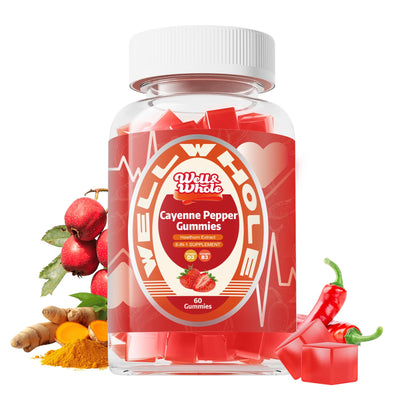
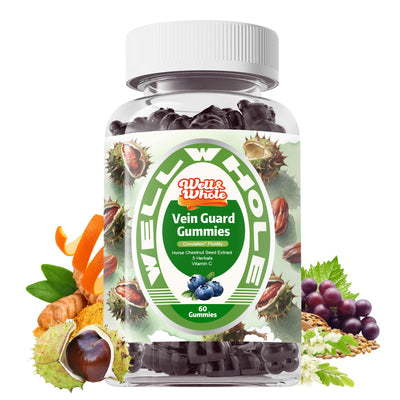
Should you decide to supplement, Well&Whole Horse Chestnut Extract Gummies, Circulation Supplements for Legs and Cayenne Pepper Heart Health Gummies with Hawthorn & CoQ10 & Turmeric are our formulation for this purpose. For a broader comparison, see the Heart Health and CoQ10 collections.
These statements have not been evaluated by the Food and Drug Administration. This product is not intended to diagnose, treat, cure, or prevent any disease. Talk to a healthcare professional before starting any new supplement, especially if you are pregnant, nursing, taking medication, or managing a health condition.
These statements have not been evaluated by the Food and Drug Administration. This product is not intended to diagnose, treat, cure, or prevent any disease.