CoQ10 in Cayenne Heart Gummies: Why It's Included
Why is CoQ10 included in heart health gummies? Discover how coenzyme Q10 supports heart energy, circulation, and cardiovascular function alongside cayenne.

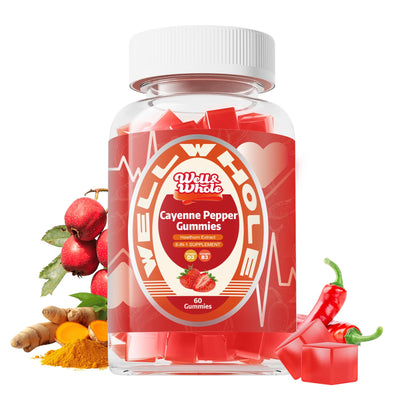
When you look at the ingredient list of well&whole Cayenne Pepper Heart Health Gummies, you'll find four powerful compounds: cayenne pepper, hawthorn berry, CoQ10, and turmeric. Each one was chosen for a specific reason—and CoQ10's reason might be the most fundamental of all.

CoQ10 (coenzyme Q10) is the compound that literally powers your heart. Every heartbeat, every contraction of cardiac muscle, requires energy—and that energy is produced in the mitochondria of heart cells, with CoQ10 as an essential component of the process.
In this article, we'll explore what CoQ10 is, why it's critical for heart health, what happens when levels decline, and why including it in a heart health gummy alongside cayenne, hawthorn, and turmeric creates a more complete cardiovascular formula.
What Is CoQ10?
The Basics
Coenzyme Q10 (also known as ubiquinone or ubiquinol) is a fat-soluble compound found in virtually every cell of the body. It serves two critical functions:
1. **Energy production**: CoQ10 is an essential component of the electron transport chain—the process by which mitochondria generate ATP (adenosine triphosphate), the energy currency of cells
2. **Antioxidant protection**: CoQ10 is one of the body's most important fat-soluble antioxidants, protecting cell membranes from oxidative damage
Where It's Found
CoQ10 is concentrated in tissues with high energy demands:
| Organ | CoQ10 Concentration | Why |
|---|---|---|
| Heart | Highest | Constant energy demand for contraction |
| Liver | High | Metabolic processing |
| Kidneys | High | Filtration and waste processing |
| Muscles | Moderate | Movement and posture |
| Brain | Moderate | Neural activity |
The heart contains the highest concentration of CoQ10 of any organ—a reflection of its relentless energy needs. A 2017 review in *Free Radical Biology and Medicine* noted that "the heart's continuous energy demand makes it uniquely dependent on CoQ10 for mitochondrial ATP production."
Why Your Heart Needs CoQ10
Mitochondrial Energy Production
The heart beats approximately 100,000 times per day, pumping about 2,000 gallons of blood. This requires a massive, continuous supply of energy. Here's how CoQ10 makes it possible:
1. **Electron transport chain**: CoQ10 shuttles electrons between Complexes I, II, and III in the mitochondrial inner membrane
2. **ATP synthesis**: This electron transfer drives the production of ATP, which powers every heartbeat
3. **Heart muscle contraction**: ATP fuels the sliding of actin and myosin filaments that cause cardiac muscle to contract
Without sufficient CoQ10, mitochondrial energy production declines, and the heart's pumping efficiency may be compromised.
Antioxidant Protection
The heart's high metabolic activity generates significant free radicals. CoQ10, in its reduced form (ubiquinol), neutralizes these free radicals before they can damage cardiac tissue. A 2018 study in *Antioxidants* demonstrated that CoQ10 protected heart tissue from oxidative damage, particularly in the lipid-rich mitochondrial membranes.
Endothelial Support
CoQ10 also supports the endothelium—the inner lining of blood vessels. A 2019 study in *Cardiovascular Diabetology* showed that CoQ10 supplementation improved endothelial function by reducing oxidative stress and supporting nitric oxide bioavailability.
The CoQ10 Decline: Why Supplementation Matters
Age-Related Decline
One of the most compelling reasons to supplement with CoQ10 is that natural production declines with age:
| Age | Approximate CoQ10 Level |
|---|---|
| 20s | 100% (optimal) |
| 40s | ~70% |
| 60s | ~50% |
| 80s | ~35% |
A 2018 study in *BioFactors* documented this age-related decline and noted that cardiac tissue is particularly affected, with CoQ10 levels in the heart decreasing by more than 50% from age 20 to 80.
Statin Depletion
If you take a statin medication for cholesterol management, your CoQ10 levels may be significantly reduced. Statins work by inhibiting HMG-CoA reductase, an enzyme involved in both cholesterol synthesis AND CoQ10 production. A 2019 meta-analysis in the *Journal of the American Heart Association* confirmed that statin therapy significantly reduces circulating CoQ10 levels.
This is why many cardiologists recommend CoQ10 supplementation for patients taking statins—the medication that saves your heart may also deplete the very compound your heart needs most.
Clinical Evidence for CoQ10 and Heart Health
Heart Failure
The most robust clinical evidence for CoQ10 involves heart failure:
A landmark study published in the *Journal of the American College of Cardiology* (2014, the Q-SYMBIO trial) followed 420 heart failure patients for two years. The CoQ10 group showed:
- 43% reduction in cardiovascular mortality
- 42% reduction in all-cause mortality
- Fewer hospitalizations for heart failure
A 2017 meta-analysis in the same journal, analyzing 13 trials with 2,289 patients, confirmed that CoQ10 supplementation was associated with improved outcomes in heart failure patients.
*Note: These studies used pharmaceutical-grade CoQ10 under medical supervision. Dietary supplements support heart health but are not intended to treat heart failure.*
Blood Pressure
A meta-analysis in the *Journal of Human Hypertension* (2018) reviewed 17 trials and found that CoQ10 supplementation was associated with modest reductions in both systolic and diastolic blood pressure.
Exercise Capacity
A 2019 study in the *European Journal of Heart Failure* showed that CoQ10 supplementation improved exercise capacity and reduced fatigue in patients with cardiovascular concerns.
Why CoQ10 in a Heart Health Gummy?
The Synergy with Other Ingredients
Including CoQ10 alongside cayenne pepper, hawthorn, and turmeric creates a formula that addresses heart health from multiple angles:
| Ingredient | Primary Action | How CoQ10 Complements |
|---|---|---|
| Cayenne pepper | Vasodilation, circulation | CoQ10 ensures heart cells have energy to use the increased blood flow |
| Hawthorn berry | Cardiac muscle support | CoQ10 provides the ATP that powers cardiac contraction |
| Turmeric | Anti-inflammatory | CoQ10 adds antioxidant protection to the anti-inflammatory effect |
| CoQ10 | Cellular energy production | The foundational fuel for everything the heart does |
The Gummy Advantage
CoQ10 is fat-soluble, which traditionally means it's best absorbed with dietary fat. The gummy format, which includes some fats and oils in the gelling matrix, can aid in CoQ10 absorption compared to dry tablet forms.
A 2019 study in the *International Journal of Pharmaceutics* found that gummy delivery systems enhanced the bioavailability of fat-soluble nutrients compared to conventional tablets, likely due to the matrix effects and pre-dissolved state of the active compounds.
Dosage and Safety
Effective Dosage
Clinical studies typically use 100-300 mg of CoQ10 per day for cardiovascular support. In a multi-ingredient formula like well&whole Cayenne Pepper Heart Health Gummies, the CoQ10 dose is calibrated to work synergistically with the other ingredients.
Safety Profile
CoQ10 has an excellent safety profile. A 2019 safety review in *Regulatory Toxicology and Pharmacology* concluded that CoQ10 is well-tolerated at doses up to 1,200 mg per day, with no significant adverse effects reported in clinical trials.
Considerations
- **Blood thinners**: CoQ10 may interact with warfarin (Coumadin). Consult your healthcare provider if you take blood thinners.
- **Blood pressure medications**: CoQ10 may have additive effects with blood pressure medications. Monitor your blood pressure and consult your healthcare provider.
- **Absorption**: Take with food containing fat for optimal absorption.
FAQ
Q: Can I get enough CoQ10 from food?
A: Small amounts of CoQ10 are found in organ meats, fatty fish, and whole grains, but it's difficult to obtain therapeutic amounts from diet alone, especially as you age.
Q: Should I take CoQ10 if I take a statin?
A: Many healthcare providers recommend CoQ10 supplementation for statin users, as statins deplete CoQ10 levels. Discuss with your doctor.
Q: What's the difference between ubiquinone and ubiquinol?
A: Ubiquinone is the oxidized form; ubiquinol is the reduced, active antioxidant form. The body converts between the two. Both are effective in supplements.
Q: How long does it take for CoQ10 to work?
A: CoQ10 builds up in tissues over time. Benefits typically become noticeable after 4-12 weeks of consistent use.
Q: Can CoQ10 replace my heart medication?
A: No. CoQ10 is a supportive supplement, not a replacement for prescribed medications. Always consult your healthcare provider before making changes.
Q: Is CoQ10 safe for long-term use?
A: Yes. Clinical studies have used CoQ10 safely for periods of several years with no significant adverse effects.
Q: Why is CoQ10 combined with cayenne in well&whole gummies?
A: Cayenne enhances blood flow and circulation, while CoQ10 ensures heart cells have the energy to utilize that increased blood flow. They address complementary aspects of heart health.
Q: Can athletes benefit from CoQ10?
A: Yes. CoQ10 supports mitochondrial function in all muscles, not just the heart. A 2019 study in the *Journal of the International Society of Sports Nutrition* showed CoQ10 improved exercise capacity and recovery.
Conclusion
CoQ10 is the unsung hero of heart health—the compound that literally powers every heartbeat. Its inclusion in well&whole Cayenne Pepper Heart Health Gummies ensures that while cayenne enhances circulation, hawthorn supports cardiac muscle, and turmeric addresses inflammation, CoQ10 provides the foundational energy that makes all of these processes possible.
Whether you're concerned about age-related CoQ10 decline, taking a statin, or simply want comprehensive heart support, CoQ10 is an essential ingredient that no heart health formula should be without.
Related supplements
Where to begin? Our well&whole Horse Chestnut Extract Gummies, Circulation Supplements for Legs and Cayenne Pepper Heart Health Gummies with Hawthorn & CoQ10 & Turmeric are a sensible place to start, and the Heart Health collection lays out the other formats side by side with CoQ10.
These statements have not been evaluated by the Food and Drug Administration. This product is not intended to diagnose, treat, cure, or prevent any disease.