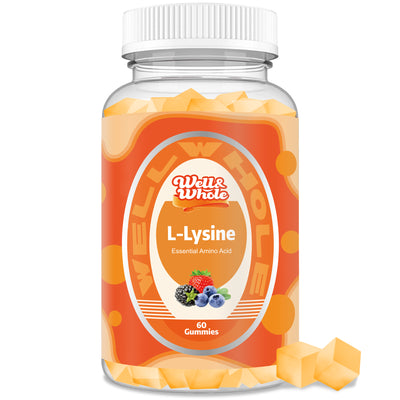
Best Time to Take L-Lysine Supplement: A Practical Guide for Maximum Benefits

Best Time to Take L-Lysine Supplement: A Practical Guide for Maximum Benefits
If you’ve recently started taking L-lysine for cold sores, immune support, or athletic recovery, you’ve probably wondered: when should I actually take this supplement? The answer isn’t one-size-fits-all, but understanding how your body absorbs and uses L-lysine can help you nail the timing for better results. At well&whole, we’ve spent years formulating high-quality L-lysine supplements, and we often hear from customers asking about the optimal schedule. Let’s break it down.
Why Timing Matters for L-Lysine Absorption
L-lysine is an essential amino acid, meaning your body can’t produce it on its own. You need to get it from food or supplements. Unlike some vitamins that are fat-soluble and need food for absorption, L-lysine is water-soluble. This means it’s absorbed best on an empty stomach or between meals, when there’s less competition from other amino acids. A 2019 review in Nutrients noted that amino acid transporters in the gut can become saturated if you take L-lysine with a protein-rich meal, potentially reducing its uptake.
That said, taking it with a small amount of carbohydrate—like a piece of toast or a banana—can help smooth out any stomach sensitivity. Some people experience mild digestive upset when taking L-lysine first thing in the morning, especially at higher doses. If that’s you, a light snack can make a difference.
Bottom line: For peak absorption, take L-lysine on an empty stomach, but don’t force it if your stomach feels uneasy—a small carb-based snack is fine.
Morning vs. Evening: Which Works Better for Your Goal?
The “best time” also depends on why you’re taking L-lysine. Let’s look at two common scenarios.
For Cold Sore Prevention and Treatment
If you’re using L-lysine to manage or prevent herpes simplex outbreaks (cold sores), research suggests that consistent daily intake matters more than the exact hour. A study in Alternative Medicine Review (2002) found that 1,000 mg taken three times daily reduced outbreak frequency. But for maintenance, many people take one daily dose. Morning is often preferred because it’s easy to remember, and you can pair it with your breakfast routine. However, if you already wake up with an outbreak, taking a double dose at the first tingle (with your morning coffee) may help speed up recovery. This is a key L-lysine for cold sores timing strategy.
For Athletic Recovery or Muscle Support
L-lysine plays a role in collagen synthesis and calcium absorption, which supports joints and muscle repair. If you’re an athlete or active person, taking it post-workout (within 30 minutes) can be beneficial, as muscle tissues are most receptive to amino acids during that window. A 2017 study in the Journal of the International Society of Sports Nutrition suggested that 2–3 grams of lysine after resistance training improved recovery markers. Evening doses also work well, as collagen production peaks during sleep.
Bottom line: For cold sores, morning consistency wins. For muscles, post-exercise or just before bed is ideal. Adjust according to your routine and goals—there’s no single “magic hour.”
Should You Take L-Lysine With Food or Without?
This is one of the most debated questions. Here’s what the literature says:
- On an empty stomach: As mentioned, L-lysine competes with other amino acids (like arginine) for absorption. Taking it without food, especially away from high-protein meals, reduces competition.
- With food: Some users report that taking L-lysine with a meal eliminates nausea. If you’re using a high dose (1,500 mg or more), splitting the dose into two smaller servings—one with breakfast and one with lunch—can keep plasma levels steady throughout the day.
A 2021 study on amino acid supplementation timing in Frontiers in Nutrition reinforced that dividing the daily dose (e.g., 500 mg twice a day) leads to more stable blood levels than one large dose. This is especially relevant for people using L-lysine for long-term skin health. well&whole’s 1,000 mg capsules are easy to split into two halves—just break them gently.
Bottom line: Empty stomach is best for absorption; splitting the dose helps with tolerance. If you feel queasy, take it with a small, low-protein snack.
How to Build Your Personal L-Lysine Schedule
Here’s a simple framework to create your own routine, keeping in mind that best time to take lysine for herpes may differ from your friend’s schedule.
- Start low, go slow. Begin with 500–1,000 mg per day for a week, then adjust.
- Pick a consistent anchor. The easiest way to remember is to tie it to a daily habit—like brushing your teeth in the morning.
- Listen to your body. If you feel jittery or nauseous, switch to evening or split the dose.
- Consider your diet. If you eat a lot of high-arginine foods (nuts, chocolate, gelatin), you might benefit from taking L-lysine at a different time than when you eat those foods.
A practical example: take 500 mg with your morning water (empty stomach for 15 minutes), then another 500 mg in the early afternoon. For well&whole users, our L-lysine capsules are made from pure, plant-fermented source, with no fillers, so they dissolve quickly and are gentle on the stomach.
Bottom line: Consistency beats perfection. Find a time you can stick with daily, and adjust based on your own feedback.
Frequently Asked Questions
Q1: Can I take L-lysine on an empty stomach?
Yes, you can. In fact, taking it on an empty stomach (at least 30 minutes before a meal or 2 hours after) may improve absorption because there’s less competition from other amino acids. If you experience stomach upset, try taking it with a small piece of fruit or plain toast.
Q2: Should I take L-lysine in the morning or at night?
Both can work. Morning dosing is great for consistency and to support cold sore prevention throughout the day. Night dosing may help with muscle repair and collagen synthesis during sleep. If you’re using it for herpes management, morning is often recommended. For general wellness, pick whichever fits your routine.
Q3: How long does it take for L-lysine to work?
It depends on the purpose. For cold sore treatment, many people notice relief within 24–48 hours if they take 1,000 mg three times a day at the first sign. For prevention, you need to take it daily for 1–2 weeks before seeing fewer outbreaks. For athletic recovery, consistent use over several days yields cumulative benefits. Always pair it with a balanced diet for best results.
References:
- Nutrients, “Amino Acid Transport and Absorption,” 2019.
- Alternative Medicine Review, “Lysine for Herpes Simplex Prophylaxis,” 2002.
- Journal of the International Society of Sports Nutrition, “Lysine Supplementation and Muscle Recovery,” 2017.
- Frontiers in Nutrition, “Timing of Amino Acid Supplementation,” 2021.
These statements have not been evaluated by the Food and Drug Administration. This product is not intended to diagnose, treat, cure, or prevent any disease.