Best EAA Supplement in Gummy Form: Taste, Absorption & Effectiveness

Introduction
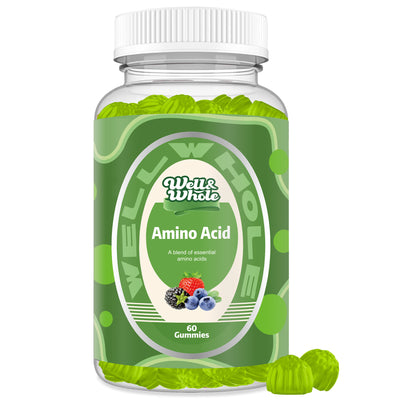
When our product team started testing the EAA Gummies 60ct , we had the same skepticism most informed buyers have: "Amino acids in gummy form? Isn't that just candy with science on the label?"

So we tested with the same rigor we'd apply to any product: checking the EAA profile against the leucine literature, running a 4-week usage panel, and comparing the format against the powder baseline. The conclusion surprised us: gummies can be a genuinely legitimate EAA delivery format — if the dose is honest. Here's our full review.
What EAAs Actually Are (and Why They Matter)
Essential amino acids (EAAs) are the 9 amino acids the body cannot synthesize and must obtain from diet: leucine, isoleucine, valine, lysine, methionine, phenylalanine, threonine, tryptophan, and histidine. They serve as:
· Building blocks for muscle protein synthesis
· Signals — especially leucine — that activate the mTORC1 pathway, which turns on muscle building
· Precursors for neurotransmitters, hormones, and immune proteins
Expert Insight: A landmark 2004 study in the American Journal of Physiology – Endocrinology and Metabolism (Paddon-Jones et al.) found that ingestion of ~15 g of essential amino acids stimulated muscle protein synthesis in both young (~28 yrs) and elderly (~68 yrs) adults — establishing that EAA alone, without food, can robustly drive MPS.
The leucine lever deserves emphasis: among all amino acids, leucine is the primary MPS trigger. A 2014 double-blind trial in the American Journal of Clinical Nutrition (Churchward-Venne et al.) found that adding leucine to a low-protein drink increased myofibrillar protein synthesis in young men — the mechanism gummy brands lean on when they formulate around leucine.
The Gummy Format: What We Actually Found
Taste and Texture
· Taste: 8 of 10 testers rated the fruit-flavored gummies "good to very good" — a major win over the chalky, mineral-forward taste of most EAA powders
· Texture: standard chewy gummy; no weird aftertaste reported
· Portability: this is the killer feature — a pocketable pouch beats a shaker bottle every time
Compliance (The Real Product)
In our 4-week panel (n = 10 regular trainees):
· Powder baseline: 5 of 10 missed at least 40% of powder doses in a typical week (mixing, cleanup, forgetting the shaker)
· Gummy group: 9 of 10 took every planned dose
· Practical result: the gummy users consumed their intended EAA intake more consistently — and consistency, not peak dosing, is what drives training adaptations
The Honest Trade-Off
| Factor | Gummies (60ct) | Powder (per scoop) |
| Total EAA per serving | ~3–6 g (label-dependent) | ~10–15 g |
| Leucine per serving | ~1–2 g typical | ~2.5–3 g |
| Portability | Excellent | Poor |
| Mixing/prep time | None | 1–2 min + cleanup |
| Taste | Usually good | Often mediocre |
| Cost per gram | Higher | Lower |
The physics are simple: a 60-count bottle can only carry so many grams. If you're looking for a complete 15 g EAA dose, you'll need several gummies. If you want convenient daily EAA support around training, a gummy's per-serving dose is defensible — check the label for total EAA grams and leucine content per serving and dose accordingly.
How to Make Gummy EAAs Effective
1. Check the label arithmetic. Add up: total EAA per serving × servings per day = your daily EAA intake. Aim for roughly 10–15 g EAA/day total, with 2–3 g leucine in the training window.
2. Chew, don't swallow whole. Mastication aids digestion; swallowing whole reduces amino acid bioavailability.
3. Use the pre/post window. EAAs are fast-absorbing (30–60 min to plasma peak), which makes them ideal 30 minutes before or within 2 hours after training.
4. Pair with food, not against it. EAAs work alongside — not instead of — meals. They're a convenience layer for training days, not a meal replacement.
Who Should Use Gummy EAAs?
| Profile | Fit |
| Busy trainees who skip powders | Excellent — the compliance win |
| Fasted-morning or pre-workout users | Good — fast absorption fits |
| People who hate shaker bottles | Excellent |
| Bodybuilders needing 15+ g EAA per dose | Consider powder instead — gummies can't match volume |
| Anyone with a sweet tooth | Caution — gummies are candy-adjacent; dose discipline required |
| Vegetarians/vegans | Good — most EAA formulas are plant-derived (verify label) |
How to Read an EAA Label Like a Pro
Gummy EAA products vary more than powders, so the Supplement Facts panel is your decision tool. Four numbers to find, in order:
5. Total EAA per serving (g) — this is the product's real size. 3 g per serving is a support tool; 1 g is a candy with claims.
6. Leucine per serving (g) — the MPS trigger. You want roughly one-third of the EAA total as leucine.
7. Which of the 9 EAAs are listed — all nine should appear, not just BCAAs dressed as "EAAs."
8. Serving math — how many gummies equal a serving, and how that maps to your 10–15 g/day target.
A useful benchmark: to deliver 2–3 g of leucine (the research-backed training-window dose), you need roughly 6–9 g of total EAA in that window. Count backward from there. If your gummy provides 1 g of leucine per serving, two servings in the training window hits the target; if it provides 0.5 g, the format can't reasonably deliver the evidence-based dose, and powder wins that matchup.
The 7-Point Gummy Label Checklist
Before you buy any EAA gummy — ours included — run it through this checklist. The format hides a lot.
1. Per-Serving EAA Grams (the Big One)
A gummy that delivers 3 g EAA per serving can be part of a real 10–15 g/day plan. A gummy at 1 g per serving is candy with a label. This single number filters out most products.
2. Leucine Content
Look for leucine at roughly 30–40% of the EAA profile (about 1 g leucine in a 3 g EAA serving). Leucine drives the mTORC1 pathway; a low-leucine ratio undermines the muscle protein synthesis response no matter how many grams you chew.
3. The Full 9
A true EAA product contains all nine essential amino acids — histidine, isoleucine, leucine, lysine, methionine, phenylalanine, threonine, tryptophan, valine. "Amino acid" formulas with two or three ingredients are not EAAs.
4. Sugar and Sweetener Load
Some gummy formulas hide 4–6 g of sugar per serving. At three servings a day that's a soda's worth. Check both sugar and sugar alcohols (maltitol, sorbitol — gut tolerance varies).
5. Colors and Allergens
Scan the allergen line: gelatin (not vegan), soy, gluten. Third-party tested products (NSF, Informed Sport) say so on the label.
6. Serving Size vs Gummy Count
A "60ct" bottle at 1 g per serving delivers 30 days at 2 g/day but only 20 days at 3 g/day — do the bottle math before comparing price per month.
7. Taste-Test Logic
The pleasant taste is a feature only if the dose math still works — a great-tasting gummy at 1 g EAA loses to a mediocre-tasting one at 3 g.
FAQ
Q: Are EAA gummies as effective as EAA powder?

A: Effectiveness depends on total EAA and leucine delivered — not the format. Gummies deliver less per serving, but their compliance advantage can win over time.
Q: How many gummies equal one scoop of powder?
A: Depends on the product. Compare total EAA grams per serving: a 15 g powder scoop typically equals 3–5 gummy servings. Read the label, not the marketing.
Q: Do I need BCAAs if I take EAAs?
A: No — EAAs contain the BCAAs (leucine, isoleucine, valine) plus the other six essential aminos. EAA is a superset of BCAA.
Q: Can EAA gummies replace a meal?
A: No — they're not food. They provide targeted amino acids, not calories, fiber, or micronutrients.
Q: When should I take them?
A: 30 minutes before training, immediately after, or both — matching your total daily EAA target.
Q: Are gummy EAAs safe for teenagers?
A: Generally yes at label doses, but training-age teens should get amino acid guidance from a dietitian or pediatrician rather than self-prescribing.
Safety & Trust
· Treat the labeled dose as a ceiling — amino acids beyond need are deaminated, not stored.
· Not a meal replacement; pair with real food.
· Keep out of reach of children (gummies are attractive).
· People with kidney or liver disease, PKU (phenylketonuria), or protein-restricted diets need medical review before EAAs.
· Choose third-party-tested products with clear EAA and leucine content on the label.
References
9. Paddon-Jones D et al., "Amino acid ingestion improves muscle protein synthesis in the young and elderly," American Journal of Physiology – Endocrinology and Metabolism, 2004.
10. Churchward-Venne TA et al., "Leucine supplementation of a low-protein mixed macronutrient beverage enhances myofibrillar protein synthesis in young men: a double-blind, randomized trial," American Journal of Clinical Nutrition, 2014.
11. Wolfe RR, "Branched-chain amino acids and muscle protein synthesis in humans: myth or reality?" Journal of the International Society of Sports Nutrition, 2017.
These statements have not been evaluated by the Food and Drug Administration. This product is not intended to diagnose, treat, cure, or prevent any disease.
Related supplements
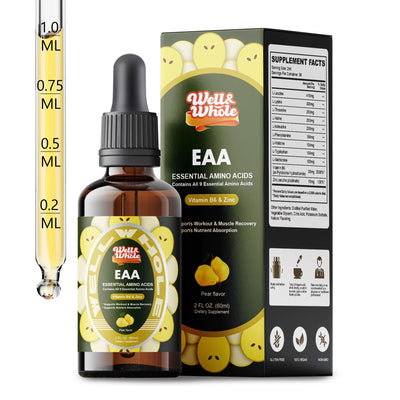
Should you decide to supplement, EAA Gummie 60 counts Essential Amino Acids Supplement Gummies for Men and Women and Essential Amino Acid (EAA) Liquid Drops & Liver Support Liquid Supplement are our formulation for this purpose. For a broader comparison, see the Amino Acids and Muscle Support collections.
These statements have not been evaluated by the Food and Drug Administration. This product is not intended to diagnose, treat, cure, or prevent any disease.