Beef Organ Supplements: Liver, Kidney, Heart — Why Combine Them?
Discover why combining beef liver, kidney, and heart in organ supplements creates a complete nutritional package. Learn about the complementary benefits of multi-organ formulas.

Walk down the supplement aisle and you'll find individual beef liver supplements, standalone beef kidney products, and isolated beef heart formulas. Each has its own nutritional profile and purpose. But there's a compelling case to be made for combining all three organs in a single supplement—and it's rooted in both traditional wisdom and modern nutritional science.
Beef organ supplements that combine liver, kidney, and heart don't just add more ingredients to the label. They create a more complete nutritional package, with each organ contributing nutrients that complement and enhance what the others provide. Together, they represent a "whole-organism" approach to supplementation that mirrors how traditional cultures consumed animals.
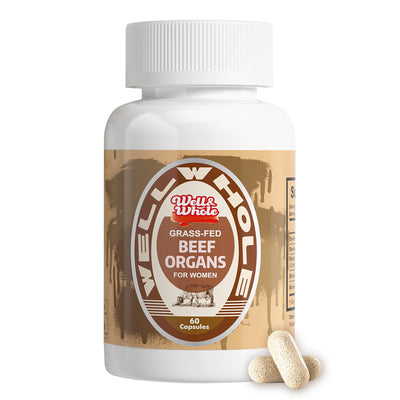
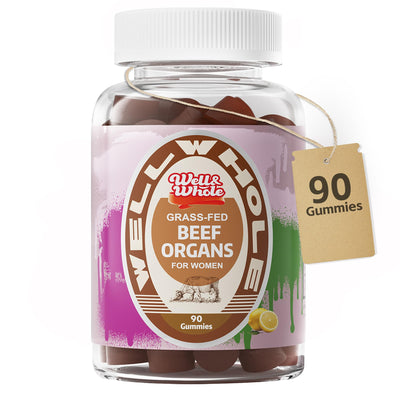
In this article, we'll explore why combining beef liver, kidney, and heart makes nutritional sense, what each organ contributes, and how well&whole's Grassfed Beef Organ Capsules and Grass-Fed Beef Organ Gummies for Women put this philosophy into practice.
The Philosophy: Whole-Animal Nutrition
Traditional Context
For virtually all of human history, when an animal was harvested for food, the entire animal was used. Organ meats weren't discarded—they were often the most prized parts, reserved for hunters, elders, pregnant women, and the sick. This wasn't coincidence or primitive superstition; it was empirical nutrition built over millennia of observation.
Dr. Weston A. Price documented this pattern across traditional societies worldwide in the 1930s. He observed that cultures consuming whole animals—including organs—had remarkable freedom from the chronic diseases that were already appearing in industrialized populations. His work, published in *Nutrition and Physical Degeneration* (1939), laid the foundation for modern interest in organ-based nutrition.
The Organ Complex Principle
Each organ in the body has a specialized function, and as a result, each organ accumulates a unique set of nutrients needed for that function:
- **Liver**: Metabolic hub — Stores vitamins, minerals, and enzymatic factors for detoxification and metabolism
- **Kidney**: Filtration and regulation — Contains DAO enzyme and minerals specific to electrolyte balance
- **Heart**: Muscular pump — Rich in CoQ10, specific amino acids, and mitochondrial support compounds
When you consume all three together, you're getting a nutritional profile that no single organ can provide. It's the difference between eating just a multivitamin versus getting a complete meal.
What Each Organ Brings to the Table
Beef Liver: The Nutritional Foundation
Beef liver is the organ complex's anchor—the most nutrient-dense of all organs and the most comprehensively studied.
Key Contributions:
- **Vitamin A (Retinol)**: Pre-formed, immediately bioavailable—~7,730 mcg RAE per 100g
- **Vitamin B12**: Energy production and neurological function—~70.7 mcg per 100g
- **Folate (B9)**: DNA synthesis and red blood cell formation
- **Iron**: Heme iron for oxygen transport—6.2 mg per 100g
- **Copper**: Essential for iron utilization and connective tissue—14.3 mg per 100g
- **Zinc**: Immune function and cellular repair
- **Choline**: Liver health and cognitive function
Liver is the metabolic center of the body, and its nutritional profile reflects this—it's stocked with the cofactors and catalysts needed for hundreds of metabolic reactions.
Beef Kidney: The DAO and Selenium Source
Kidney brings nutrients not found in significant quantities in liver:
Key Contributions:
- **DAO Enzyme**: Diamine oxidase for histamine breakdown—kidney is the body's richest source
- **Selenium**: Thyroid function and antioxidant protection—141 mcg per 100g (256% DV)
- **Vitamin B12**: 27.5 mcg per 100g (1,145% DV)
- **Riboflavin (B2)**: Energy metabolism—3.0 mg per 100g (230% DV)
Kidney's nutrient profile reflects its role in filtration and systemic regulation. The high selenium content is particularly noteworthy—selenium is essential for glutathione peroxidase, one of the body's most important antioxidant enzymes.
Beef Heart: The CoQ10 and Mitochondrial Organ
Heart muscle is fundamentally different from liver and kidney tissue. It's a dense, oxidative, mitochondrial-rich organ designed for constant mechanical work.
Key Contributions:
- **Coenzyme Q10 (CoQ10)**: Essential for mitochondrial energy production—heart is the body's richest source
- **Specialized amino acids**: Including taurine, carnitine, and creatine in their natural ratios
- **B-vitamin complex**: Supporting energy metabolism
- **Iron and Zinc**: In the proportions needed for cardiac muscle function
- **Collagen and elastin**: Structural proteins supporting cardiovascular tissue
A 2013 study published in the *Journal of Agricultural and Food Chemistry* confirmed that bovine heart tissue is one of the richest dietary sources of CoQ10, containing significantly more than skeletal muscle (Kubo et al., 2013).
Nutrient Synergy: Why the Combination Matters
The real power of an organ complex isn't just addition—it's synergy. Nutrients from different organs work together in ways that enhance overall effectiveness:
The Iron-Copper Partnership
| **Nutrient** | **Liver Provides** | **Heart Provides** | **Kidney Provides** | **Combined Benefit** |
|-------------|-------------------|-------------------|--------------------|--------------------|
| Iron | 6.2 mg (rich) | Moderate | 5.8 mg | Total heme iron package |
| Copper | 14.3 mg (very rich) | Moderate | Trace | Copper essential for iron utilization |
Iron and copper work together. Copper-containing ceruloplasmin mobilizes iron from storage and incorporates it into hemoglobin. Without adequate copper, iron can't be properly used—even if iron intake is sufficient. The organ complex provides both minerals together.
The B-Vitamin Ensemble
| **B-Vitamin** | **Liver** | **Kidney** | **Heart** | **Combined Benefit** |
|--------------|-----------|-----------|----------|--------------------|
| B12 | Very High | Very High | Moderate | Comprehensive B12 |
| B2 (Riboflavin) | High | Very High | High | Energy metabolism support |
| B3 (Niacin) | High | Moderate | Moderate | NAD+ production |
| B6 | Moderate | Moderate | Moderate | Protein metabolism |
| Folate | High | Moderate | Trace | DNA synthesis |
Each organ has a slightly different B-vitamin profile. Together, they provide a more complete B-complex than any single organ alone.
Specialized Compounds
| **Compound** | **Primary Organ Source** | **Function** |
|-------------|-------------------------|-------------|
| DAO Enzyme | Kidney | Histamine breakdown |
| CoQ10 | Heart | Mitochondrial energy |
| Retinol | Liver | Vision, immunity, skin |
| Selenium | Kidney | Antioxidant defense, thyroid |
| Choline | Liver | Brain, liver health |
A single organ provides a subset of these compounds. The organ complex provides all of them.
Research on Multi-Organ Supplementation
Ancestral Nutrition Research
A 2019 review in *Current Developments in Nutrition* examined the nutrient contributions of organ meats in traditional diets and concluded that "the practice of consuming multiple organ meats provided complementary nutrient profiles that single organs could not achieve" (O'Keefe et al., 2019).
Nutritional Completeness
Analysis published in *Food Chemistry* (2018) comparing the nutritional profiles of different bovine organs found that "significant differences in micronutrient composition between organ types support the traditional practice of consuming diverse organ meats for nutritional completeness" (Purchas et al., 2018).
Modern Supplement Context
While direct clinical trials on multi-organ supplements are limited, the nutritional science underlying the approach is solid. Each organ's unique nutrient profile is well-documented by USDA FoodData Central and independent research. The concept of combining them rests on established biochemistry rather than novel mechanisms.
Organ Complex Formats: Capsules vs Gummies
well&whole offers organ complexes in two formats:
Grassfed Beef Organ Capsules
- Multi-organ blend: liver, kidney, heart
- Grass-fed New Zealand beef
- Freeze-dried for nutrient preservation
- Capsule format for those who prefer traditional supplements
- No taste concerns
Grass-Fed Beef Organ Gummies for Women
- Same multi-organ philosophy: liver, kidney, heart
- Formulated with women's specific nutritional needs in mind
- Pleasant gummy format for daily compliance
- Grass-fed sourcing
- Convenient, portable format
| **Feature** | **Capsules** | **Gummies (Women's)** |
|------------|-------------|---------------------|
| Format | Swallowable capsules | Chewable gummies |
| Organs | Liver, kidney, heart | Liver, kidney, heart |
| Taste | None (capsule) | Pleasant |
| Best for | Those comfortable with capsules | Those preferring gummies |
| Audience | General | Women's formulation |
FAQ
Q: Why should I take multiple organs instead of just beef liver?
A: Each organ has a unique nutrient profile. Liver provides vitamin A, B12, and iron; kidney provides DAO enzyme and selenium; heart provides CoQ10. Together they create a more complete nutritional package than any single organ alone.
Q: What is CoQ10 and why is it in beef heart?
A: Coenzyme Q10 is essential for mitochondrial energy production. The heart—a constantly working muscle—contains the body's highest natural concentration of CoQ10. Beef heart supplements provide this compound in its natural food matrix.
Q: Do I need all three organs if I only have one health concern?
A: It depends on your goal. For targeted support (e.g., histamine focus), kidney alone may be appropriate. For comprehensive nutritional support, the organ complex provides a broader foundation that addresses multiple systems simultaneously.
Q: How do organ complex supplements differ from multivitamins?
A: Organ supplements provide nutrients in their natural food matrix—the forms, ratios, and cofactors found in nature. Synthetic multivitamins isolate individual nutrients. The food matrix approach may offer absorption advantages through natural nutrient synergy.
Q: Are all the organs in organ supplements from grass-fed animals?
A: well&whole's organ supplements use grass-fed New Zealand beef. Not all brands do—always verify sourcing claims. Grass-fed sourcing matters for nutrient profiles and product quality.
Q: Can I take organ complex supplements every day?
A: Yes, when taken as directed. Organ supplements are designed for daily use, providing nutrients in concentrations consistent with the recommended serving size. Follow label directions.
Q: How do I choose between capsules and gummies?
A: Choose based on personal preference and lifestyle. Capsules offer zero taste and a familiar supplement format. Gummies offer pleasant taste, no swallowing required, and may improve daily compliance.
Q: What makes the women's formulation different?
A: The women's organ gummies by well&whole are formulated with the same liver, kidney, heart complex, with attention to nutrients particularly relevant to women's health—including iron, folate, and B12.
Q: Are beef organ supplements sustainable?
A: Using organ meats for supplements supports nose-to-tail sustainability—utilizing parts of the animal that might otherwise go to waste. This approach honors the animal and reduces food waste.
Conclusion
Beef organ supplements that combine liver, kidney, and heart offer a nutritional approach that no single-organ product can match. Each organ contributes its unique nutrient profile—liver provides the foundational vitamins and minerals, kidney brings DAO enzyme and selenium, and heart contributes CoQ10 and mitochondrial support compounds. Together, they mirror the whole-animal nutrition that traditional cultures have relied on for millennia.
well&whole's Grassfed Beef Organ Capsules put this philosophy into practice, delivering the complementary benefits of multiple organs in convenient daily formats. Whether you prefer capsules or gummies, the organ complex approach provides comprehensive nutritional support from nature's most nutrient-dense foods.
Explore well&whole's organ supplements at wellwholeshop.com
Related supplements
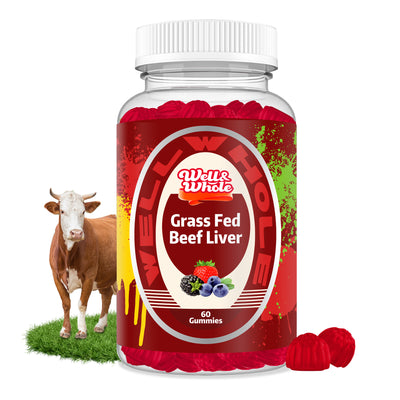
Should you decide to supplement, Grass Fed Beef Liver Supplement Gummies with 60 Count for Full Wellness and Grassfed Beef Organ Supplement Capsules, Grass Fed & Pasture Raised, Total Body Wellness Support are our formulation for this purpose. For a broader comparison, see the Vitamin A and Health Benefits collections.
These statements have not been evaluated by the Food and Drug Administration. This product is not intended to diagnose, treat, cure, or prevent any disease.